

Manual visual inspection has been a bottleneck in pharmaceutical and food manufacturing for decades. Human inspectors examine vials for particulates, tablets for coating defects, blister packs for seal integrity, and food products for contamination — under lighting conditions that cause fatigue after hours of repetitive work. Error rates climb as shifts progress, and consistency between inspectors varies widely.
AI-powered machine vision is changing that equation. The technology has matured to the point where neural network models trained on defect libraries can detect issues that human inspectors miss — consistently, at production speed, without fatigue.
Market Outlook: $1.4 Billion by 2028
The AI-based quality inspection market is projected to reach $1.4 billion by 2028, growing at roughly 16% annually. Pharmaceutical manufacturing and food processing are among the fastest-growing segments, driven by tightening regulatory expectations for inspection documentation and an industry-wide struggle to recruit and retain qualified manual inspectors.
For companies running LIMS software and quality management systems, AI inspection adds a data-rich quality layer that feeds directly into batch records and trending analytics.
How AI Visual Inspection Actually Works
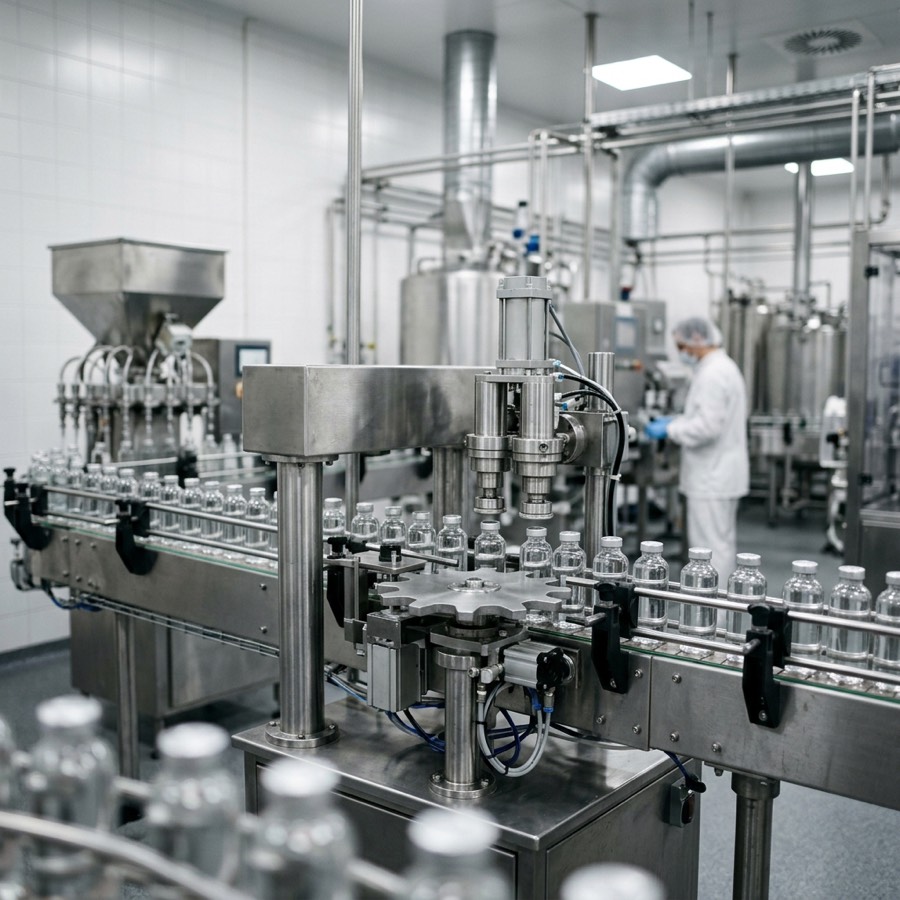
Modern AI inspection systems combine high-resolution cameras (often multiple angles with specialized lighting) with convolutional neural networks (CNNs) trained to distinguish acceptable product from defective product. The training process requires thousands of labeled images — good units and defective units across every expected defect type.
What separates AI from traditional machine vision is adaptability. Rule-based systems need explicit programming for every defect type. AI models learn defect patterns from examples and can identify novel defect types that weren't explicitly programmed, as long as they deviate from the "normal" pattern the model has learned.
Pharmaceutical Manufacturing Applications
In pharma, AI inspection is gaining traction in several areas:
- Parenteral (injectable) products — Detecting particles, fibers, glass fragments, and container defects in vials, syringes, and ampoules. This is where AI's consistency advantage is most pronounced, since manual inspection of clear liquids is notoriously unreliable
- Solid dosage forms — Identifying tablet coating defects (chipping, picking, sticking), capsule fill weight anomalies, and printing errors on imprinted tablets
- Packaging integrity — Verifying blister seal quality, label placement accuracy, and serialization code readability at line speed
- Lyophilized products — Inspecting freeze-dried cake appearance for collapse, meltback, and discoloration — historically one of the hardest visual inspections to standardize between operators
Food & Beverage Quality Control
Food manufacturers face similar inspection challenges with higher throughput demands. AI inspection applies to foreign object detection on conveyor lines (metal, plastic, bone fragments that X-ray and metal detectors miss), color and size grading for produce and baked goods, fill level verification for liquid products, and packaging label compliance for allergen declarations and nutritional information. For labs running GMP food laboratory software, AI inspection data integrates into the same quality record structure, providing batch-level inspection metrics alongside analytical test results.
GMP Validation Considerations
Deploying AI in a GMP environment isn't as simple as plugging in a camera. Regulators — particularly FDA and EMA — expect thorough validation demonstrating that the AI system performs at least as well as human inspection across all expected defect types. Key validation requirements include defined detection sensitivity for each defect category with documented probability of detection, challenge testing with known-defective units at defined defect severity levels, revalidation protocols for model updates or retraining, and computer system validation documentation covering the complete AI pipeline.
The CORPEX Informatics approach treats AI inspection systems as validated instruments within the LIMS framework — subject to the same calibration scheduling, qualification protocols, and data integrity controls as any analytical instrument.
The Integration Challenge
The biggest gap in most AI inspection deployments isn't the AI itself — it's getting inspection data into quality systems where it can be used for disposition decisions, trending, and regulatory reporting. Standalone AI inspection stations that generate PDFs or CSV exports create data silos. A properly integrated system feeds inspection results directly into the LIMS batch record, triggers reject events in the QMS, and provides trending data for annual product quality reviews.
Where AI Quality Inspection Is Heading
AI inspection is moving from novelty to necessity. As regulatory agencies increasingly question the adequacy of manual visual inspection — especially for parenteral products — manufacturers that haven't started evaluating AI alternatives will find themselves at a competitive and compliance disadvantage. The technology is mature. The validation frameworks exist. The remaining barrier is integration — making sure AI inspection data flows into your LIMS, QMS, and batch record systems without creating another data silo. CORPEX Informatics software is designed with exactly this kind of instrument and system integration in mind.
Exploring AI for Your Quality Operations?
CORPEX Informatics integrates with AI inspection platforms to bring intelligent quality data into your LIMS and QMS.
Request a Demo