
21 CFR Part 11
Electronic records & signatures
Signatures re-authenticate with the password and record name, time and meaning; password policy, idle timeout and optional two-factor sign-in.
CORPEX LIMS is laboratory information management software for QC, microbiology, stability and water laboratories. Samples, worksheets, calculations, investigations, equipment and certificates share one sample record, one audit trail and one set of electronic signatures.
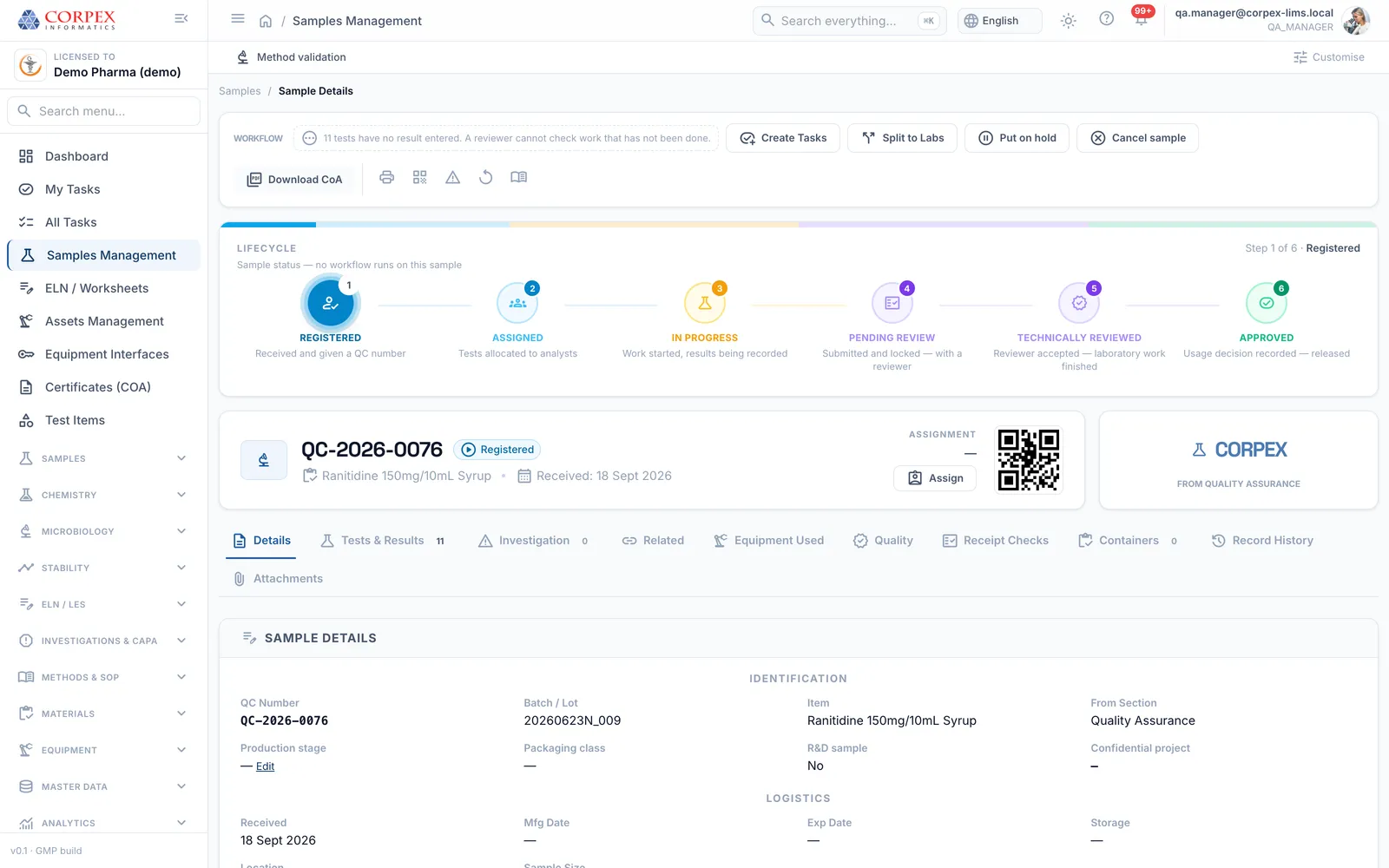
Every sample walks the same six steps. A hold or an investigation pauses it and returns it to the step it left; approval records the usage decision.
Each step adds to the same sample record, so the number on the certificate is the number the analyst entered and the reviewer signed.
Pick a module to see its screen. Every screenshot is taken from CORPEX LIMS running on demo data. Each module is available on its own or as part of the platform.
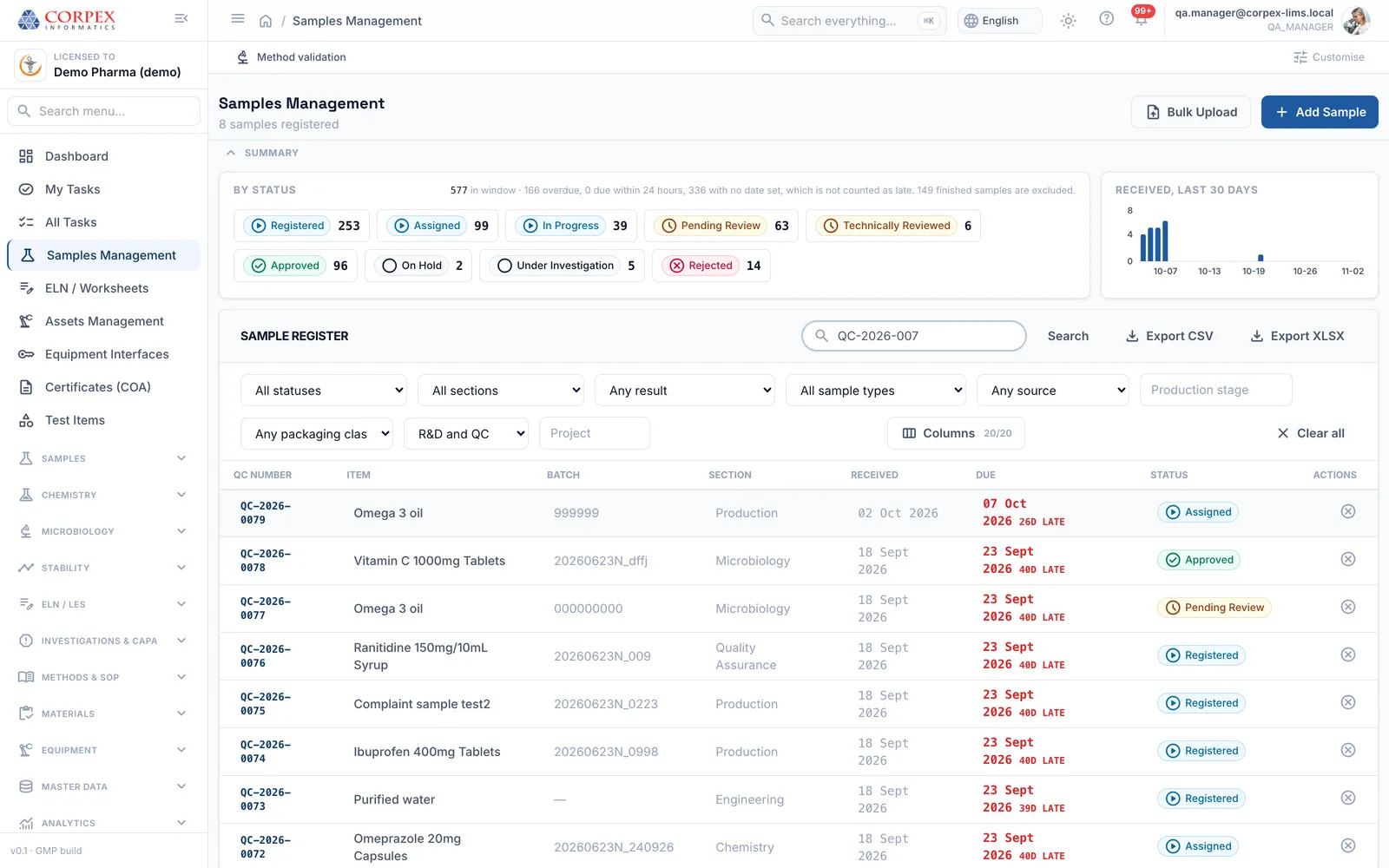
Register a sample once; the system works out what it owes.
Explore Samples & QC testing · for bioanalytical labs · Bioprocessing LIMS · CFast CoA software
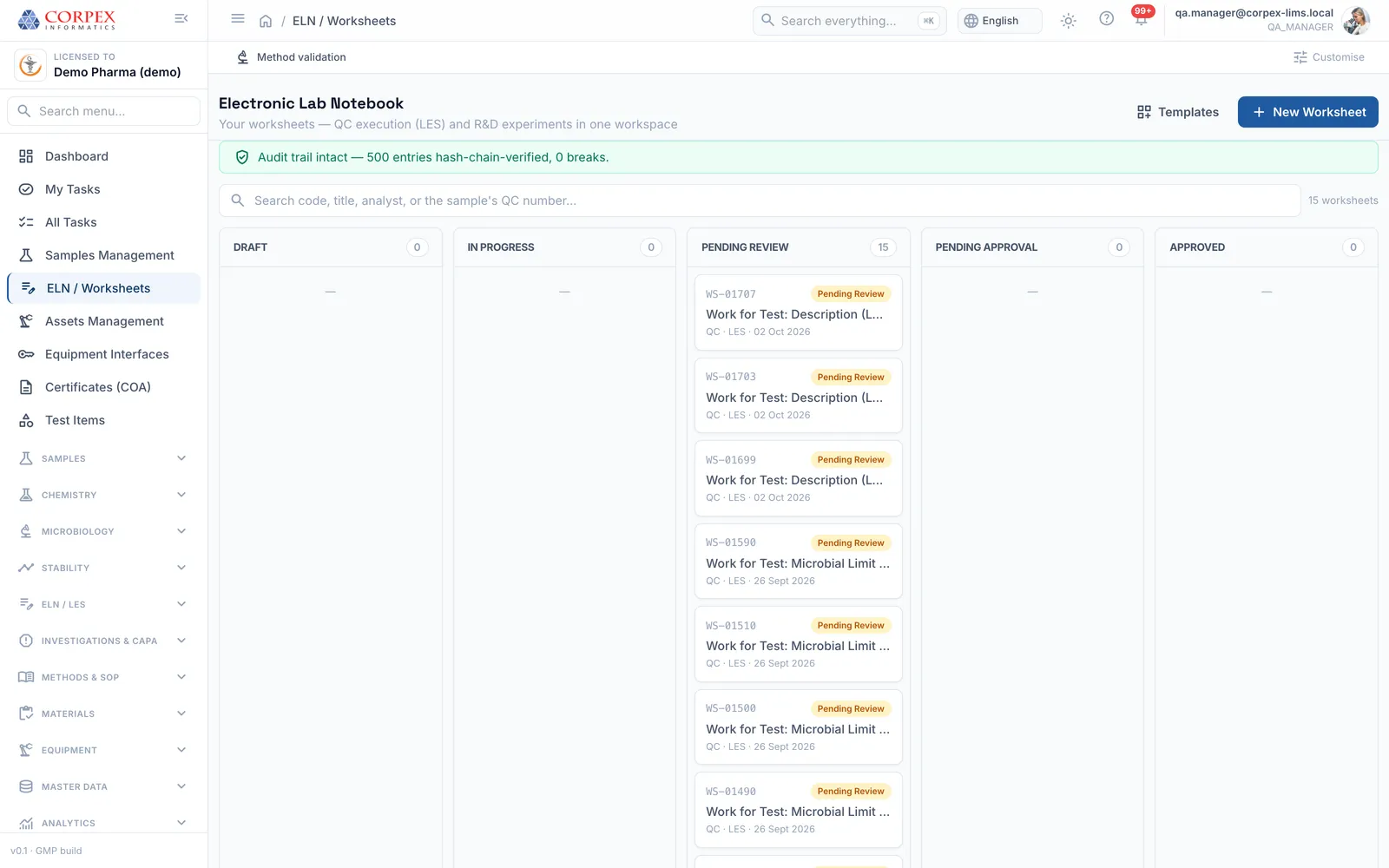
The worksheet is the record an inspector actually reads.
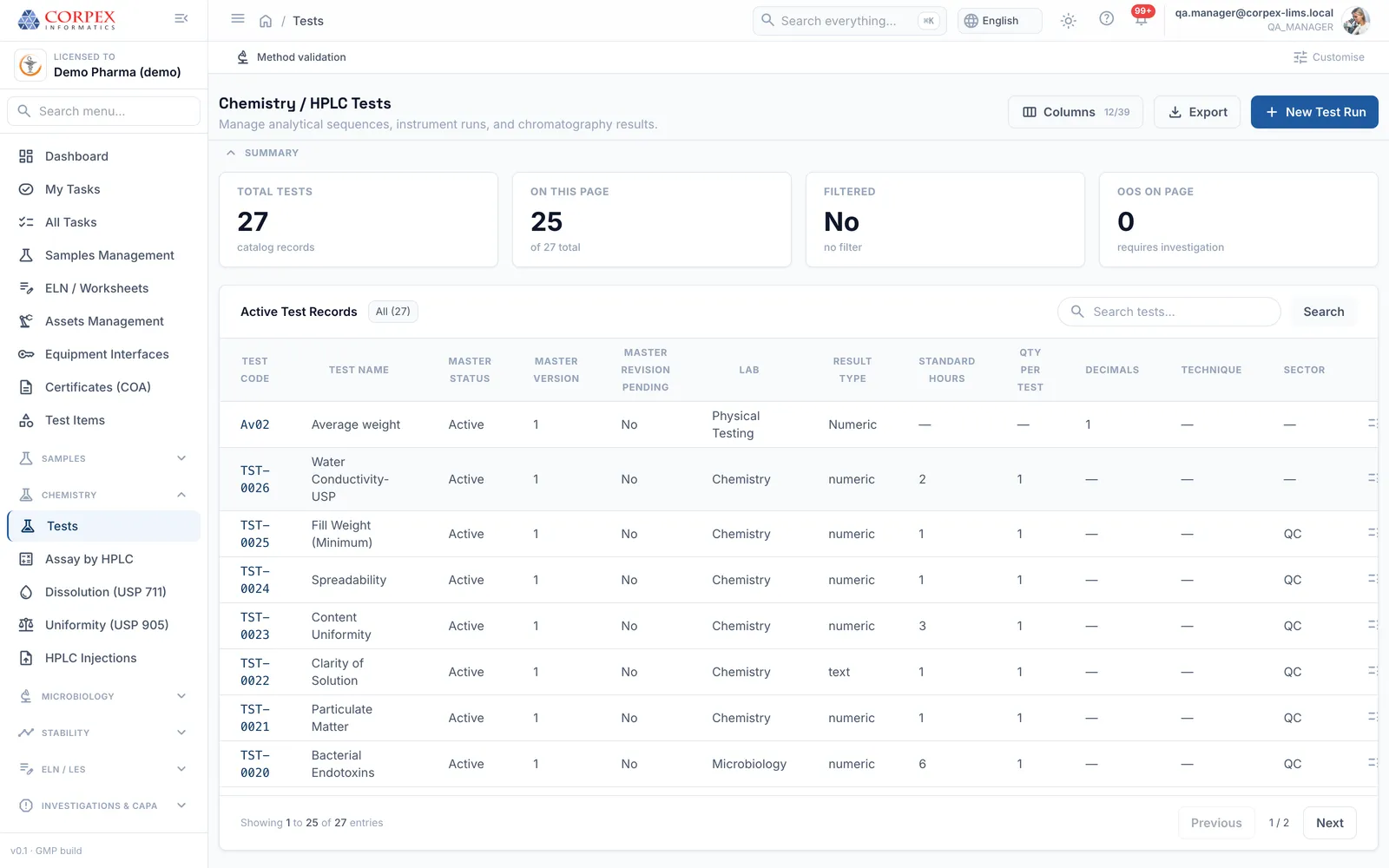
The pharmacopoeial maths lives in the software, not a spreadsheet.
Microbiology testing and environmental monitoring on one schedule.
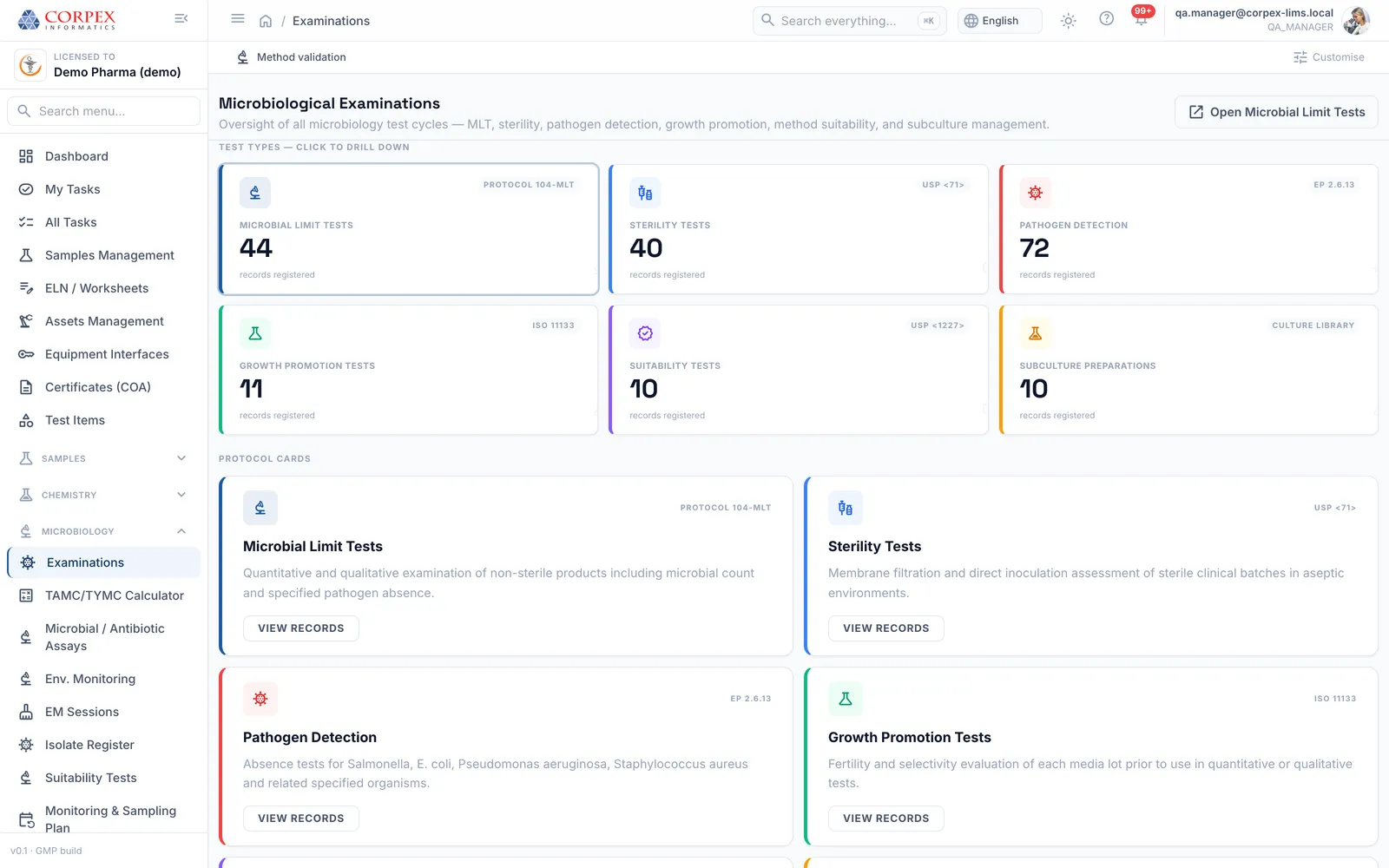
Years of pull points, none of them missed.
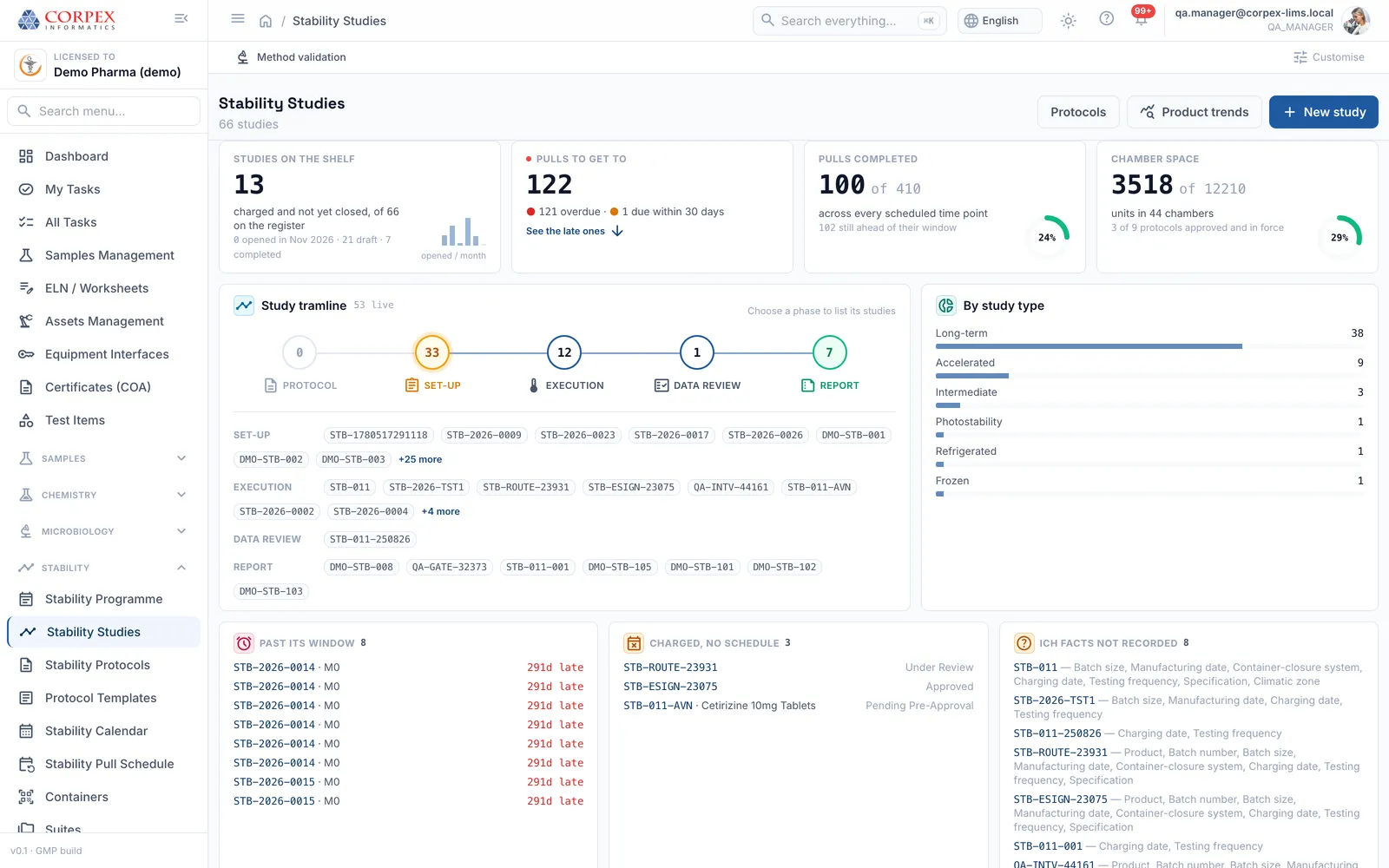
Every point, every loop, on the cadence the plan sets.
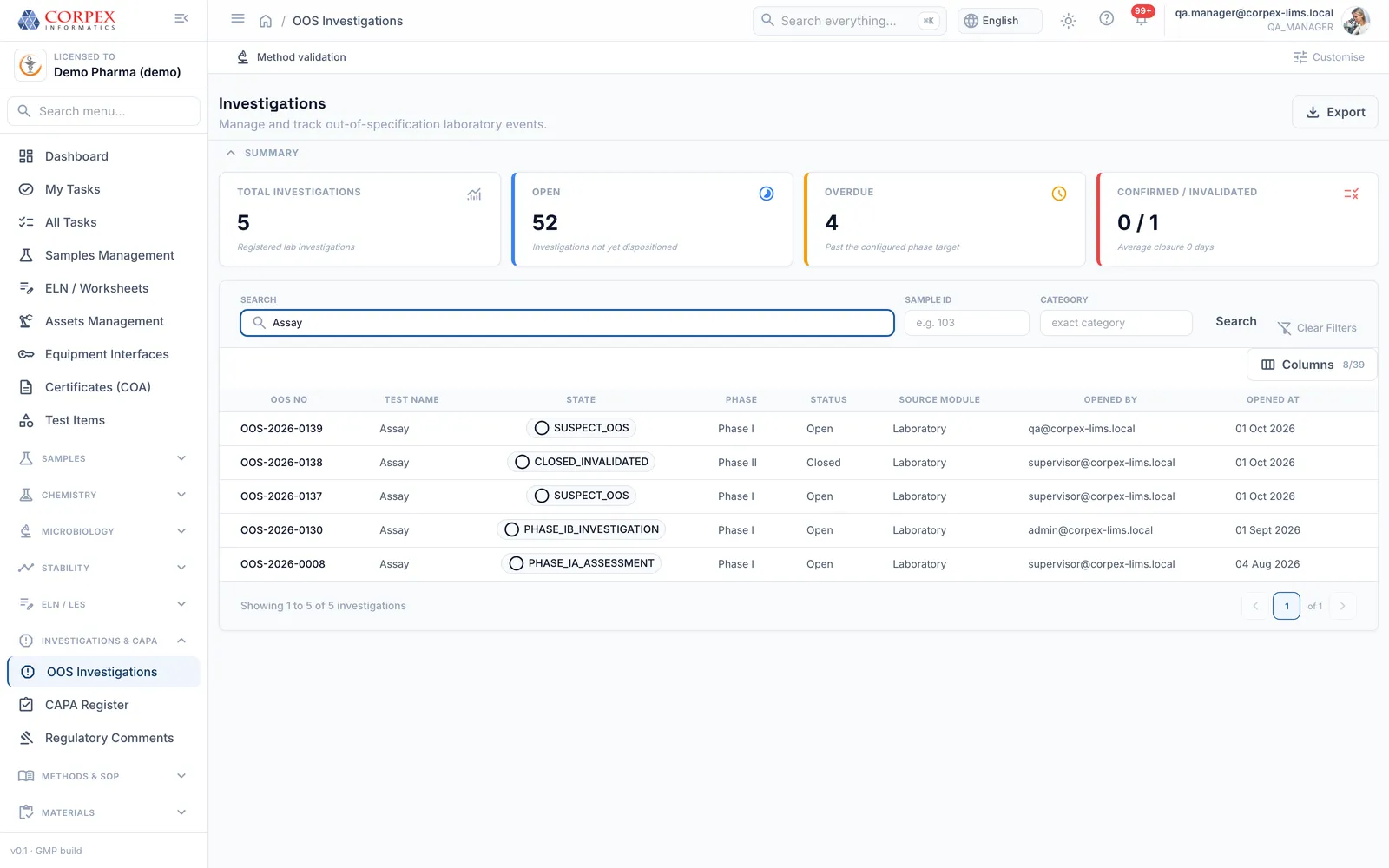
An out-of-specification result is a record, not a bad day.
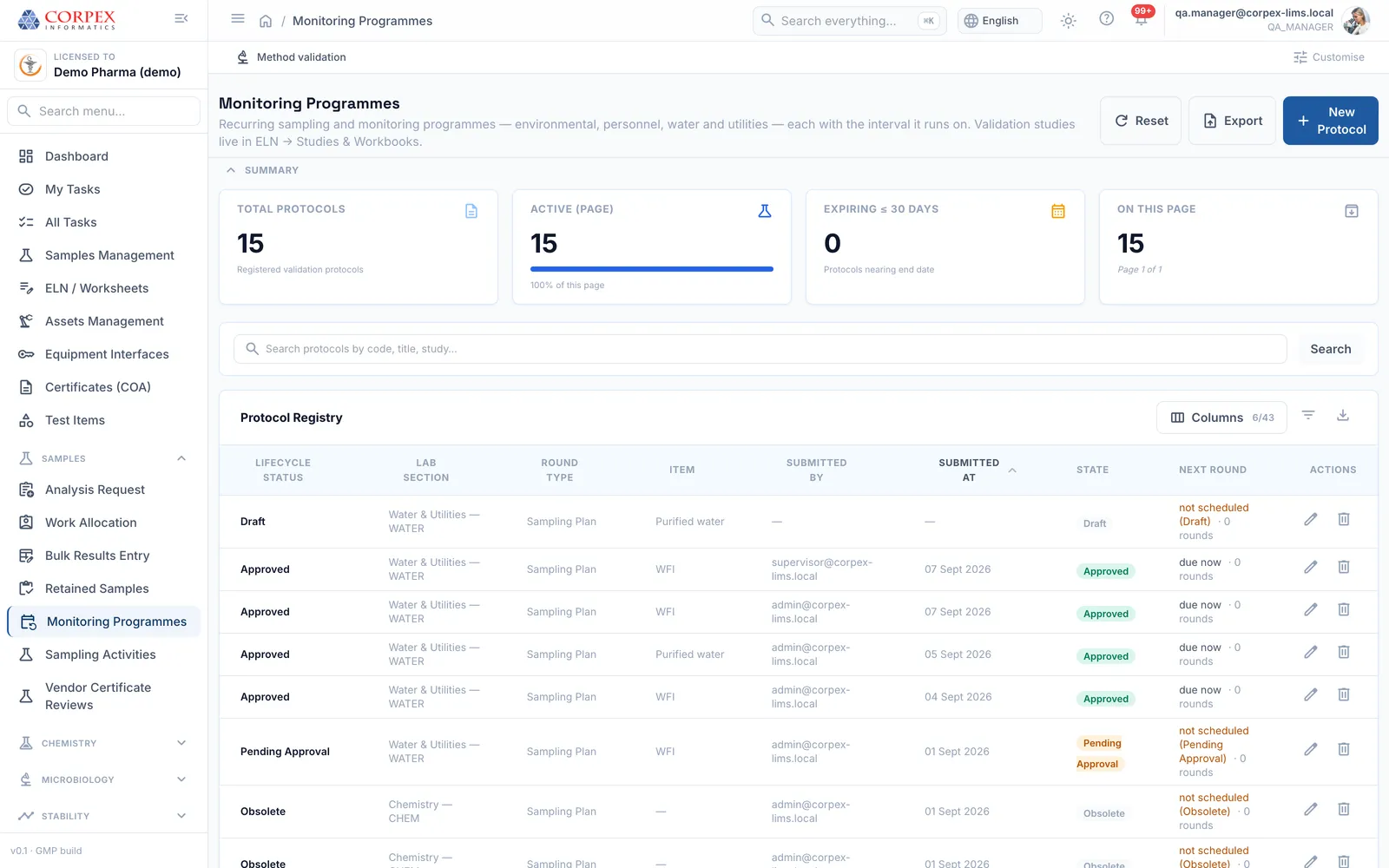
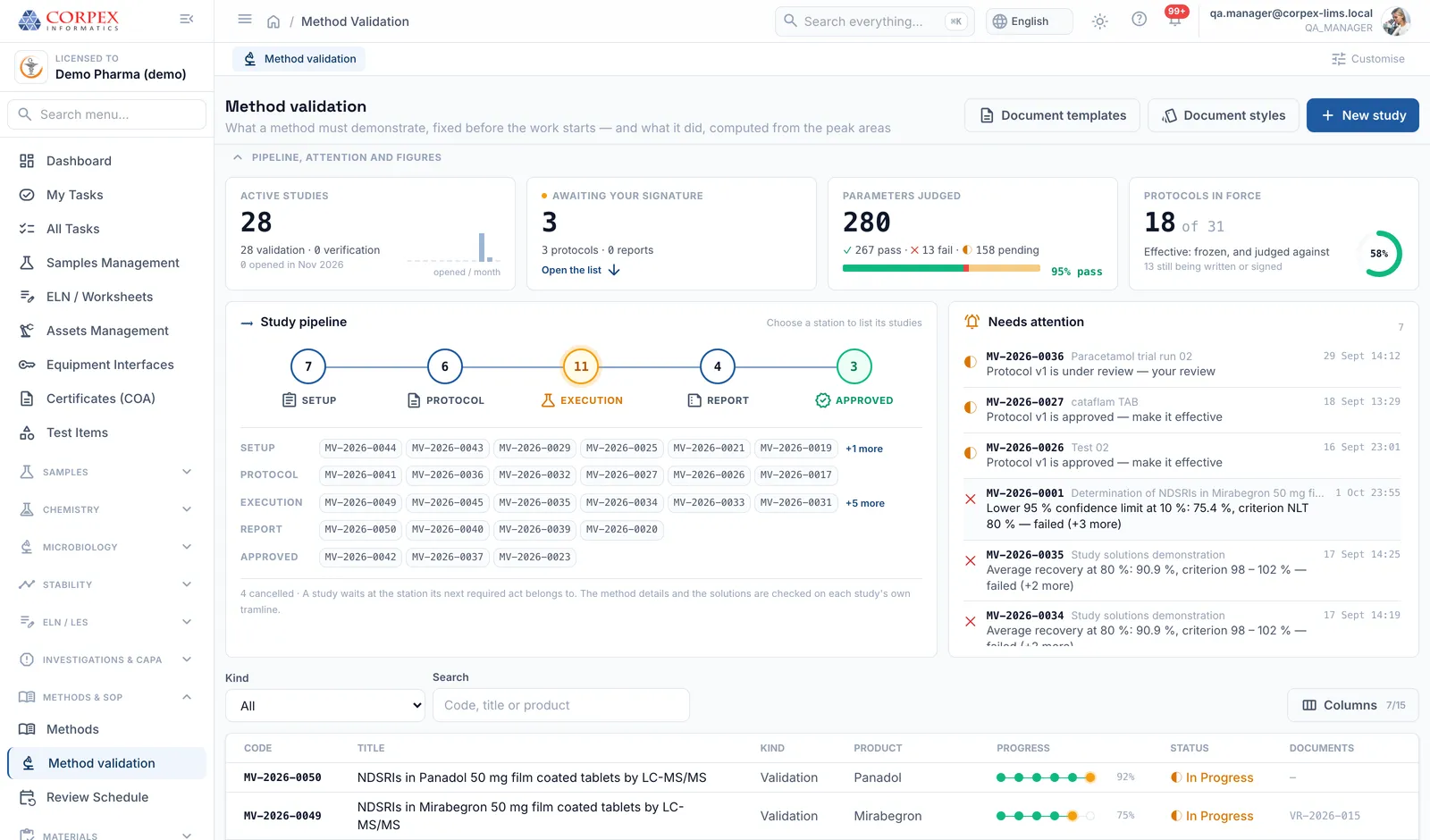
A validation plan you cannot change after seeing the results.
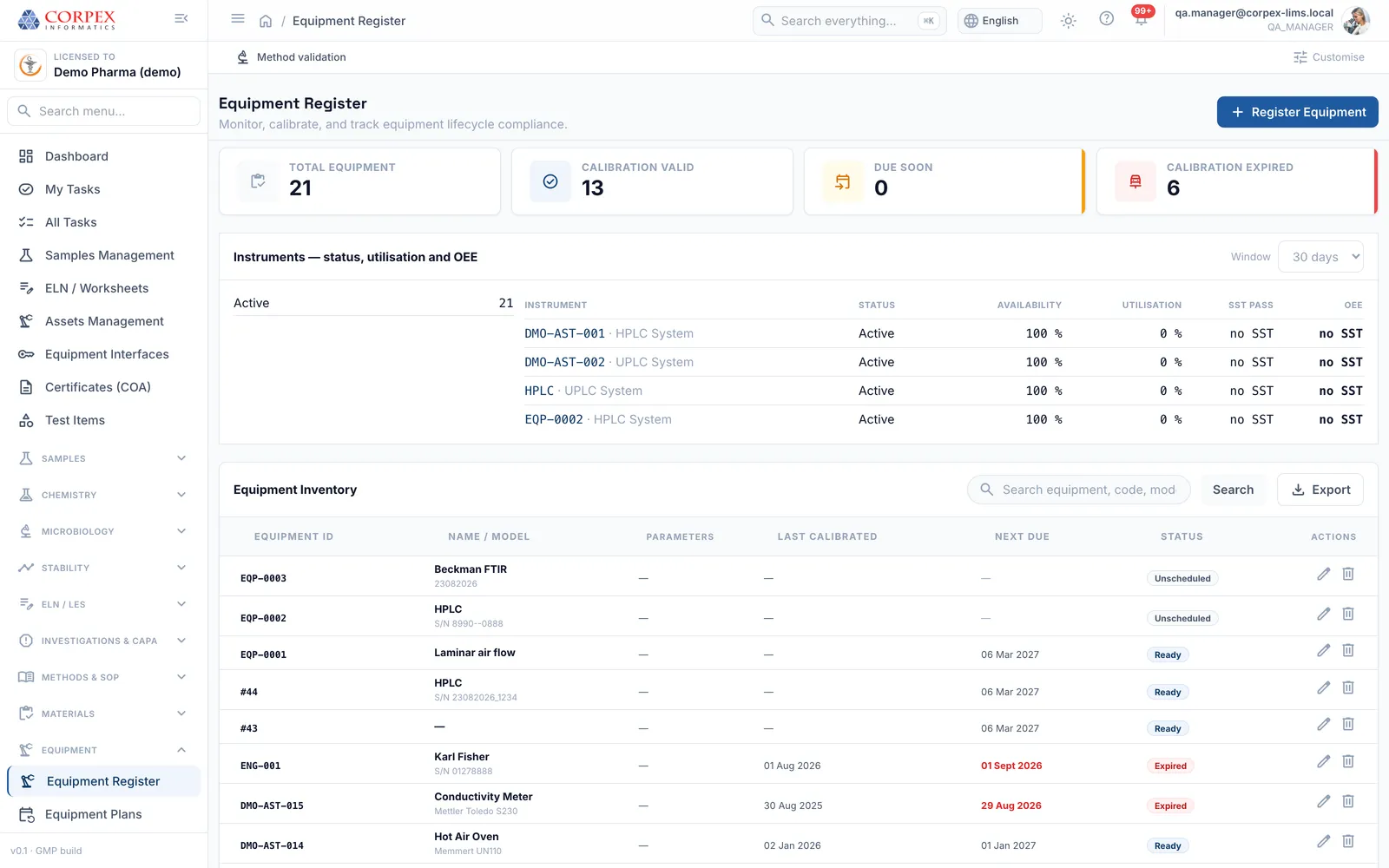
Out of calibration means refused, not warned.
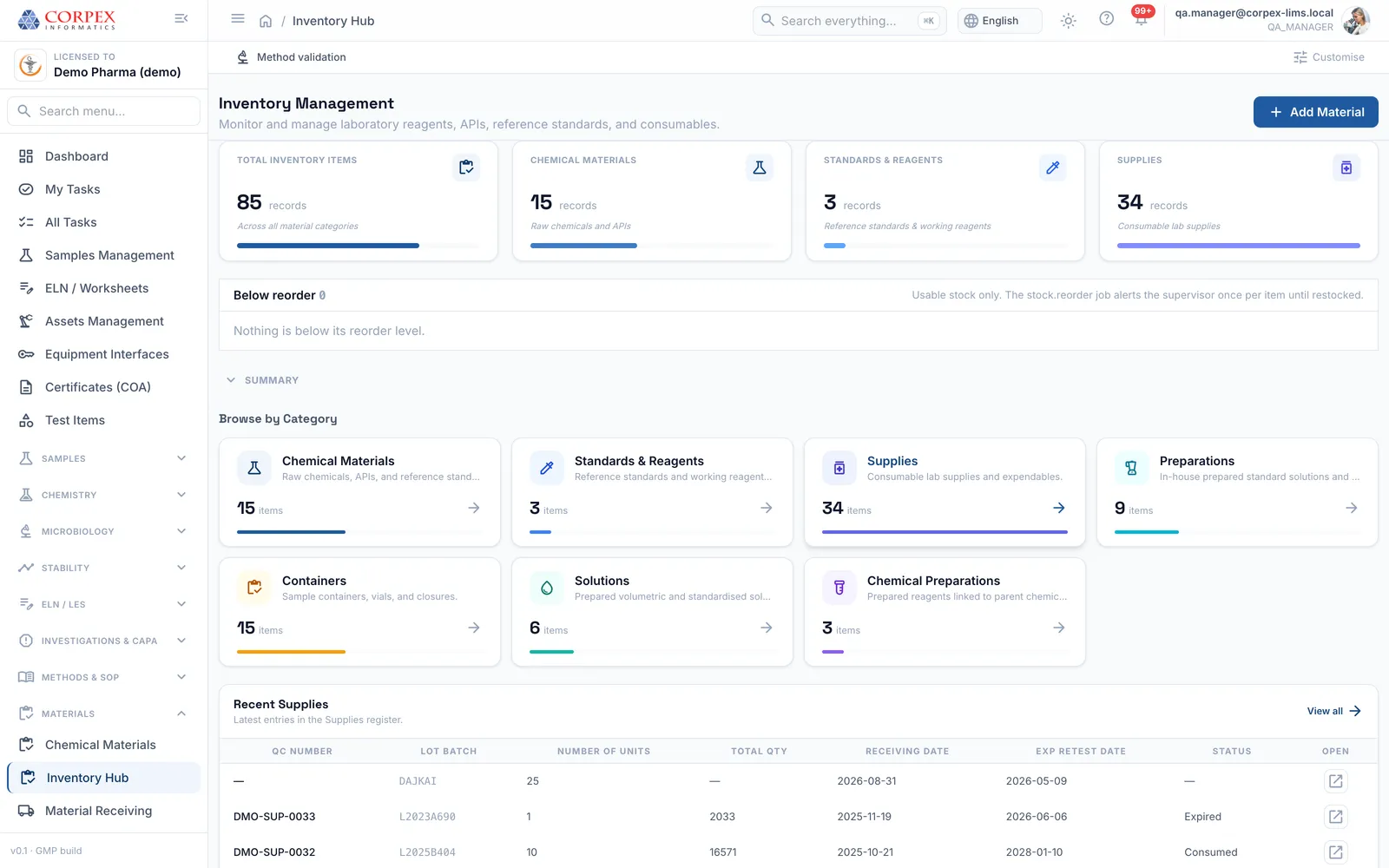
A reagent opened in March expires sooner than the bottle says.
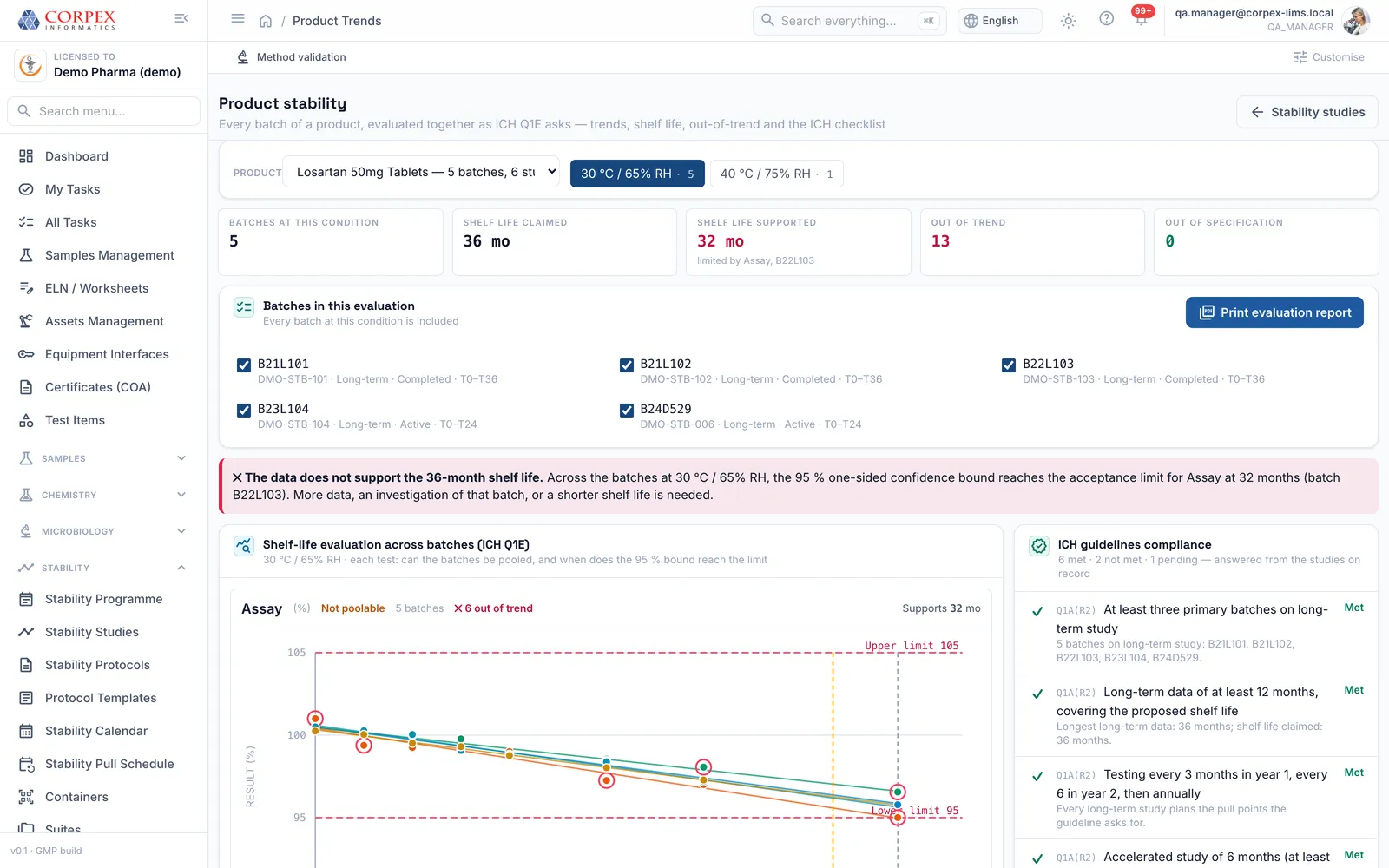
Every batch of a product at one storage condition is evaluated together, the way ICH Q1E asks. CORPEX LIMS tests whether the batches can be pooled and takes the shelf life from the 95 % one-sided confidence bound, not the fitted line through the middle of the data.
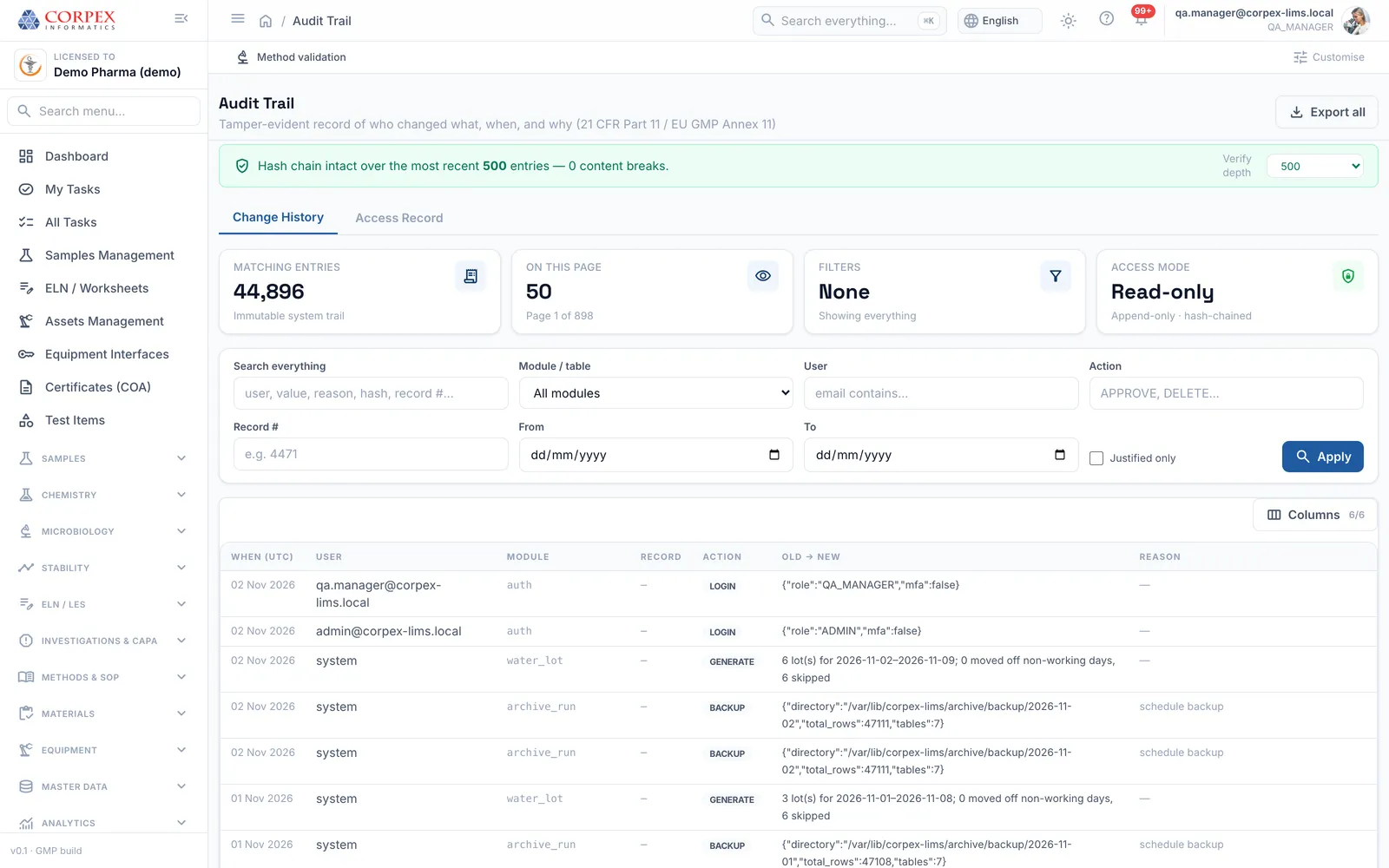
Every create, change and delete is written by the system, with the old and new value, the user, the time and the reason. Each entry carries a fingerprint of the one before it, and the database refuses to update, delete or truncate the trail.
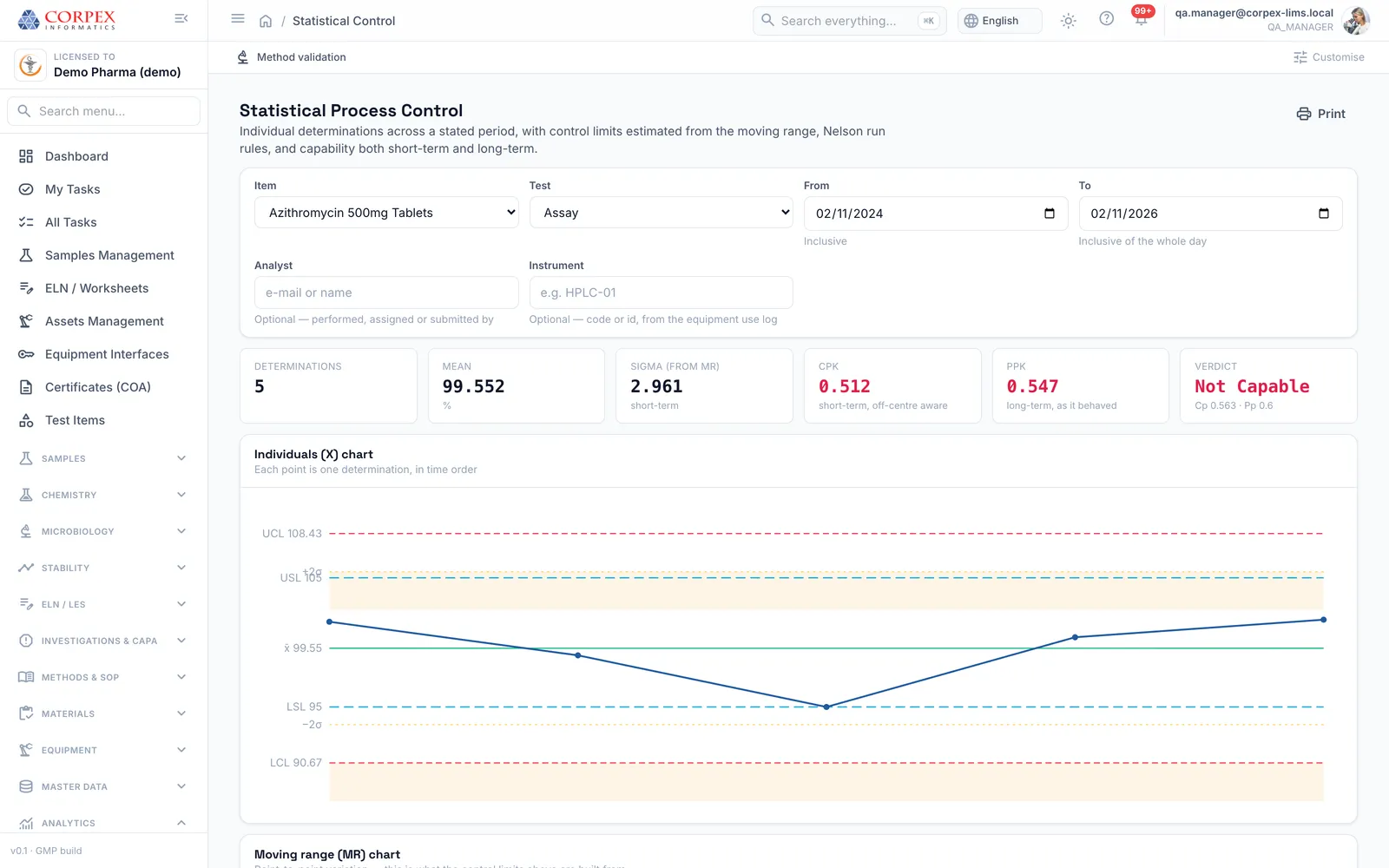
Control limits come from the moving range, and Nelson’s eight run rules are applied to every series. A result inside specification can still be the ninth in a row on one side of the mean, and that is the signal a limit check alone never gives you.
The same LIMS software runs a pharma QC bench, a stability chamber room, a microbiology suite and a wastewater lab, but each of them reads the system differently. Pick the page that matches your laboratory.
Raw files are fingerprinted at upload and checked on every read, and they cannot be deleted. An OOS result is never edited or excluded.
Every change carries the user, the time, the old and new value and the reason, in a trail the database will not let anyone alter.
Work cannot be allocated to an unqualified analyst, and an instrument past its calibration date is refused, not just flagged.
Review and approval are separate electronic signatures with name, time and meaning; the person who did the work cannot approve it.
The technical controls in CORPEX LIMS map to the regulations and standards below. Each card names the control that answers it.
Electronic records & signatures
Signatures re-authenticate with the password and record name, time and meaning; password policy, idle timeout and optional two-factor sign-in.
Computerised systems
Role-based access to every function, a hash-chained audit trail the database protects, and workflows that can add controls but never remove them.
Testing laboratory competence
Analyst qualification gates work allocation, out-of-calibration equipment is refused, and methods are validated in the system.
Data integrity
Raw data checksummed and undeletable, controlled records superseded rather than overwritten, and every entry attributable to a user and a time.
Investigating OOS results
Phase Ia, Ib and II in order, the original result never excluded, and invalidation only on a QA-approved root cause.
Stability testing and evaluation
Each study is checked for the facts Q1A(R2) requires, and shelf life is estimated from the 95 % one-sided confidence bound.
Analytical procedure validation
Characteristics drawn from Table 1, results computed, and the approved protocol frozen by a database trigger.
Environmental monitoring
Viable counts judged against alert and action limits snapshotted onto each round; an action-level count raises an investigation.
Dissolution and uniformity
Staged dissolution acceptance and the content uniformity acceptance value computed; an incomplete stage gets no verdict.
Risk-based validation
Validated by the CORPEX team with a risk-based approach and IQ, OQ and PQ documentation; see CSV services.
Compliance belongs to the validated system and the procedures around it. CORPEX LIMS supplies the technical controls, and the CORPEX validation team documents them for your inspection or accreditation assessment.
A pharma or QC lab buying a LIMS should be able to point at the clause and at the control. This is the short version; the validation pack carries the evidence.
| Requirement | Topic | Control in CORPEX LIMS |
|---|---|---|
| 21 CFR 11.10(e) | Audit trail | Each audit entry is chained to the hash of the one before it (SHA-256), and database triggers reject any update, delete or truncate of the audit log. |
| 21 CFR 11.50 | Signature manifestation | A signature record carries the signer’s name, the date and time and the meaning of the signature, applied the same way on worksheets and on workflow approvals. |
| 21 CFR 11.200(a) and 11.300 | Two components, password controls | Signing asks for the password again. An administrator sets the password policy; the defaults are a 10-character minimum, 90-day expiry, a history of 5, lock-out after 3 failed attempts and a 15-minute idle timeout. Time-based two-factor codes are available. |
| EU GMP Annex 11 §12 | Security | Roles restrict who can reach each function, and every operator entry, change or confirmation is recorded with the user and the time. |
| EU GMP Annex 11 §14 | Electronic signature | The signature is stored against its record with the time and date it was applied. |
| EU GMP Annex 11 §9 | Audit trail | Changes are recorded, and the trail can be read in the application. Reviewing it on a schedule is a procedure your QA writes; the system gives you something to review. |
| ISO/IEC 17025 §6.2 | Personnel competence | An analyst, reviewer or releaser needs a current qualification record, and the system checks it before work is allocated. |
| ISO/IEC 17025 §6.4 | Equipment | Calibration and maintenance dates are tracked per instrument, and a policy setting can refuse work on an instrument that is overdue for calibration. |
| ISO/IEC 17025 §7.2 | Method validation | A validation module holds the protocols and results, and an approved protocol is frozen. |
| ALCOA+ (PIC/S PI 041-1) | Original, attributable, enduring | Uploaded raw-data files cannot be deleted, only superseded by a new version, and the person who did the work cannot be the one to approve it. |
Sources: 21 CFR Part 11 (ecfr.gov), EU GMP Annex 11 (EudraLex Volume 4) and PIC/S PI 041-1. ISO/IEC 17025:2017 clause numbers refer to the published standard. Compliance is a property of the validated system plus your procedures, not of the software alone.
A laboratory information management system is the software of record for a testing lab: it logs every sample, tracks it through each analytical step, stores the result against the method and specification that applies, and produces the certificate at the end. CORPEX LIMS does that for pharmaceutical QC and stability labs, food, water and chemical labs, and microbiology and bioanalytical facilities, with the ELN in the same system rather than a second product. It works alongside CORPEX-eQMS and CORPEX-ERP, and is validated like any GxP computerized system through computer system validation (CSV).
Runs in any modern browser on desktops and tablets. The API is stateless and the data sits in Oracle Database.
Navigation, sign-in and in-app help in English, Spanish, Portuguese, Czech and Arabic (right to left). Module screens are in English.
CORPEX SDMS for scientific data, data and instrument integration, and SAP and ERP integration set up during implementation.
Instruments. The LIMS does not carry a driver per instrument. It has one inbound address per registered instrument, and what arrives can be a delimited table, fixed-width columns, key=value lines, JSON, a spreadsheet or a PDF report. A balance or pH meter on a serial cable, an HPLC data system exporting to a shared folder and a database view all end at the same door, carried by a small collector program. The LIMS watches the shape of each export, so a column inserted into a report template is caught instead of silently reading the wrong value. See data and instrument integration and the balance data capture guide.
SDMS. Raw chromatography and spectroscopy output that does not fit a single sample record belongs in CORPEX SDMS, a separate product that feeds the LIMS.
ERP and SAP QM. For a LIMS ERP link the LIMS accepts messages on an API-key-secured endpoint, imports suppliers, products and tests as master data, exports master data, and queues outbound documents. There is no pre-built SAP connector. The SAP or ERP interface is designed, built and validated during the integration project, and LIMS and SAP integration shows the inspection-lot round trip we normally agree. Where you also run CORPEX-ERP or CORPEX-eQMS, each is its own product with its own defined interface to the LIMS.
Users work in a browser. Behind it sits a stateless API and Oracle Database, so the API can run as more than one worker for failover. We deploy CORPEX LIMS on your own servers when data residency or your SFDA or EDA inspection posture calls for it, or hosted when connectivity and your policy allow, and we settle which during scoping. Backups, restore tests and the business-continuity arrangements Annex 11 §16 asks for are agreed with your IT team and documented in the validation package. Sign-in is by user name and password with optional two-factor codes; OpenID Connect single sign-on can be switched on once your identity provider is configured.
A focused CORPEX deployment typically runs three to six months: assessment and design in two to four weeks, configuration and training in four to eight, validation and go-live in four to eight. The number of modules, instruments and interfaces moves that range, so we confirm it after scoping.
There is no public price list. A quote reflects the size of the lab, the number of users, the modules you need and the deployment model, and it is issued after a scoping call. Egyptian customers can be quoted and contracted in Egyptian pounds; see LIMS software in Egypt. Ask for a scoping call.
Plain-language guides for labs evaluating or extending a LIMS. See all articles. Running a lab under SFDA? See LIMS software for SFDA-regulated labs in Saudi Arabia.
A vendor-neutral checklist: compliance, deployment, cost, support and validation.
A plain guide to what each lab system does, where they overlap and which your lab needs.
Sample tracking, instrument integration, stability testing and compliance compared.
Storage conditions, pull-date scheduling, trending and shelf life under ICH Q1A(R2).
Audit trails, electronic signatures and automated controls for GxP environments.
Book a demo and we will walk one sample through registration, testing, review, an OOS investigation and its Certificate of Analysis with you.
Request a LIMS DemoA LIMS is software that manages laboratory data, samples, workflows, and instruments. It automates quality control processes, ensures data integrity, and helps laboratories comply with FDA 21 CFR Part 11, ISO 17025, and GMP regulations.
LIMS software is used in pharmaceutical, food and beverage, chemical, environmental, water treatment, biotechnology, and clinical laboratories. Any lab requiring sample tracking, data integrity, and regulatory compliance benefits from LIMS.
CORPEX LIMS supplies the technical controls Part 11 asks for, and compliance is confirmed when the system is validated with your procedures. Every module (Samples & QC testing, Stability, Water, Microbiology & EM, ELN/LES worksheets) is built for it, with electronic signatures that record name, time and meaning, a hash-chained tamper-evident audit trail, and data integrity controls.
LIMS focuses on sample management, testing workflows, and quality control data. An ELN (Electronic Lab Notebook) records experimental procedures and observations. CORPEX LIMS covers both: the ELN is part of CORPEX LIMS, so experiment records and routine sample testing live in one system.
Yes. Balances, pH meters, HPLC data systems and other instruments send their readings to CORPEX LIMS through a small collector program or an export folder, so results are not retyped. The original data is kept with the result, and a change in an instrument's export layout is caught before a value is read from the wrong column.
Yes. CORPEX LIMS includes an API-key-secured interface for SAP or any ERP, enabled during the integration project: master data comes in, and results and documents go out. The interface is set up during implementation, and the CORPEX services team delivers SAP and ERP integration projects. See LIMS and SAP integration for detail.
A QC LIMS registers each sample, assigns the tests and the analyst, judges every result against the effective specification, raises an OOS investigation when a result fails, and issues the certificate of analysis after review and approval. CORPEX LIMS for pharma QC adds analyst qualification checks, instrument calibration status and a tamper-evident audit trail.
Inspectors ask whether the reported result is the original, who changed what and why, whether the analyst and instrument were qualified, and who approved the release. A pharma LIMS answers those with an audit trail, separate review and approval signatures, qualification and calibration checks, and raw data that cannot be deleted. See the clause-to-control table above.
The ERP owns materials, batches and inspection lots; the LIMS owns samples, results and the audit trail. Master data flows from the ERP into the LIMS, and results and documents flow back. CORPEX has no pre-built SAP connector, so the interface is built and validated in the integration project. See LIMS and SAP integration.
CORPEX LIMS runs in the browser and can be deployed on your own servers or hosted, as agreed during scoping. Pricing depends on lab size, users, modules and deployment model, and is quoted after a scoping call. A focused implementation typically takes three to six months.