
Computer System Validation (CSV)
Proving your systems perform as intended. Comprehensive validation services for GxP compliance and data integrity.
What Is Computer System Validation?
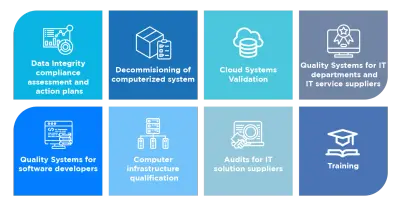
Software validation ensures the system fits its intended use. For laboratory informatics (LIMS, ELN, CDS) in regulated industries (pharma, food & beverage), validation is essential for product safety and data security. The FDA and other global agencies regulate industries that directly impact consumer health, mandating validation to ensure accuracy and reliability.









FDA CFR Part 11
In the US, 21 CFR Part 11 deals with electronic records and signatures. It mandates that electronic records/signatures must be accurate, reliable, readily retrievable, and secure to replace paper records legally. Validating your computer system is the primary means of proving compliance with these regulations.
The Validation Process
Validation spans the system life cycle. For new systems, it starts from the ground up. for existing systems or upgrades, it ensures the system remains in a validated state. The process ends only when the system is retired and data migrated/archived. It supports the entire project lifecycle.








The Validation Master Plan
The Validation Master Plan (VMP) guides the entire process. It includes requirements gathering, functional risk assessment, trace matrix, IQ/OQ/PQ protocols, and change control procedures. Each step is executed in order (Requirements -> Risk Assessment -> Trace Matrix -> Testing) to minimize risk and rework.
IQ/OQ/PQ Testing
Successful completion of Installation Qualification (IQ), Operational Qualification (OQ), and Performance Qualification (PQ) verifies that the system functions as intended. Testing should be performed by qualified personnel familiar with lab informatics systems (LIMS, ELN, CDS) to ensure comprehensive coverage and compliance.

GAMP 5 and Computer Software Assurance (CSA)
Modern validation is not about testing every button the same way — it is about focusing effort where risk lives. GAMP 5 (Good Automated Manufacturing Practice) is the industry framework for a risk-based system lifecycle, and the FDA’s Computer Software Assurance (CSA) guidance takes the same idea further: concentrate scripted testing and documentation on the functions that carry the highest risk to product quality, patient safety and data integrity, and apply lighter, unscripted testing to low-risk features.
CORPEX applies a CSA-aligned, risk-based methodology. That means your validation is rigorous where an inspector will look hardest — audit trails, electronic signatures, calculations, data integrity — and efficient everywhere else, so you reach a validated state faster and at lower cost, without cutting the corners that matter.
One Validated System, Every Regulator
Regulated organisations in Egypt sit under several overlapping expectations at once. A single, well-executed validation is what lets one system answer to all of them:
- FDA 21 CFR Part 11 — electronic records and electronic signatures for products and data touching the US market.
- EU Annex 11 — the European standard for computerised systems in GxP environments, closely mirrored by most modern inspectorates.
- GAMP 5 & ICH — the risk-based lifecycle and quality guidelines the whole industry validates against.
- WHO GMP — the baseline for pharmaceutical manufacturing and QC data across much of the region.
- Egyptian Drug Authority (EDA) — local GMP inspections that increasingly scrutinise ALCOA+ data integrity and computerised-system control.
- EGAC ISO/IEC 17025 — accreditation for testing laboratories, where control of data and electronic records is assessed directly.
What a CORPEX Validation Delivers
The validation package is the evidence. Here is the documentation produced across a CSV project — the same set an EDA, EGAC or FDA inspector expects to review.
| Deliverable | Purpose |
|---|---|
| Validation Master Plan (VMP) | Defines the scope, approach, roles and acceptance criteria for the whole validation. |
| User Requirements Specification (URS) | Captures what the system must do, in the language of the regulation and the workflow. |
| Functional Risk Assessment | Ranks each function by risk to quality, safety and data integrity to focus testing effort (GAMP 5 / CSA). |
| Requirements Traceability Matrix (RTM) | Links every requirement to its test, proving nothing was missed. |
| IQ / OQ / PQ Protocols & Reports | Executed evidence that the system is installed, operates, and performs as intended. |
| Validation Summary Report | Concludes the system is fit for its intended use and released for GxP operation. |
Systems We Validate
CSV for CORPEX products or as an independent service for third-party systems.
LIMS & CDS
Laboratory Information Management Systems, chromatography data systems and ELNs — the data backbone inspectors examine first.
eQMS
Electronic Quality Management Systems: document control, CAPA, change control, deviations and audit trails.
ERP & MES
Enterprise resource planning, manufacturing execution and environmental monitoring systems operating under GxP.
Based in Egypt and validating on-site across the country and the MENA region — see our computer system validation services in Egypt, available in Arabic and English.
Computer System Validation — Frequently Asked Questions
What is computer system validation (CSV)?
CSV is the documented process of proving that a computerised system — a LIMS, QMS, ERP or chromatography data system — consistently performs as intended and complies with regulatory requirements. It provides inspection-ready evidence that electronic records and signatures are accurate, reliable, secure and attributable, as required by FDA 21 CFR Part 11 and EU Annex 11.
What is the difference between CSV and CSA?
Computer Software Assurance (CSA) is the FDA’s modern, risk-based evolution of traditional CSV. Rather than testing every function to the same depth, CSA concentrates scripted testing and documentation on high-risk features and allows lighter, unscripted testing for low-risk ones. CORPEX applies a CSA-aligned approach so validation is thorough where it matters and efficient everywhere else.
What are IQ, OQ and PQ?
Installation Qualification (IQ) verifies the system is installed and configured to specification; Operational Qualification (OQ) verifies each function works across its operating range; Performance Qualification (PQ) verifies the system performs reliably in the real workflow with real users and data. Passing all three demonstrates the system is fit for its intended use.
Which regulations require computer system validation?
Chiefly FDA 21 CFR Part 11, EU Annex 11, GAMP 5, WHO GMP and ICH guidelines. In Egypt, laboratories and manufacturers also validate to satisfy Egyptian Drug Authority (EDA) GMP inspections and EGAC ISO/IEC 17025 accreditation.
What documents are produced during a CSV project?
A Validation Master Plan (VMP), User Requirements Specification (URS), Functional Risk Assessment, Requirements Traceability Matrix (RTM), IQ/OQ/PQ protocols and executed reports, and a Validation Summary Report — together the package an EDA, EGAC or FDA inspector expects to see.
Does CORPEX provide computer system validation in Egypt?
Yes. CORPEX is an Egyptian company headquartered in the New Administrative Capital and provides on-site CSV services across Egypt and the MENA region, in Arabic and English, aligned to EDA, EGAC, FDA 21 CFR Part 11 and EU Annex 11. See our CSV services in Egypt.
How long does a computer system validation take?
It depends on system complexity, the number of functions in scope and the risk level. A focused single-system validation is typically completed in a few weeks; an enterprise platform with many integrations takes longer. A risk-based, CSA-aligned approach shortens the timeline by concentrating effort on high-risk functionality.
Ensure Your Compliance Today
Contact our experts for a comprehensive validation plan tailored to your regulatory needs — in Arabic or English.
Contact Us