
Bioanalytical LIMS Software — Samples & QC Testing for Bioanalytical Labs
The CORPEX LIMS Samples & QC testing module, applied to bioequivalence and bioavailability study labs. Available on its own or as part of the CORPEX LIMS platform.
One Record for Every Sample
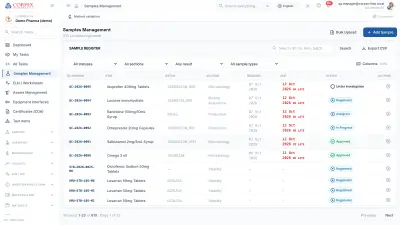
Bioanalytical labs use the same Samples & QC testing module that runs pharmaceutical QC in CORPEX LIMS: samples are tracked from receipt, results are recorded against the method and its limits, and each result is reviewed and released with an electronic signature.
Every change is written to a hash-chained, tamper-evident audit trail, which is the part an inspection actually looks at: not whether the work was done correctly, but whether the record proves it.
Who It Is For
Contract research organizations, and generic manufacturers proving equivalence to a reference product.
A bioequivalence study compares how a test formulation and a reference product behave in the body, usually by measuring drug concentration in plasma samples over time. A bioavailability study asks a related question: how much of an administered dose actually reaches systemic circulation, and how fast. Both produce large numbers of samples whose identity and history have to be beyond doubt.
CORPEX LIMS gives those samples one record: registration and tracking from receipt, results with their review and release signatures, out-of-specification flags, and a complete audit trail. Digitizing that trail removes the reliance on manual record-keeping across work that can run for months and involve thousands of samples.
The Data-Integrity Requirement Behind a Bioanalytical Report
Why a sponsor or regulator trusts the number in the final report.
Good Laboratory Practice (GLP) governs how non-clinical and bioanalytical studies are planned, run, and reported: a written protocol has to exist before the study starts, raw data has to be retained and attributable to the person who generated it, and deviations have to be documented rather than quietly absorbed into the result. Regulators reviewing a bioequivalence submission are, in large part, reviewing whether the work can be reconstructed from its records.
CORPEX LIMS supports that reconstruction with a tamper-evident audit trail, electronic signatures (name, time and meaning) on result review and release, and instrument capture into ELN worksheets that refuses wrong units and out-of-calibration instruments. The same controls are built to FDA 21 CFR Part 11 and EGAC ISO/IEC 17025 expectations, so work done for an Egyptian sponsor holds up to an export-market review as well.
What the Module Tracks
The core records a bioanalytical lab relies on.
Samples
Each sample is registered and tracked from receipt through testing, review and release, with its status visible in the sample register at any time.
Results and review
Results are entered or captured from instruments, out-of-specification values are flagged at entry, and review and release carry electronic signatures.
Certificates and audit trail
Certificates of Analysis cannot print before release, reprints are marked uncontrolled with a reason, and every change is kept in a hash-chained audit trail.

From Sample to Report
CORPEX LIMS acts as a central database for the lab: samples are registered first, results follow through manual entry or instrument capture, and the report draws on that same underlying data rather than being assembled separately at the end.
Analysts record and retrieve sample and result information throughout the work, which keeps the record consistent even when it runs across many sample deliveries and analytical runs.
What Changes for a Bioanalytical Lab
- Inspection readiness: a complete, tamper-evident audit trail reduces the administrative work of proving data integrity during an inspection.
- Documentation as you go: data is captured as the work runs, not reconstructed afterward.
- Controlled certificates: Certificates of Analysis come from the same released data instead of being assembled by hand.
- One workflow: samples, results, review and certificates sit in a single system.
- Fewer transcription errors: instrument capture into ELN worksheets replaces re-typing a reading from a printout into a spreadsheet.

How It Connects to the Rest of the Lab
Bioprocessing, QC, and validation notes.
Working in biopharmaceutical manufacturing rather than a bioanalytical study lab? Explore our bioprocessing LIMS for upstream, downstream, and bioanalytical workflows under 21 CFR Part 11. A lab that also runs routine QC testing uses the same Samples & QC testing module, available on its own or as part of the CORPEX LIMS platform. Once a study report is finalized, it commonly feeds into a regulatory dossier, which is where RENOVA RDX, CORPEX's regulatory affairs platform, archives the bioequivalence study alongside the rest of the CTD file.
CORPEX LIMS is implemented and supported in Arabic and English for Egyptian laboratories working toward Egyptian Drug Authority (EDA) GMP expectations or EGAC accreditation under ISO/IEC 17025; see LIMS software in Egypt for the local detail. Because deploying a LIMS is itself a computerized system change, every implementation is backed by computer system validation (CSV), with IQ/OQ/PQ documentation ready before the system goes live.
Ready to Streamline Your Bioanalytical Lab?
Contact us today to learn how CORPEX LIMS can support your laboratory.
Contact UsFrequently Asked Questions: Bioanalytical LIMS
What is the CORPEX LIMS module for bioanalytical labs?
It is the Samples & QC testing module of the CORPEX LIMS platform, applied to bioanalytical laboratories such as bioequivalence and bioavailability study labs. It tracks samples from receipt, records results with electronic signatures and a tamper-evident audit trail, and issues controlled Certificates of Analysis. It is available on its own or as part of the CORPEX LIMS platform.
Does it support GLP data-integrity expectations?
It supports the data-integrity controls GLP and FDA 21 CFR Part 11 inspections look for: every change is written to a hash-chained, tamper-evident audit trail, and result review and release carry electronic signatures with name, time and meaning. GLP compliance itself also depends on the laboratory's own procedures and validation.
How does it relate to QC testing in the same lab?
It is the same Samples & QC testing module that runs routine pharmaceutical raw-material, in-process and finished-product testing, so a lab doing both bioanalytical and QC work uses one system with one audit trail.
Can it capture results from analytical instruments?
Yes. Instrument readings are captured into ELN worksheets instead of being retyped. Capture refuses wrong units and out-of-calibration instruments, and any override needs a recorded reason.
Is it suitable for biopharmaceutical manufacturing rather than study labs?
For upstream, downstream and bioanalytical workflows in biopharmaceutical manufacturing, see our bioprocessing LIMS page.
Is it supported in Egypt with Arabic language support?
Yes. CORPEX is an Egyptian company, and implementation, training and support are available in Arabic and English for laboratories working toward EDA GMP or EGAC ISO/IEC 17025 accreditation.