

RENOVA-RDX: Pharmaceutical R&D Software for Regulatory Information Management
RENOVA-RDX connects R&D, Regulatory Affairs and the departments around them in one platform, so formulation, analytical and stability records feed straight into CTD dossier management and submissions tracking, instead of living in separate spreadsheets and shared folders.
What Is RENOVA-RDX and Who Is It For?
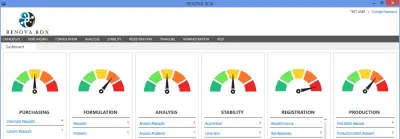
RENOVA-RDX is pharmaceutical R&D software and CTD dossier management software built to bridge the gap between R&D and Regulatory Affairs, the two departments whose records eventually have to agree with each other in front of an inspector.
It is designed for R&D managers, formulation scientists, analytical chemists and regulatory affairs officers inside pharmaceutical manufacturers who carry more than one product through development at a time, often across several dosage forms. Task management gives users throughout the facility appropriate access to input and retrieve data from a single, centralized system, so a formulation change, a new analytical method or an updated stability result is visible to the regulatory team that has to reflect it in a dossier, rather than arriving as a phone call after the fact.
Where a spreadsheet tracks one product at a time, RENOVA-RDX is a fully scalable system meant to hold the whole picture: every product, every dosage form, and every regulatory status, in one place.
Why Pharmaceutical Companies Need Regulatory Information Management
A pharmaceutical registration dossier is built to the Common Technical Document (CTD) structure: Module 1 for administrative and regional information, Module 2 for summaries, Module 3 for quality data (formulation, manufacturing and analytical information), Module 4 for nonclinical study reports, and Module 5 for clinical study reports. Module 3 alone draws directly on formulation records, analytical method validation, specifications and stability data — the exact records a formulation scientist and a QC analyst produce months or years before a regulatory affairs officer ever opens the submission.
Regulatory information management is the discipline of keeping that whole picture current: which dossier version was submitted to which authority, what variations and renewals are outstanding, and which underlying formulation, analysis or stability record each dossier section actually cites. Without a system built for this, that picture typically lives across a formulation binder, a QC archive and a regulatory officer's personal spreadsheet, and has to be reconciled by hand before every audit or renewal deadline. RENOVA-RDX keeps dossier compilation, registration tracking, renewal alerts and correspondence with authorities inside the same platform that holds the formulation, analysis and stability records the dossier is built from, so that reconciliation is not repeated for every product, every year.
Integrated Modules, One Product Record
The tabs below follow a product in the order it actually moves through development — formulation, then analysis, then stability, then regulatory submission.
Formulation Module
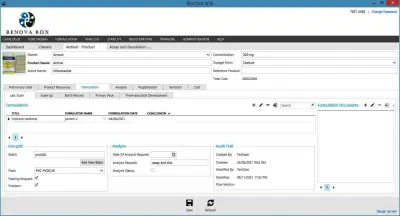
Manage product development from concept to pilot. Track active ingredients, excipients, and process parameters.
- Recipe management and version control
- Bill of Materials (BOM) optimization
- Process parameter tracking
- Scale-up parameters carried through to manufacturing
Analysis Module
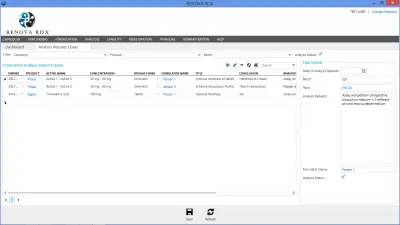
Comprehensive analytical data management for raw materials, intermediates, and finished products.
- Method validation management
- Specification tracking
- Certificate of Analysis (CoA) generation
- Integration with laboratory instruments
Stability Module
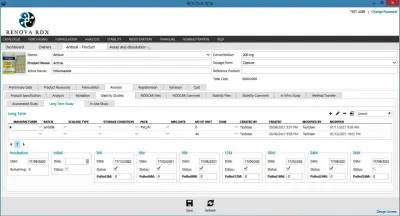
Manage stability studies with precision. Schedule testing intervals, track samples, and analyze degradation trends.
- Automated study scheduling & alerts
- Chamber management & monitoring
- Trend analysis & shelf-life prediction
- Compliant with ICH guidelines
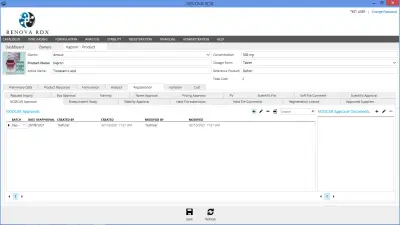
Regulatory Affairs Module
Streamline submission processes and ensure compliance with local and international regulations.
- Dossier management & compilation
- Registration tracking & renewal alerts
- Correspondence tracking with authorities
- eCTD support readiness
How the RENOVA-RDX Workflow Runs, Step by Step
- Formulation is recorded and versioned. Active ingredients, excipients and process parameters go into the Formulation module as a Bill of Materials, with version control so a later change is traceable back to the version that was analyzed and tested.
- Analytical methods and specifications are attached. The Analysis module holds method validation records, specification limits and the resulting Certificates of Analysis for that product and formulation version, integrated with laboratory instruments where the lab already has them connected.
- Stability studies run against that formulation. The Stability module schedules pull points and chamber monitoring for the same product, tracks degradation trends, and produces the shelf-life data a CTD Module 3 quality section requires, compliant with ICH guidelines.
- The Regulatory Affairs module compiles the dossier. Dossier management and compilation draws on the formulation, analysis and stability records already in the system, while registration tracking, renewal alerts and correspondence tracking with authorities keep every market's status current after submission.
What a Regulatory Reviewer Checks, and How the Records Answer It
A regulatory authority reviewer working through a submission, and an internal auditor preparing for one, are both looking for the same things: that the quality data in Module 3 matches the formulation on file, that specifications and test methods are validated and version-controlled, that stability data supports the claimed shelf life, and that every piece of correspondence and every variation or renewal has a documented trail.
- Formulation-to-dossier traceability. Recipe version control means the formulation cited in the dossier is the one that was actually analyzed and tested.
- Validated methods and specifications. Method validation records and specification tracking sit behind every Certificate of Analysis referenced in the submission.
- Registration status by market. Registration tracking and renewal alerts mean a question about status in a given market has a current answer, not a search through email.
- A documented correspondence history. Correspondence tracking with authorities keeps every request, response and commitment in one record instead of scattered mailboxes.
How RENOVA-RDX Connects to the Rest of the CORPEX Platform
R&D and regulatory data does not stand alone — it depends on what the QC lab and the quality system already hold.
QC Data from LIMS
Certificates of Analysis and specification data referenced in a dossier originate in the QC laboratory. CORPEX-LIMS laboratory information management is where that data is generated and controlled.
Document Control from eQMS
Standard operating procedures cited in a submission, and the change controls that trigger a variation filing, live in the CORPEX eQMS document control and change management system.
Built for Pharma
RENOVA-RDX is one module of a wider platform for regulated manufacturers — see how it fits alongside QC, QA and manufacturing on the pharmaceutical software solutions page.
Implementation and Validation
Because RENOVA-RDX holds GxP records — formulation history, analytical and stability data, and the dossiers built from them — the system itself has to be validated before it can be relied on for a submission. CORPEX delivers computer system validation (CSV) alongside every RENOVA-RDX implementation: a Validation Master Plan, IQ/OQ/PQ execution, and traceability from user requirements through to test evidence, so the platform is inspection-ready at go-live rather than validated after the fact.
Pharmaceutical R&D Software for Egyptian Regulatory Affairs Teams
Registering a product with the Egyptian Drug Authority (EDA) follows the same CTD logic as any other agency, with Module 1 carrying Egypt-specific administrative documents, labeling and pricing information. An Egyptian regulatory affairs team tracking several products, each with its own registration date, variation history and renewal cycle, faces the same reconciliation problem described above — multiplied by however many products are on file with the EDA at once.
CORPEX Informatics is an Egyptian company headquartered in the New Administrative Capital, and RENOVA-RDX is deployed with Arabic-speaking implementation and support, on-site configuration, and contracts in Egyptian Pounds. It runs alongside the CORPEX eQMS software in Egypt that controls the SOPs and change records a dossier cites, and is validated on-site through computer system validation services in Egypt — see the full suite on the regulatory affairs software page. For the full local picture, in English and Arabic, see regulatory affairs software in Egypt.
RENOVA-RDX — Frequently Asked Questions
What is RENOVA-RDX used for?
RENOVA-RDX is pharmaceutical R&D software that manages formulation, analytical methods, stability studies and regulatory affairs for one or more products across multiple dosage forms, so R&D and regulatory teams work from the same records instead of separate spreadsheets and folders.
Does RENOVA-RDX handle eCTD publishing or submission to health authority gateways?
RENOVA-RDX manages dossier compilation, registration tracking, renewal alerts and correspondence tracking with authorities, with eCTD support readiness built in. It does not publish to or submit through a specific health authority's electronic gateway — confirm the publishing and submission tools your target markets require with your regulatory team.
How does RENOVA-RDX support stability studies for CTD submissions?
The Stability module schedules pull points and chamber monitoring, tracks degradation trends, and produces shelf-life data compliant with ICH guidelines — the evidence a CTD Module 3 quality section needs to support a claimed shelf life.
Can RENOVA-RDX integrate with our QC lab and quality system?
Yes. RENOVA-RDX is part of the CORPEX platform, so Certificates of Analysis and specification data from CORPEX-LIMS, and SOPs and change records from CORPEX eQMS, connect to the same product record without re-keying.
Is RENOVA-RDX validated for GxP use?
RENOVA-RDX implementations are validated through CORPEX's computer system validation (CSV) service — a Validation Master Plan, IQ/OQ/PQ execution and traceability from user requirements to test evidence — so the system is inspection-ready at go-live.
Does RENOVA-RDX support Egyptian Drug Authority (EDA) registration?
Yes. RENOVA-RDX is deployed by CORPEX, an Egyptian company, with Arabic-speaking implementation support, on-site configuration, and dossier, registration and renewal tracking structured around the CTD format the EDA and other authorities use.
Accelerate Your R&D Pipeline
Contact our experts to see how RENOVA-RDX can streamline your development and regulatory processes.
Request a Demo