
21 CFR 211.165
Testing and release
Release rests on laboratory results that meet specification, recorded on the sample and signed in the usage decision.
CFast turns an approved sample into a certificate of analysis: the effective specification, the reviewed results, the batch or lot, the conclusion and the people who signed, on a controlled template and in a numbered copy. It is part of CORPEX LIMS, so the certificate always reflects the live record.
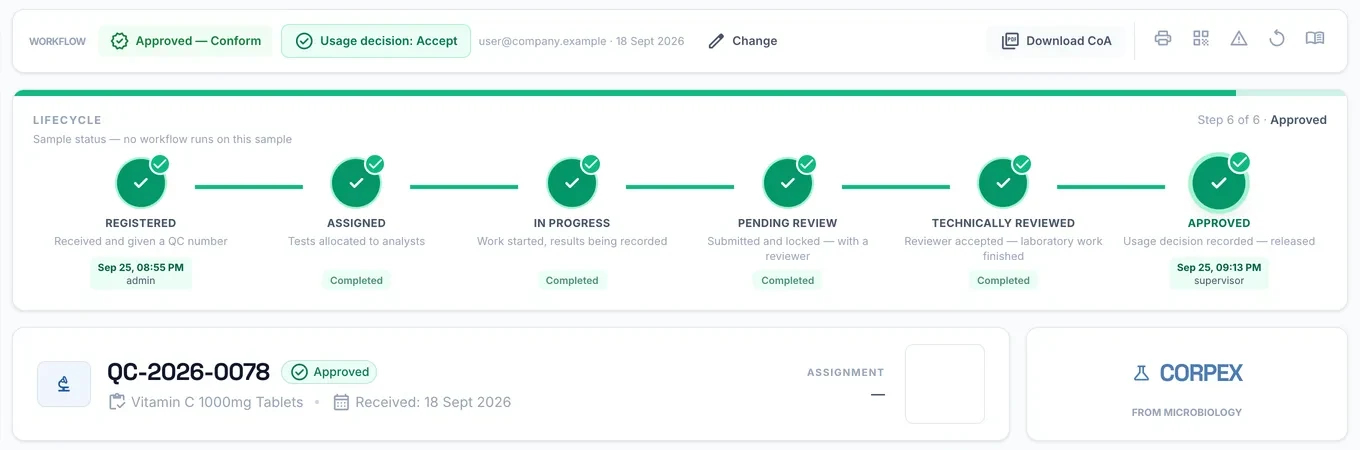
The CoA workflow in CORPEX LIMS. Results are reviewed one by one, the reviewer signs, and the usage decision releases the sample.
Tests, limits and criteria come from the specification version that was effective when the sample was registered. A specification is versioned and e-signed, one version is effective per code, and the sample carries that version with it. Each result is evaluated against its criterion, so conform or not conform is stated by the system, not typed.
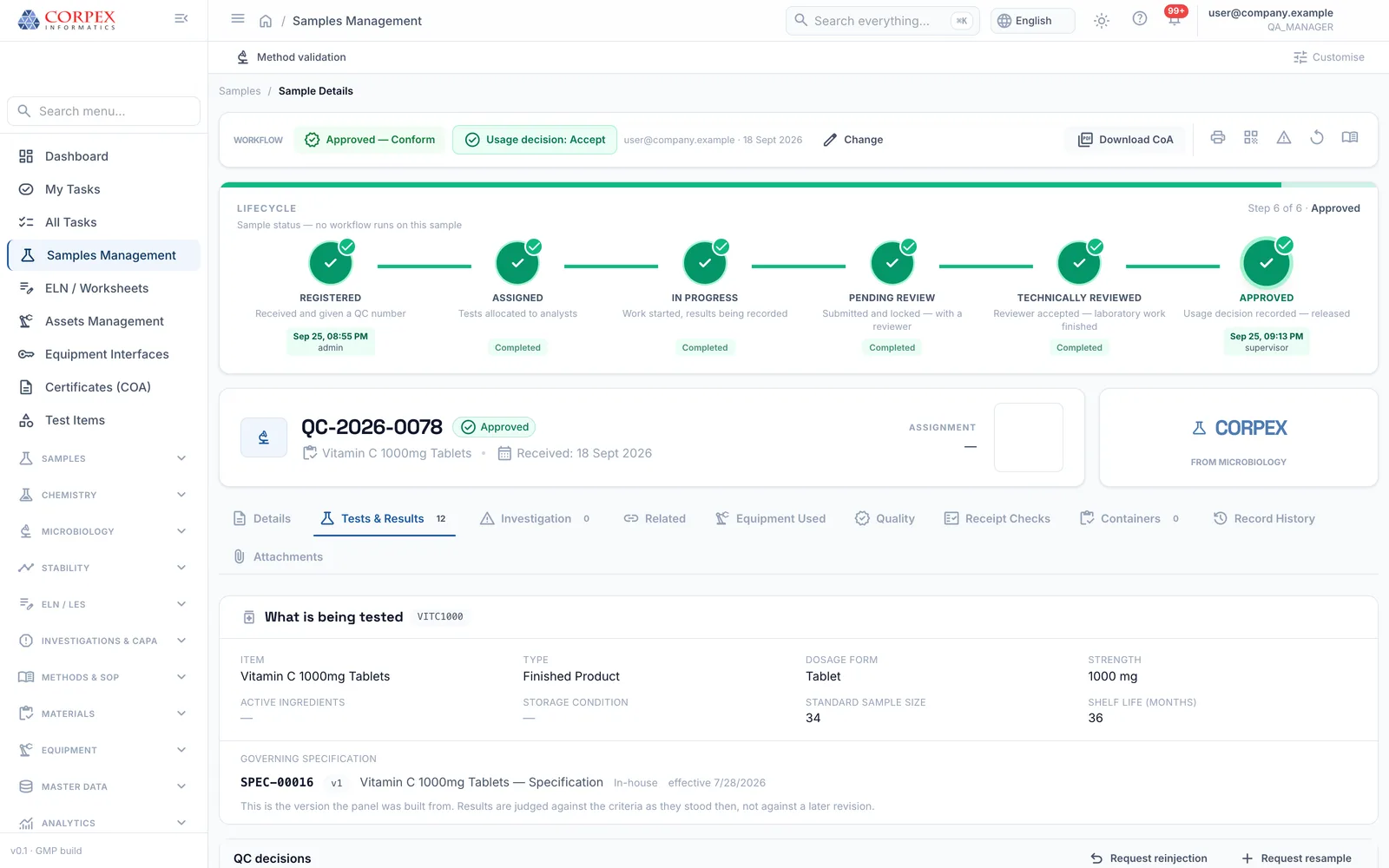
The certificate view checks the sample before it offers a download. A test with no result, a result nobody has reviewed, an unapproved template or a missing usage decision each stop it, with the reason on screen. The download enforces the same rule as the button, so a direct link does not get around it.
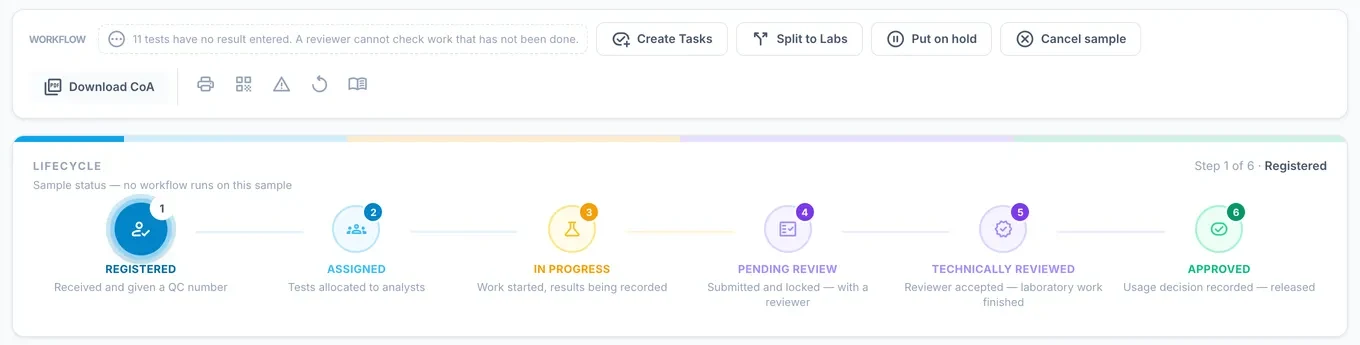
A released certificate is issued as a controlled copy and booked in the print register with a copy number. Others get an information copy. A draft copy is available only where your policy allows printing before the usage decision. A retest produces a new version, with carried-forward results marked.
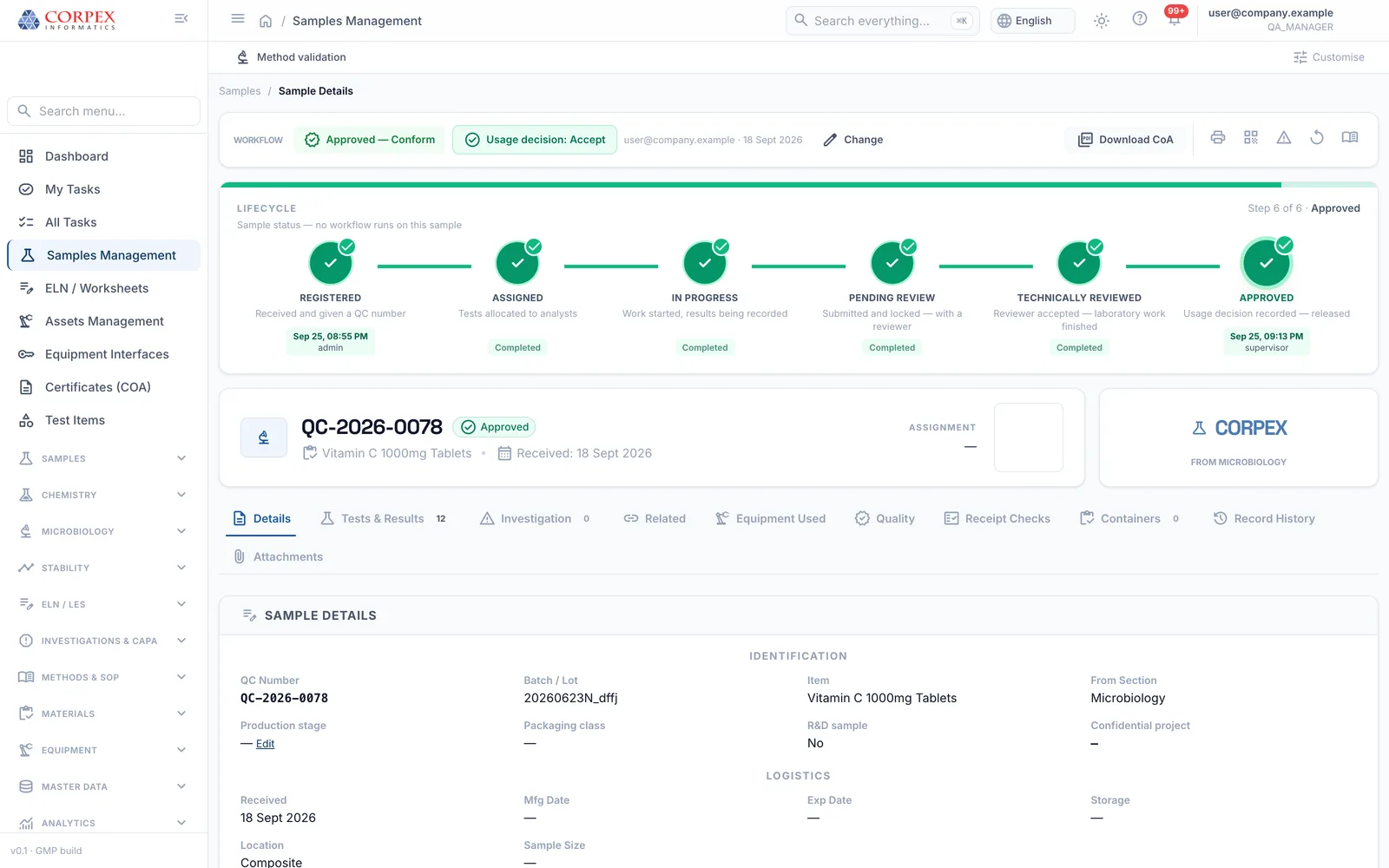
The certificate is built from the record, so each field has a source you can trace.
Item, QC number, batch or lot, section, received date, sample size, manufacturing and expiry date, and the specification number where your market wants it.
Test, specification, result and outcome per row, then an overall conclusion band that shows not conform as soon as one result fails.
Reviewed by, approved by and the usage decision with who made it and when, so the reader can tell who made the decision.
These checks are in the software, not in an SOP that someone has to remember.
A template moves from draft to review to approved with a signature. The approver must differ from the author and the reviewer, and signs with a password.
On single-sample certificates, name, logo, subtitle and address can differ by template; a template without them falls back to the site profile. A combined certificate for split sub-samples does not use the template letterhead.
Reviewing and approving a sample follow the same rule: you do not sign your own work.
An open OOS on the same product and batch blocks technical approval of the sample.
Approvals, usage decisions and print bookings are written to a hash-chained audit trail.
Signatures print with date and time of day, not date alone.
Each card names the control in the software that answers it.
Testing and release
Release rests on laboratory results that meet specification, recorded on the sample and signed in the usage decision.
Certificates of analysis
Certificates carry batch, results against limits, dates and the identity of the approver. The finished-product equivalents are 21 CFR 211.194 and EU GMP Chapter 6.
Signature manifestations
Printed name, date, time and the meaning of each signature on the certificate.
Computerised systems
Role-based rights, segregation of duties and an audit trail on the records the certificate comes from.
This page describes software controls. Your quality unit decides how they meet each rule.
Short answers, based on what the software does today.
CFast is the certificate of analysis capability of CORPEX LIMS. It builds the certificate from the sample record that already holds the batch, the specification and the reviewed results, so nothing is retyped. It is not a separate database; it runs on the same records as the laboratory.
Only when every test on the sample has a result and every result has been reviewed. If the template is not approved, or the usage decision has not been recorded and is not favourable, the certificate is refused too. The screen shows the reason, for example that a test has no result entered.
An open OOS on the same product and batch blocks technical approval, so no certificate can be issued for that sample until the investigation is dispositioned.
The person who issues certificates gets a controlled copy, which is booked in a print register with a copy number. A reprint needs a reason and is marked as a numbered reprint. Anyone else who can see the sample downloads an information copy, watermarked not for release, and a draft copy is available only where your policy allows printing before the usage decision.
The certificate issued after a retest is a new version of the first one. The version is printed on its face, and results that were not re-measured are carried forward and marked with an asterisk and a legend.
A certificate template controls the letterhead, header and footer text, which tests the customer sees, how below-limit results read and whether the specification number is printed. Templates are controlled documents: drafted, reviewed and approved with a signature, and the approver must differ from the author and the reviewer. Only an approved template may issue a single-sample certificate.
Book a demo and we will take one sample from specification to a signed, numbered certificate with you.
Request a Demo