Scientific Data Management System (SDMS)
Capture raw instrument data automatically, keep it ALCOA+ compliant, and connect it to your LIMS.
The Challenge of Data Management
The large volume of data generated by commercial and research laboratories, along with requirements mandated by regulatory agencies, have forced companies to use laboratory information management systems (LIMS) to improve efficiencies in tracking, managing samples, and precisely reporting test results.
However, most general purpose LIMS do not provide an interface to automatically collect data from analytical instruments to store in a database.
The CORPEX SDMS Solution
CORPEX SDMS captures the output an instrument produces the moment it produces it — a "print-to-database" path that takes the report an instrument generates and writes it directly into the SDMS database, rather than someone reading a printout and typing the result into a spreadsheet or a LIMS field by hand. That single change closes the most common data-integrity gap in a laboratory: the manual transcription step where a number gets copied wrong, rounded, or quietly corrected before anyone else sees it.
A standard SDMS stops there — it archives the raw file but does not analyze it further. Most LIMS, in turn, do not interface directly with instruments, so labs are often left stitching together per-instrument plug-ins with no general path from instrument to LIMS. CORPEX SDMS is built to sit in that gap: it captures the raw data at the source, keeps the original file intact, and hands structured data on to CORPEX LIMS or another system of record for further analysis and reporting.
Raw Data Capture and ALCOA+
ALCOA+ is the data-integrity standard inspectors actually apply when they review a laboratory record: it must be Attributable, Legible, Contemporaneous, Original and Accurate, plus Complete, Consistent, Enduring and Available. Most of those properties are decided at the moment data is created, not when a report is finalized.
A printed chromatogram that gets read off and retyped into a worksheet has already lost "Original" and usually "Contemporaneous" too, no matter how carefully the transcription is checked afterward. Automated capture is what keeps the original electronic record intact from the instrument onward, with the paper or PDF report treated as a copy of it rather than the record itself.
This is also why raw data capture matters more than reporting features on their own. A result can be reported correctly and still fail an audit if the raw file behind it cannot be produced, or if it was ever possible to edit that file without a trace. CORPEX SDMS keeps the raw instrument output under the same secure access and audit-trail controls as the rest of the system, so the file an inspector asks for is the same file the instrument produced.
For a longer comparison of where an SDMS, a LIMS and an electronic lab notebook each fit — and where labs most often confuse the three — see LIMS vs ELN vs SDMS: what each one actually does.
From Instrument to Reportable Result
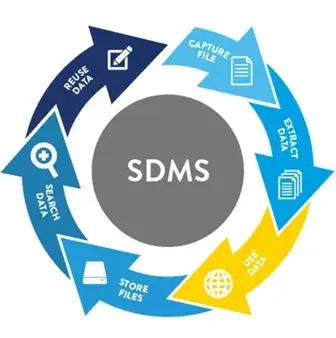
CORPEX SDMS sits between the instrument and the systems that use its data, in three stages:
1. Capture
Real-time instrument interfacing and file-sharing services pull the raw output — a chromatogram, a spectrum, a balance readout — into the SDMS database as it is generated, across the common instrument firmwares in a lab.
2. Secure & Audit
Every captured file is held under role-based access control with a full audit trail, so who accessed or reviewed a record — and when — is always reconstructable.
3. Report & Hand Off
Structured data moves from initial registration through to the final reporting phase, and can be passed to CORPEX LIMS or another system for further analysis, review and document control.
What an Auditor Checks in a Laboratory Data Review
- Original record: can the raw instrument file behind a reported result be produced on request, not just the summary report.
- Metadata intact: does the file retain its instrument-generated timestamp and method parameters rather than a re-saved copy.
- Access control: who could view, export or (where permitted) reprocess a file, and is that list current.
- Audit trail: is every access and action against the record logged with a user identity and timestamp.
Where CORPEX SDMS Connects
Connecting an instrument to SDMS is integration work — cabling, firmware, file formats, network segmentation in a validated environment. CORPEX's data and instrument integration services handle that connection for both new instruments and legacy equipment that was never designed to talk to a network.
Once data is captured, it typically feeds CORPEX LIMS for sample and result management, and the same environment is validated as part of any computer system validation (CSV) engagement, since an SDMS is a GxP computerized system in its own right.
Scientific Data Management for Egyptian Laboratories
CORPEX Informatics is an Egyptian company headquartered in the New Administrative Capital, and CORPEX SDMS is deployed alongside CORPEX LIMS in Egyptian pharma, food, water and chemical labs — on-site implementation, Arabic-language support, and contracts and pricing in Egyptian Pounds, aimed at the raw-data integrity expectations EDA inspections and EGAC ISO/IEC 17025 assessments increasingly look for.
Why Choose CORPEX SDMS?
Data Acquisition & Integration
Real-time instrument interfacing and file-sharing services across common instrument firmwares, so data integrity does not depend on manual transcription.
Full Validation Package
Includes validation scripts (DQ, IQ, OQ) and comprehensive documentation to meet regulatory standards.
Regulatory Compliance
Attain compliance with GxP, GAMP5, and FDA 21 CFR Part 11 requirements.
Secure Access & Audit Trail
Administrators manage roles and user access, with comprehensive audit trails for all actions against a record.
Reporting Services
A laboratory reporting toolkit covering initial registration through to the final reporting phase.
Document Management
Document control as part of the same integrated quality suite that runs the rest of a lab's compliance records.
Scientific Data Management System — Frequently Asked Questions
What is a scientific data management system (SDMS)?
A scientific data management system (SDMS) captures the raw output of laboratory instruments — chromatograms, spectra, balance readouts — directly into a central database as the instrument produces it, instead of relying on someone to transcribe a printed result. It preserves the original file alongside any report generated from it, which is what a data-integrity audit actually checks for.
How is an SDMS different from a LIMS?
A LIMS tracks samples, tests and results as business records — what was tested, by whom, against which specification. An SDMS captures and archives the raw instrument data behind those results. Most general-purpose LIMS do not interface directly with analytical instruments, so an SDMS fills that gap and can then hand structured data to the LIMS.
What is ALCOA+ and why does SDMS matter for it?
ALCOA+ is the data-integrity standard regulators use: records must be Attributable, Legible, Contemporaneous, Original, Accurate, plus Complete, Consistent, Enduring and Available. Manual transcription of instrument output breaks the Original and Contemporaneous requirements the moment a number is retyped. CORPEX SDMS captures the instrument's native output directly, which keeps the original record intact.
Does CORPEX SDMS integrate with existing lab instruments?
Yes. CORPEX SDMS provides real-time instrument interfacing and file-sharing services across common instrument firmwares, and CORPEX's data and instrument integration services handle the connection work for labs bringing new or legacy instruments onto the system.
Is CORPEX SDMS validated for FDA 21 CFR Part 11?
CORPEX SDMS is delivered with a full validation package — DQ, IQ, OQ scripts and supporting documentation — aligned to GxP, GAMP 5 and FDA 21 CFR Part 11 requirements, with secure role-based access and a complete audit trail on every record.
Ready to Secure Your Laboratory Data?
Talk to CORPEX about capturing raw instrument data with SDMS.