
Water LIMS Software for Drinking Water and Wastewater Labs
Sampling points, schedules, limits and exceedances for water quality programmes, from the tap or outfall to the signed certificate. The Water module of CORPEX LIMS, available on its own or with the rest of the platform.
Watch: the Water module in 25 seconds
Sampling points with their own schedules and limits, alert, action and specification bands, and a tamper-evident audit trail.
What a Water LIMS Does
A water LIMS is a laboratory information management system built around sampling points rather than around samples. Every intake, treatment stage, reservoir, tap and outfall has its own schedule, its parameter list and its limits, and every result is judged against the limit for the point it came from. That is the difference between a water lab and a general testing lab, and it is why spreadsheets fail once a monitoring programme grows past a few dozen points: nobody can see at a glance which point is overdue, which one has crossed its alert level three weeks running, or whether the limit used was the right one.
The Water module of CORPEX LIMS software keeps that cycle in one record: sampling points with their own limits, sampling schedules, results banded as they are entered, investigations, certificates and trending. It shares the platform’s audit trail, electronic signatures and access control.
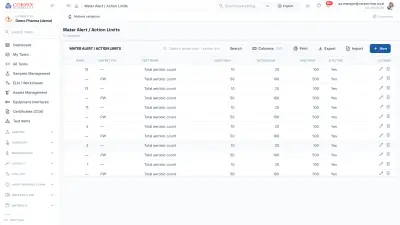
What a Drinking Water or Wastewater Lab Actually Runs
Whether the lab belongs to a utility, a treatment plant, a factory with an effluent permit or an accredited testing house, the work has the same shape. The table sets each part against what the Water module does, so you can see where the software carries the load and where the set-up work lies.
| Lab task | In the Water module |
|---|---|
| Sampling points and routes: intakes, treatment stages, network taps, influent, final effluent | Each point has a code, name, facility, building, room, loop and a routine or non-routine class. Schedules are per point with daily, weekly, monthly, quarterly, yearly or on-request frequency. |
| Receipt of the sample: container intact, labelled, enough volume, right temperature | A receipt checklist configured per sample type. Answers are recorded with the prompt as it was asked, and a failed critical check has to be rejected or justified, not waved through. |
| Parameter limits by regulation or contract | Alert, action and specification limits per test, held per sampling point or per water grade. The point limit is applied first. |
| Results and exceedances | Every result is placed in a band as it is entered: Within Limits, Alert, Action or Out of Specification. Runs of exceedances are flagged. |
| Instrument data | Readings captured into ELN worksheets from the instrument, with wrong units and unusable instruments refused. |
| Reports and certificates | A certificate of analysis is issued only when every test has a result and every result has been reviewed. |
| Accreditation under ISO/IEC 17025 | Versioned methods, calibration status checked at capture, a hash-chained audit trail and e-signatures. See ISO 17025 LIMS in Egypt. |
From Sampling Point to Certificate
- Register the sampling points. Once, with their water grade, location and class. Limits are attached to the point or to the grade.
- Build the schedule. A schedule generates nothing while it is a draft. Only when somebody makes it effective does it raise sampling lots, so a half-built plan cannot start producing work.
- Let the calendar absorb holidays. When a scheduled date falls on a non-working day, a routine point is moved to the next working day, and a non-routine point, sampled only on request, is skipped. Skipping a routine loop silently would leave a gap in the trend that looks like a clean week.
- Register and test the sample. The sample is registered against its point, checked at receipt, tested against the approved method and captured into the worksheet.
- Act on the band. The result is judged against the limits for its point at entry. A result in the Action band raises an investigation record automatically. Alert, Action and Out-of-Specification results are all marked investigation-required.
- Report and review. Certificates, the results register and the trend per point and test come from the same data.
Water Quality Limits, Alert Levels and Exceedance Alerts
A water result has two separate questions to answer. Does it conform, and does it still need a look? A value can sit inside the specification, cross its action level and demand an investigation. The module keeps conformance and severity apart: the band says where the result sits, and a separate flag says whether it conforms.
Limits are resolved point first, then grade. A specific outfall or tap can be held to a tighter limit than the general criterion, and the specific one wins, otherwise the tightening would be pointless.
The pattern a water system actually fails by is a trend, not a single excursion. Three consecutive results at Alert or worse on the same point and test are flagged as a finding in their own right, even though each one passed alone.
Drinking water, wastewater and utility water in one register
Limits per point and per test are open: any parameter, any unit, with alert, action and specification values. A network tap, a treatment stage or a final effluent outfall is registered as a sampling point and carries its own parameter list and limits.
For plants that also run process water, the module comes with the utility water grades a pharmaceutical or industrial site monitors: purified water (PW), water for injection (WFI), raw, softened, demineralised (DM) and pure steam, with limits that can be held per grade. How your drinking water, influent and effluent points are organised is set up during implementation, together with the parameter list and the limits you load.
Water Quality Standards and Egyptian Regulations
Limits are configuration, not fixed tables: you load the standard that applies to each point and report against it. The Water module does not ship the numeric limit tables of any decree. The texts it is typically configured against are:
| Standard | How it is used |
|---|---|
| WHO Guidelines for Drinking-water Quality | The international reference most national standards build on; guideline values are entered as limits per parameter. |
| Egypt: Ministry of Health and Population Resolution 458 of 2007 | Sets the maximum limits for drinking water and domestic use and assigns analysis to the Central Department of Laboratories of the Ministry. Limits are configured per sampling point from the current text. |
| Egypt: Law 48 of 1982 and its executive regulations | Protection of the Nile and waterways from pollution; the executive regulations set the standards for effluent discharged to water channels. They have been amended more than once, so load limits from the current consolidated text. |
| ISO/IEC 17025:2017 | Competence of testing laboratories, accredited in Egypt by EGAC: method control, technical records, validity of results and reporting. |
| Standard Methods, EPA and ISO methods | Kept as versioned methods of analysis, linked to the tests that use them. |
A typical water test menu covers physical parameters (pH, turbidity, colour, conductivity, temperature), chemical (residual chlorine, hardness, nitrate, nitrite, ammonia, fluoride, sulphate), metals (lead, iron, manganese, arsenic), microbiology (total coliforms, E. coli, heterotrophic plate count) and, for effluent, BOD, COD, suspended solids, oil and grease. Which apply to which point, and how often, is configuration. Microbiology can run through the Microbiology and EM module where a lab needs dedicated workflows.
A Water LIMS Implemented Where Your Lab Is
The Water module is implemented and supported by our own team in Egypt, in Arabic and English, and priced in Egyptian pounds. The people who configure your sampling points are the ones who answer when an assessor asks a question. A lab can start with water and add microbiology, stability or ISO 17025 accreditation workflows later on the same LIMS software. Pricing and implementation are covered on LIMS software in Egypt.
Water LIMS: Frequently Asked Questions
What is a water LIMS?
A water LIMS is a laboratory information management system configured for water testing. It knows your sampling points and schedules, records each result against the limit that applies to that point, flags exceedances, and produces the certificates and reports that drinking water, wastewater and environmental programmes are judged on.
Can one system handle drinking water and wastewater?
The module keeps limits per sampling point, checked before the limit for the water grade, so a treated-water tap and an effluent outfall can sit in one system with their own parameters and limits. Each point carries its own parameter list and limits, and how your drinking water and wastewater points are organised is set up during implementation.
Does the Water module support Egyptian water quality standards?
Limits are configured per sampling point, so a lab can load the limits of Ministry of Health and Population Resolution 458 of 2007 for drinking water, the effluent limits that apply under Law 48 of 1982 and its executive regulations, or a client's contractual limits. The module does not ship those limit tables; you load them from the current text. It also supports the records EGAC assessors expect under ISO/IEC 17025.
What is the difference between alert, action and specification limits?
The specification is the limit a result must meet to conform. The alert and action levels sit inside it and show a trend developing before a failure. A result can conform and still cross its action level, and then it requires an investigation. The module keeps conformance and severity as separate answers.
What happens when a result exceeds its limit?
The result is placed in its band as it is entered. A result in the Action band raises an investigation record automatically, and Alert, Action and Out-of-Specification results are all marked investigation-required. Three consecutive results at Alert or worse on the same point and test are flagged as a trend.
How are samples scheduled?
Schedules are kept per sampling point with daily, weekly, monthly, quarterly, yearly or on-request frequency. A schedule generates sampling lots only when made effective. A routine point falling on a holiday is moved to the next working day; a point sampled only on request is skipped.
Can the Water module capture results from instruments?
Instrument readings are captured into ELN worksheets instead of being typed in. Capture refuses a reading in the wrong unit and an instrument that is not usable, for example one out of calibration.
Is the Water module available in Egypt and the Middle East?
Yes, on its own or as part of the CORPEX LIMS platform, implemented and supported locally in Arabic and English with pricing in Egyptian pounds. See CORPEX LIMS in Egypt.
Planning a Water Quality Programme?
Tell us about your sampling points and parameters and we will show you the Water module set up for your lab.
Request a Demo