
Complaint Management Software
Log every product complaint once, investigate it to a root cause, and keep the file 21 CFR 211.198 expects an inspector to be able to review.
What Complaint Management Software Does, and Who Uses It
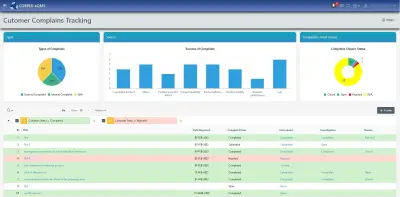
CORPEX-CM is the complaint management module inside CORPEX-eQMS: one system of record for every product quality complaint, from the moment it is reported to the moment it is closed.
It is built for the quality assurance staff who are legally responsible for reviewing a complaint, deciding whether it needs investigating, and answering the customer, not for a customer-service team logging a shipping delay. A CORPEX-CM record captures the intake channel, the investigation, the root cause, the corrective action and the reply sent back, so the same file that starts as a phone call can be reopened months later during an audit and read start to finish.
Related: CAPA Management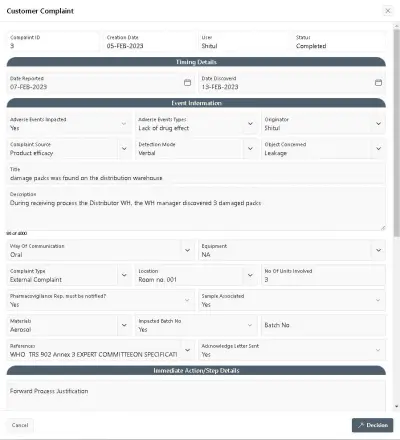
The Regulatory Requirement: 21 CFR 211.198
Complaint handling in a pharmaceutical plant is not customer service. It is a written obligation with specific record-keeping requirements.
What 211.198 Requires
FDA 21 CFR 211.198 requires a written procedure describing how both oral and written complaints are handled. It requires a written record of every complaint, an evaluation of whether the complaint involves a possible failure of a batch to meet specification, and a separate, more detailed investigation record for complaints alleging a product defect. Records must distinguish complaints that were investigated from those that were not, and give a reason where no investigation was performed.
EU GMP Chapter 8
EU GMP Chapter 8, Complaints, Quality Defects and Product Recalls, sets a parallel expectation: complaints and quality defects are recorded, investigated, and periodically reviewed for trends, with a documented process for deciding whether a defect warrants a market action. Both frameworks treat the complaint file as evidence, not correspondence.
How the CORPEX-CM Workflow Runs, Step by Step
Six stages carry a complaint from intake to a closed, reportable file.
1. Multi-Channel Intake
A complaint is logged the same way whether it arrives by phone, email, a website form or social media, so nothing sits unrecorded in someone's inbox.
2. Automated Workflows
Routing, assignment and escalation follow pre-defined criteria, so a complaint alleging a product defect reaches the right investigator without waiting for someone to notice it.
3. Centralized Database
Every complaint lives in one platform, which is what makes analysis, reporting and 211.198's periodic trend review possible in the first place.
4. Root Cause Analysis
Integrated tools support the investigation into why the defect happened, distinguishing a one-off packaging error from a process problem likely to repeat.
5. Corrective Action
Corrective actions are developed and tracked to resolve the complaint and address the process behind it, not just the individual unit that was returned.
6. Feedback Loop
The customer is kept informed as the investigation progresses and receives a timely, documented response once it closes.
Trending Complaints, and When One Becomes a Recall Decision
A single complaint is a data point. A pattern is a signal. Because every complaint sits in CORPEX-CM's centralized database with the same fields, quality staff can pull complaints by product, batch, defect type or time period and run the periodic trend review that 211.198 and EU GMP Chapter 8 both expect, instead of relying on memory or a scan through old emails.
Whether a quality defect uncovered through a complaint rises to the level of a market action or recall is a separate, risk-based decision the quality unit makes, drawing on the complaint record, any linked deviation, and the batch history. CORPEX-CM does not make that call for you. What it does is make sure the complaint history behind the decision is complete, dated and easy to hand to whoever has to make it.
Product Complaints vs. Adverse Events
Not every report from a customer belongs in CORPEX-CM. A complaint about a broken seal, an off-colour tablet or a labelling error is a product quality complaint and it is handled here. A report that a patient experienced a reaction to a drug is an adverse event, and it is subject to its own pharmacovigilance reporting timelines. CORPEX keeps that distinction as two separate systems: product complaints in CORPEX-CM, and adverse events in InFlow-PV. Intake staff are trained to read a report and route it to the correct one, and a single incident can trigger both when it involves both a product defect and a reported reaction.
What an Inspector Looks For in a Complaint File
An FDA or EDA inspection of complaint handling tends to check the same handful of things.
Was every complaint logged, not just the serious ones?
Multi-channel intake means a phone complaint is recorded the same way as a written one, so the log an inspector reviews is not missing an entire channel.
Is the investigate/no-investigate decision documented?
The centralized record holds the reason a complaint was or was not investigated, which is exactly what 211.198 asks to be distinguishable.
Does root cause lead to a real corrective action?
Root cause analysis and corrective action sit on the same file, so an inspector can trace a defect to the fix without cross-referencing a second system.
Is trending actually happening?
Reporting drawn from the centralized database is the evidence that periodic trend review is a real practice, not a line in a procedure nobody follows.
How Complaint Management Connects to the Rest of CORPEX-eQMS
A complaint is rarely the end of the story. It is usually the start of one somewhere else in the quality system.
CAPA
A complaint that points to a systemic cause, rather than an isolated unit failure, is escalated into CORPEX-CAPA for a formal corrective and preventive action.
Deviation Management
Where the root cause traces back to something that happened during manufacture, the finding is linked to a record in CORPEX-DM deviation management rather than investigated twice.
Implementation and Validation
CORPEX-CM is deployed and validated as part of the wider CORPEX-eQMS rollout, with intake channels, routing rules and report templates configured to match your existing complaint procedure. See computer system validation (CSV) services for how CORPEX documents IQ, OQ and PQ for a module like this one, producing the evidence an FDA or EDA inspection expects to review.
Complaint Management Software in Egypt
Egyptian pharmaceutical manufacturers handle product complaints under Egyptian Drug Authority (EDA) GMP inspection, which follows the same complaint-file and trending expectations as 21 CFR 211.198 and EU GMP Chapter 8. CORPEX-CM is delivered as part of CORPEX-eQMS in Egypt, with Arabic and English support so intake staff can log a complaint from an Egyptian customer in the language it was reported in, and QA can produce the trend reports an EDA inspector reviews in the same system.
Complaint Management Software — Frequently Asked Questions
What is complaint management software?
Complaint management software is the system a quality department uses to log a product complaint from whatever channel it arrives on, route it for investigation, record the root cause and corrective action, and keep the complaint file a regulator can review. CORPEX-CM is the complaint management module of CORPEX-eQMS.
How does CORPEX-CM support 21 CFR 211.198 complaint files?
CORPEX-CM keeps every complaint in a centralized database with the intake channel, investigation record, root cause and corrective action attached to the same file, which is the record 21 CFR 211.198 asks a written complaint procedure to maintain, including the distinction between complaints that were and were not investigated.
Are adverse events handled in CORPEX-CM?
No. A product quality complaint is handled in CORPEX-CM. A report of an adverse drug reaction or adverse event is a pharmacovigilance matter with its own reporting timelines and is handled in InFlow-PV, CORPEX's separate pharmacovigilance system. Intake staff are trained to route a report to the correct system based on what it describes.
Does CORPEX-CM support complaint trending?
Yes. Because every complaint sits in one centralized database, it can be pulled into reports and analysis by product, batch, defect type or time period, which is what periodic complaint trending under 21 CFR 211.198 and EU GMP Chapter 8 requires.
How does a complaint connect to CAPA and a possible recall?
A complaint's root cause analysis and corrective action are developed using tools integrated into CORPEX-CM, and where a complaint indicates a systemic problem it is escalated into CORPEX-CAPA. Whether a quality defect found through a complaint requires a market action or recall is a separate risk-based decision the quality unit makes, informed by the complaint record and any related deviation or CAPA.
Is CORPEX-CM used by pharmaceutical companies in Egypt?
Yes. CORPEX-CM is part of CORPEX-eQMS, used by Egyptian pharmaceutical manufacturers, and supports the complaint-handling and trending records an Egyptian Drug Authority (EDA) GMP inspection reviews, with Arabic-language support. See CORPEX-eQMS in Egypt.
Turn Feedback into Growth
Contact our experts to see how CORPEX-CM can help you build stronger customer relationships.
Request a Demo