MicroLIMS™ — Microbiology LIMS Software
A microbiology LIMS built for sterility testing, environmental monitoring, and microbial limits work in GMP labs.
What MicroLIMS Is Built For
MicroLIMS is a microbiology LIMS for labs that run sterility testing, environmental monitoring, microbial limits testing, and antibiotic bioassay work as a daily routine, not an occasional side task. It manages sample accessioning, media and culture tracking, and result reporting inside one auditable record, instead of leaving microbiologists to reconcile paper logbooks, spreadsheets, and a chemistry-focused LIMS that was never built for plate counts and incubation windows.
It is aimed at QC microbiology sections in pharmaceutical, food and beverage, and biochemical labs — the group that answers to inspectors on sterility assurance, bioburden, and cleanroom contamination, and needs a system that produces a defensible record every time, not just when someone remembers to fill in a logbook.
The Regulatory Requirement Behind Each Test
MicroLIMS panels are not generic quality control checks — each one answers a specific compendial or GMP expectation.
Growth promotion testing exists because USP <61> and <62> require proof that the media a lab uses can actually detect the organisms it is meant to detect, before that media is used to release a batch. Sterility testing under USP <71> has to be run by membrane filtration or direct inoculation in a way that rules out a false negative caused by inhibitory product residue — which is why a documented test suitability (neutralization) study has to sit alongside the sterility result, not stand apart from it.
Preservative and disinfectant efficacy testing follows USP <51>, confirming that a formulation's antimicrobial system actually controls bioburden for the life of the product. Bacterial endotoxins testing under USP <85> catches pyrogenic contamination that a sterility pass alone will not. And for cleanroom-based manufacturing, EU GMP Annex 1 (the 2022 revision) raised the bar on environmental monitoring specifically: it expects a documented contamination control strategy built on trended viable and non-viable counts, not a folder of isolated pass/fail slips reviewed once a quarter.
Comprehensive Microbiology Suite
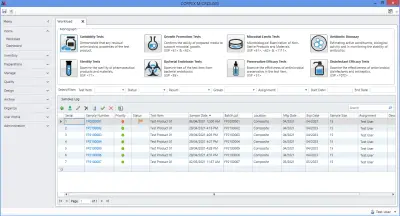
MicroLIMS covers microbiological examinations including test suitability, growth promotion tests (GPT), microbiological limits tests (MLT), antibiotic bioassay, sterility tests, bacterial endotoxins, and preservative and disinfectant efficacy tests.
Common laboratory activities like media preparations, reference strains, and stock control are included, along with assets and instrument logs. Control of samples that are out of specification (OOS) is fully managed, with the result routed for investigation rather than just flagged and left in a queue.
Key Features
Designed for the specific needs of microbiology labs.
Media Preparations
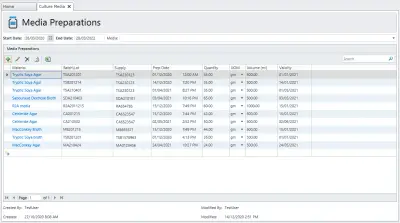
Microbial culture media preparation is a routine task. MicroLIMS provides recording of all pertaining information for culture media, subculture of Certified Reference Microorganisms (CRMs), and other preparations that support integration of laboratory workflows.
Growth Promotion Tests (GPT)
GPT (USP <61>/<62>) confirms the ability of a new batch of media to support growth before that media is trusted for a release test. MicroLIMS links media preparation data with associated GPTs to support metrological traceability for all media used in cGMP facilities.
Suitability Tests
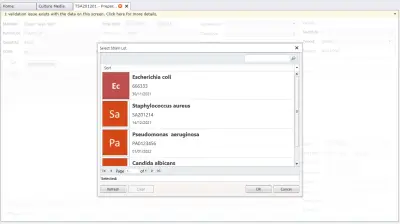
Demonstrate that any residual antimicrobial properties have been neutralized before a sterility or MLT result is trusted. MicroLIMS records the suitability protocol used, exports the supporting data, and generates the printed documentation an auditor expects alongside the test result (USP 41 compliant).
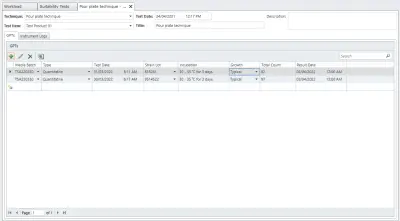
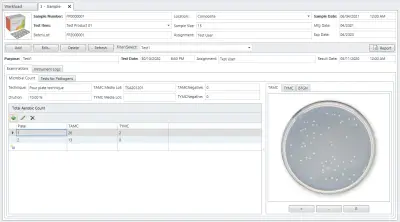
Microbial Limits Tests (MLT)
Assess viable microorganisms in non-sterile products under USP <61>/<62>. MicroLIMS integrates total aerobic microbial count (TAMC), total yeast and mold count, and tests for specified pathogenic microorganisms to determine compliance with established specifications.
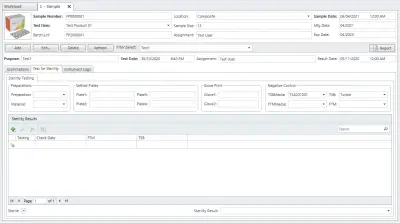
Sterility Tests
Confirm sterile products do not contain viable microorganisms before release, under USP <71>. MicroLIMS supports both sterility testing methods (membrane filtration and direct inoculation) and links each result to its underlying test suitability study, essential for medical devices and pharmaceutical products.
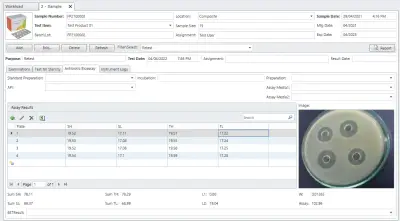
Antibiotic Bioassay
Estimate active constituents and biological activity of antibiotics. Microbiological assay helps in monitoring stability and resolving doubts regarding possible changes in potency that chemical methods may not detect — the same data set that a stability program later pulls into shelf-life review.
Endotoxin and Preservative Efficacy Testing
Two panels that a sterility pass does not cover, and that inspectors ask about separately.
Bacterial Endotoxins (USP <85>)
A sterile product can still be pyrogenic if endotoxin from dead gram-negative bacteria is present. MicroLIMS logs the LAL test method, reagent lot, and result against the product's endotoxin limit, keeping the record separate from, but linked to, the sterility result for the same batch.
Preservative & Disinfectant Efficacy (USP <51>)
Antimicrobial effectiveness testing confirms a formulation's preservative system controls bioburden across its shelf life, and disinfectant efficacy testing confirms a cleaning agent actually kills the organisms it's used against in the cleanroom. MicroLIMS records challenge organism, exposure interval, and log-reduction data for both.
How a Sample Moves Through MicroLIMS
The same six-stage path runs whether the sample is a sterility check or an antibiotic assay.
- Accessioning and CRM traceability — the sample is logged against its specification, and any Certified Reference Microorganism used for the run is linked back to its own subculture history.
- Media preparation and the GPT gate — a media batch cannot be used for a release test until its own growth promotion result is on file.
- Test execution — suitability, sterility, MLT, bioassay, or endotoxin testing runs against the linked media and reference strain records, with instrument results captured directly where an interface exists.
- OOS handling — a result outside specification is flagged automatically and routed for investigation rather than left for someone to notice on the next report run.
- Review and electronic signature — a second reviewer signs off before the result is released, with every change to the record captured in the audit trail.
- Reporting — the finished record exports to the certificate of analysis or environmental monitoring report, without re-keying data by hand.
Coliform, E. coli and plate-count testing on drinking water and wastewater runs the same way; labs whose work is organised around sampling points and discharge limits use it alongside WaterLIMS, our water LIMS software.
What an Inspector Looks For in a MicroLIMS Record
An EDA or FDA inspector reviewing a microbiology lab is not just checking that a result passed. They are checking whether the record can withstand scrutiny: is there an electronic signature on the release, does the audit trail show who touched the record and when, and can the media used for a sterility test be traced back to a documented GPT result for that specific batch.
MicroLIMS answers each of those with electronic signatures, a tamper-evident audit trail, and ALCOA+ data-integrity controls aligned with FDA 21 CFR Part 11 and WHO GMP. Instrument and identification-system interfacing reduces the transcription error that inspectors flag most often, because results move from the instrument into the record without someone retyping a plate count by hand.
MicroLIMS Across the CORPEX Quality System
Microbiology data rarely stays inside one module.
MicroLIMS is one product in the CORPEX LIMS software family. Its environmental monitoring data feeds the same cleanroom trending logic used by Cleantrol EM, CORPEX's environmental monitoring software, and field or point-of-care microbiologists can run the same panels from a tablet with Leeuwenbook, the portable microbiology LIMS. When a result falls out of specification, MicroLIMS routes it into deviation management rather than leaving it as an isolated flag on a report.
Because a microbiology LIMS is a GxP system, it needs to be validated, not just configured and switched on. CORPEX pairs MicroLIMS deployments with computer system validation, with DQ, IQ, OQ and PQ scripts mapped to the specific panels a lab runs, so the validation package matches the system actually in use, not a generic template.
MicroLIMS for Microbiology Labs in Egypt
Egyptian pharmaceutical and food microbiology labs work to Egyptian Drug Authority (EDA) GMP expectations and, where accredited, EGAC ISO/IEC 17025. Both expect the same data-integrity basics MicroLIMS already provides: reviewed audit trails, electronic signatures, and traceable media and reference-strain records rather than initialed paper logbooks.
As a CORPEX product, MicroLIMS ships with Arabic and English support and local implementation across Egypt. See our LIMS software for Egyptian laboratories page for how CORPEX scopes and prices deployments locally.
CORPEX MicroLIMS — Frequently Asked Questions
What is MicroLIMS?
CORPEX MicroLIMS is a laboratory information management system for microbiology labs. It manages sterility testing, environmental monitoring, microbial identification, media and incubation tracking, and produces compliant reports with a complete audit trail.
Does MicroLIMS handle environmental monitoring?
Yes. MicroLIMS schedules environmental monitoring, records counts against alert and action limits by location, trends contamination, and triggers investigations when limits are breached — essential for cleanroom and sterile-manufacturing environments.
Is MicroLIMS compliant with 21 CFR Part 11 and GMP?
Yes. MicroLIMS provides electronic signatures, a tamper-evident audit trail and ALCOA+ controls aligned with FDA 21 CFR Part 11, WHO GMP and the data-integrity expectations of the Egyptian Drug Authority and EGAC ISO/IEC 17025.
Can MicroLIMS integrate with identification systems and instruments?
Yes. MicroLIMS supports instrument and identification-system interfacing so results flow automatically into the record, reducing transcription error and preserving traceability from sample to result.
Is MicroLIMS suitable for Egyptian microbiology labs?
Yes. As a CORPEX product MicroLIMS ships with Arabic and English support, local implementation across Egypt and pricing in Egyptian pounds. See our LIMS for Egyptian laboratories page.
Ready to Modernize Your Microbiology Lab?
Contact us today to discuss how MicroLIMS can support your specific needs.
Contact Us