
Electronic batch records for Saudi pharmaceutical plants, built for QP release.
Corpex-EBR is electronic batch record software for manufacturers working to SFDA GMP. It runs the master batch record on the shop floor, collects electronic signatures, and hands QA and the Qualified Person a record ready for review by exception. It installs on your own servers or private cloud, so the data can stay in the Kingdom.
Or meet us in Riyadh during CPHI Middle East, 26–28 April 2027.
- 2023
- SFDA joined PIC/SParticipating Authority from 1 July 2023
- +18%
- Licensed factories and warehousesAll SFDA sectors, 2025 vs 2024
- §15
- Annex 11, batch releaseQP only, by electronic signature
- 5 yr
- After QP certificationMinimum batch documentation retention
Start paperless instead of migrating later
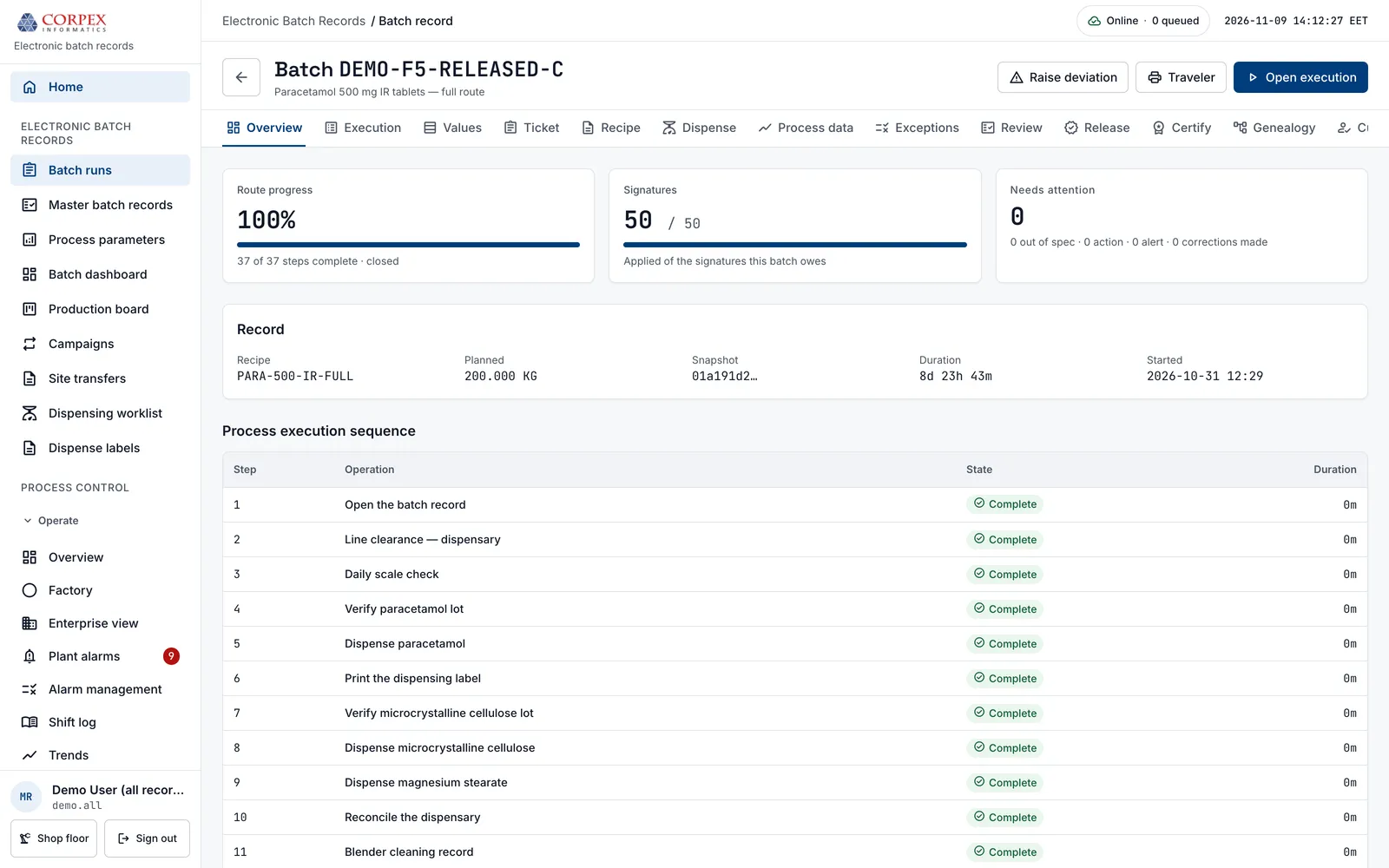
SFDA reported an 18% rise in licensed factories and warehouses in 2025, and its biosimilar guideline says it aims to promote access to biosimilars through localisation of the industry in the Kingdom. A plant that is being built, or a product being localised from another site, has no paper habit to unlearn. The batch record can be electronic from the first engineering batch.
- Copy a master batch record from another site or product. The system reports what must be re-verified: equipment, language and regulatory text.
- Compare the recipe at the sending site with the one at your site and get a gap report.
- Promote recipes from development to validation to production with a signed manifest, re-approving only what changed.
- Every version links to a change control record, and a running batch keeps the version it started on.
Sources: SFDA news, 26 January 2026 (licensed factories and warehouses); SFDA biosimilar quality guideline. The 18% covers food, drugs, devices, cosmetics and feed together, not pharmaceuticals alone.
What the SFDA GMP Guide Asks of a Batch Record
SFDA publishes a Guide to Good Manufacturing Practice for Medicinal Products. It contains Chapter 4 (Documentation), Annex 11 (Computerised Systems) and Annex 16 (Qualified Person and Batch Release). Each point below names the clause and the control in Corpex-EBR.
Annex 11 §15: only a QP certifies release
The system should allow only Qualified Persons to certify, identify and record who certified, and use an electronic signature. In Corpex-EBR certification is limited to the Qualified Person role and records the certifying person.
Annex 11 §8.2: printouts that show changes
Records supporting batch release should print with an indication of data changed since entry. A correction supersedes the earlier value with a reason, and the printout shows it as changed.
Annex 11 §9: audit trail, reviewed
A record of GMP-relevant changes, with a reason, available in readable form and regularly reviewed. The audit trail is always on, and audit-trail review is a gate in the release path.
Annex 16: QP certification is the release
Annex 16: QP certification is the quality release. In Corpex-EBR, QA’s review and disposition come first; the QP then certifies, and the batch can move to saleable stock only after certification.
Chapter 4 §4.11: retention
One year after expiry or at least five years after QP certification, whichever is longer. The retention date is computed from the batch's own dates, and deletion inside the window is refused.
Annex 11: business continuity
Critical processes need provision for a system breakdown. Entries made offline are held on the device, flagged in the record, and sent when the connection returns. A sync conflict goes to a person.
Source: SFDA, Guide to Good Manufacturing Practice for Medicinal Products, version 4.4 (sfda.gov.sa). The guide says that new editions are published on the SFDA website, so check the current version. SFDA became a PIC/S Participating Authority on 1 July 2023. Corpex-EBR provides the technical controls; compliance belongs to your validated system and your procedures.
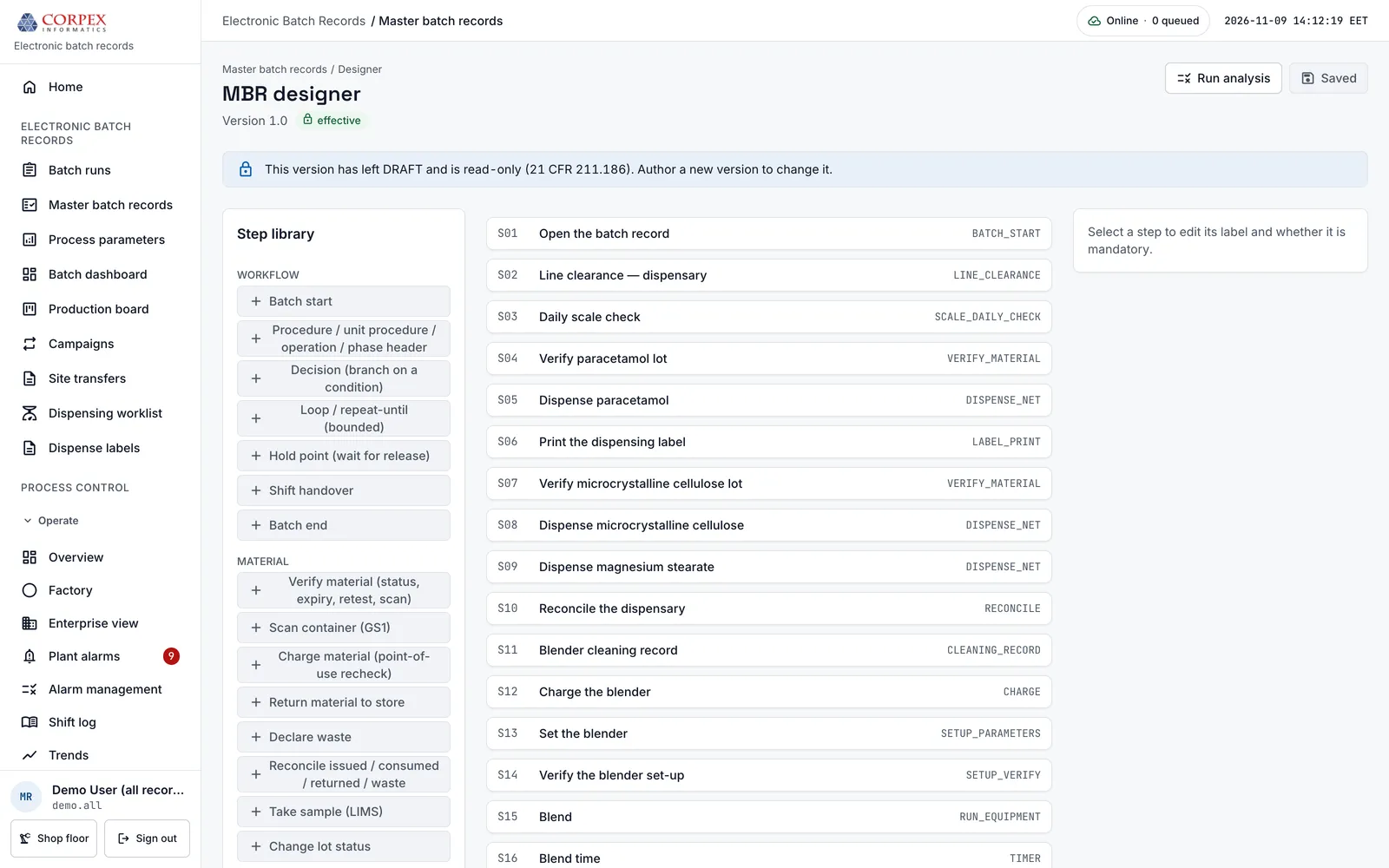
Review the findings, not 150 pages
Exceptions are raised while the batch runs, graded critical, major, minor or info, and listed in an exception-only review view. SFDA GMP v4.4, Chapter 4, in the note under the batch processing record, says that where a validated process is continuously monitored and controlled, automatically generated reports may be limited to compliance summaries and exception / OOS data reports. Corpex-EBR allows review by exception only when the process is marked validated and continuously monitored; otherwise it is a full review.
- 24 exception rules cover limits, sequence, late entry, missing signatures, yield and alarms.
- The audit-trail reviewer is refused if they took part in the activities under review.
- Open deviations block release until they are dispositioned.
The Qualified Person signs last, and knows what is open
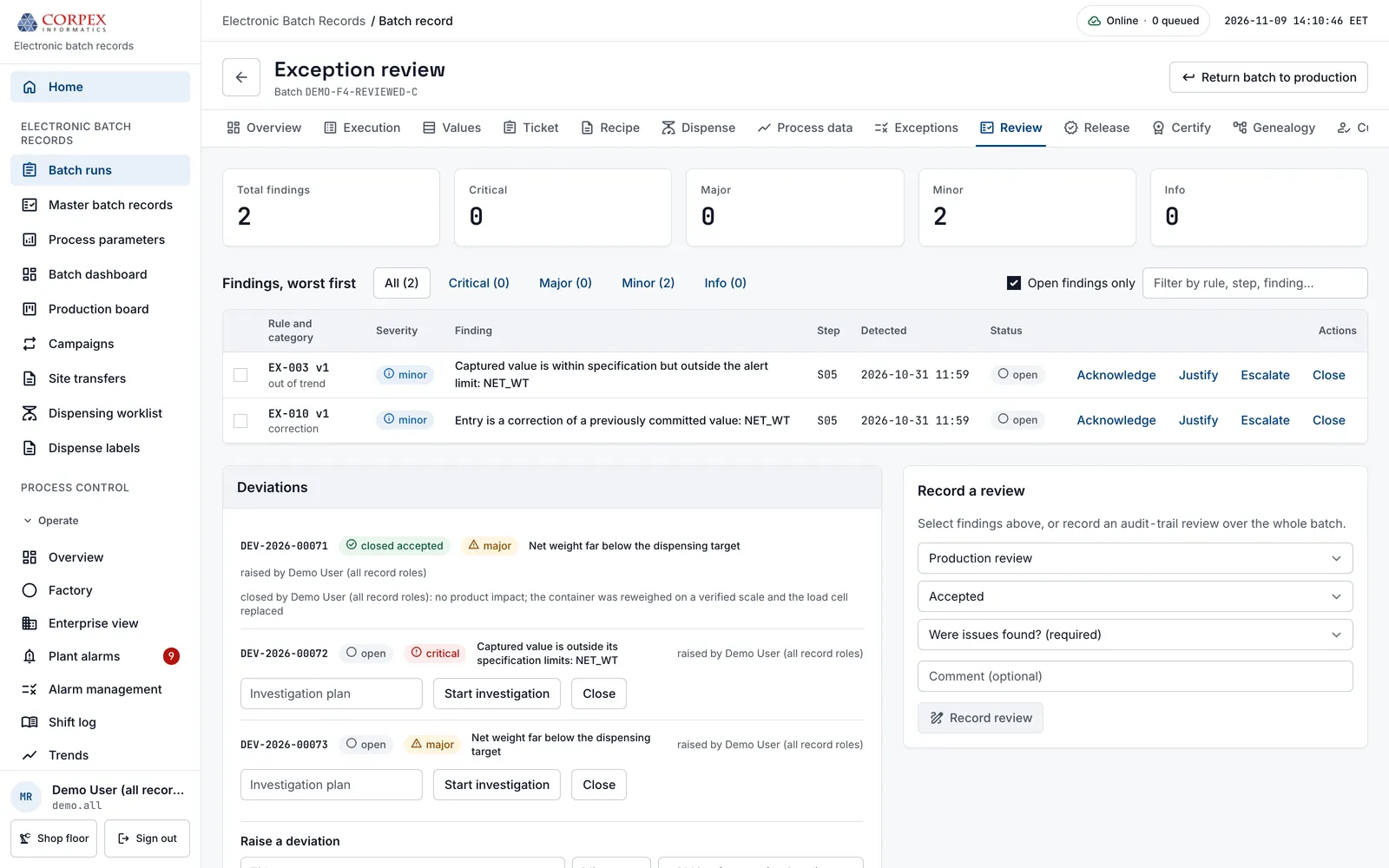
In Saudi Arabia the SFDA guide names the Qualified Person as the person who certifies each batch. Certification follows QA disposition as its own step. The QP records the market, a declaration and, where applicable, a registration reference, and signs with a fresh authentication, not the login session.
- Limited to the Qualified Person role, with the certifying person recorded.
- Refused until QA has completed its disposition.
- Release is possible for a batch executed partly on paper, with the hybrid record set defined.
One gate lists everything that must be true
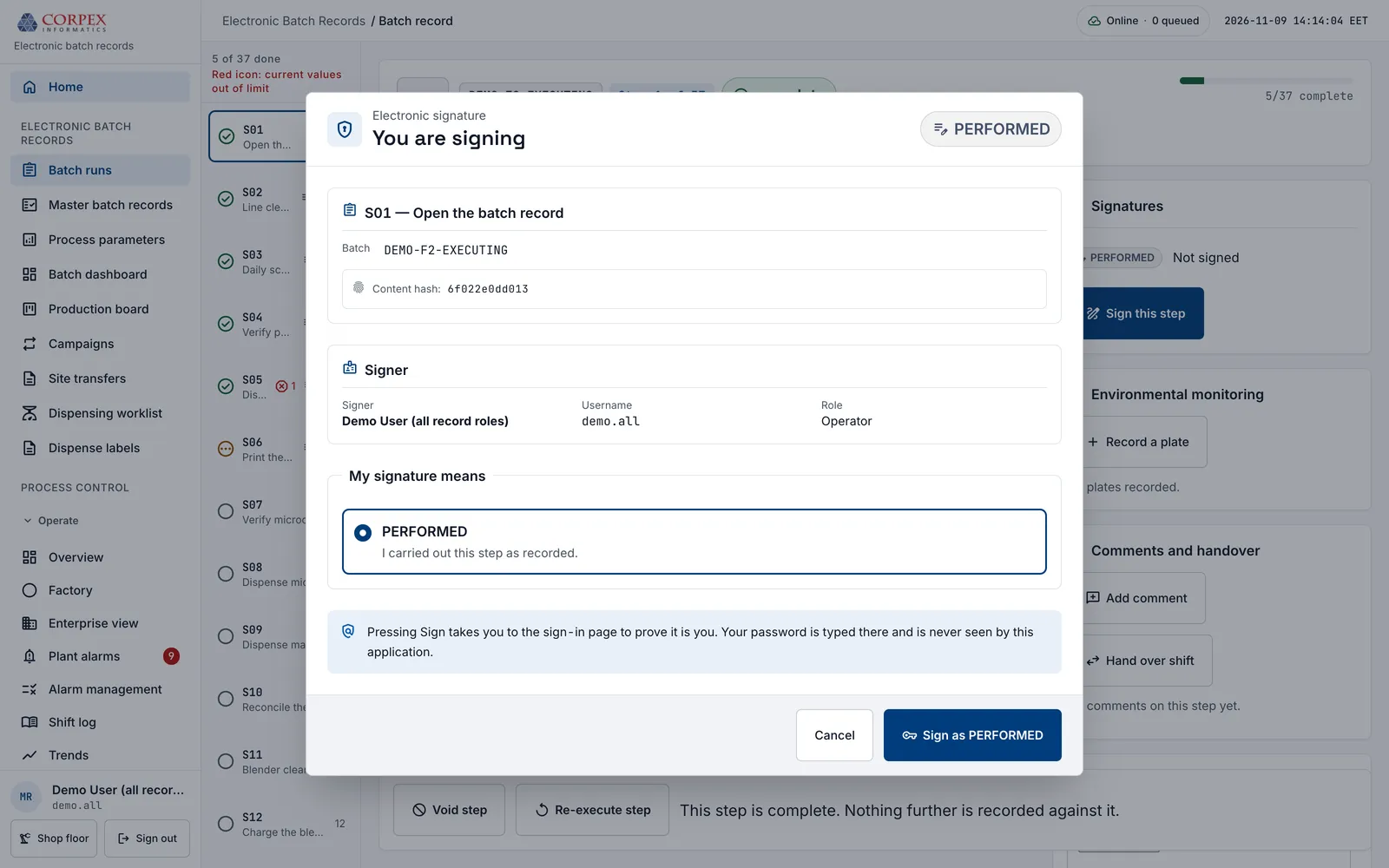
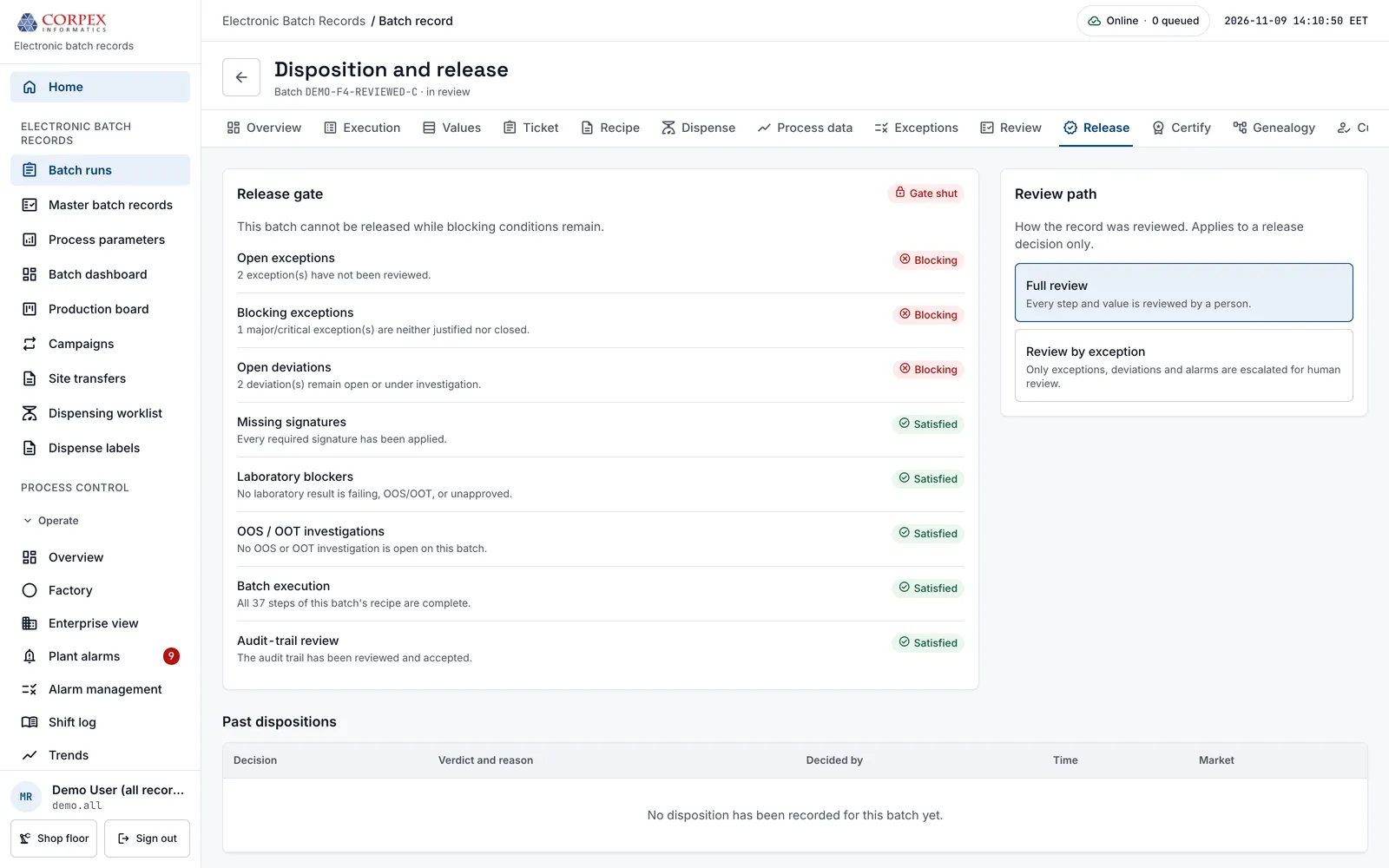
The gate checks exceptions, deviations, signatures, laboratory results, OOS or OOT investigations, batch execution and audit-trail review. While any is open, the gate stays shut and says why. The same record prints as a PDF/A-3b true copy for inspection, with the audit trail on request.
Where the Data Lives, and in Which Language
On your servers or private cloud
Corpex-EBR is installed in your environment, so batch records, signatures and audit trails can sit on infrastructure you place in Saudi Arabia. Operator names in those records are personal data under the Personal Data Protection Law (Royal Decree M/19), which SDAIA administers. This describes where the system runs. It is not a certification, and transfers abroad are for you and your legal adviser to decide.
The record survives the network
Sign-in is self-hosted, so the shop floor can authenticate when the wide-area link is down. Time comes from the server, not the operator's device, and offline entries are flagged in the record, the PDF and the audit trail.
Language
The screens are in English. A master batch record version can carry instruction text in more than one language, and a version that declares a language cannot go effective until that language is approved. There is no Arabic interface today.
The Batch Record Behind the RSD Barcode
RSD is SFDA's drug track-and-trace system. SFDA describes a 2D barcode on each pack that carries the expiry date, batch number, GTIN and a serial number. Serialisation is done on the packaging line and in your serialisation system. Corpex-EBR does not serialise packs and has no RSD integration. It can emit batch events (commissioning, aggregation, transformation) as GS1 EPCIS 2.0 events that a serialisation or track-and-trace system can consume. It holds what stands behind the batch number: the executed process, the signatures, the exceptions and the release decision.
More for Saudi Manufacturers
LIMS for Saudi Arabia
Laboratory results that feed the release gate.
eQMS for Saudi Arabia
Deviations and change control behind the batch record.
Corpex-EBR, global overview
All areas of the product, shown in the application.
Book an Online Demo
Book an online demo and we will walk one batch from recipe to QP certification with you. Or meet us in Riyadh during CPHI Middle East, 26–28 April 2027. Corpex is based in New Capital, Egypt, and serves the region.
Book an online demoElectronic Batch Records in Saudi Arabia: Questions
Who certifies a batch in Saudi Arabia, and can Corpex-EBR record it?
The SFDA Guide to Good Manufacturing Practice for Medicinal Products includes an Annex 16, "Qualified Person and Batch Release", which makes the Qualified Person (QP) responsible for confirming that each batch was made and checked in line with Saudi law, the marketing authorisation and GMP. Corpex-EBR records QP certification as its own signature step after QA disposition. Only users with the Qualified Person role can sign it, the certifying person is recorded, and it is refused until QA has completed its disposition.
Does SFDA GMP say anything about electronic batch records and signatures?
Yes. Annex 11 in the SFDA GMP guide covers computerised systems. Section 15 says that when a system records certification and batch release, it should allow only Qualified Persons to certify, should identify and record the person certifying, and that this should be done with an electronic signature. Section 8.2 asks that printouts supporting batch release can show whether data changed after the original entry. Corpex-EBR is built to those points; your validation and procedures still decide whether your site complies.
Is SFDA a PIC/S member, and what does that mean for a batch record?
SFDA became a PIC/S Participating Authority on 1 July 2023. For a manufacturer it means SFDA GMP inspections sit inside the same inspection scheme as many European and other regulators, so records are read against familiar expectations: traceable entries, an audit trail that is reviewed, and signatures that cannot be repudiated. Corpex-EBR keeps the audit trail on at all times and cannot be switched off by any user, including administrators.
Can we use review by exception in Saudi Arabia?
SFDA GMP v4.4, Chapter 4, says that where a validated process is continuously monitored and controlled, automatically generated reports may be limited to compliance summaries and exception / OOS data reports. Corpex-EBR allows review by exception only when the process is marked validated and continuously monitored; otherwise the reviewer follows the full-review path. In both cases the release gate stays shut while exceptions, deviations, missing signatures or open laboratory investigations remain.
Can the system and its data stay inside the Kingdom?
Yes. Corpex-EBR installs on your own servers or private cloud, so batch records, signatures and audit trails can stay on infrastructure you place in Saudi Arabia. Batch records contain operator names, which is personal data under the Saudi Personal Data Protection Law (Royal Decree M/19), which SDAIA administers. Where you transfer data outside the Kingdom is a decision for you and your legal adviser. This is a statement about where the system runs, not a certification.
How long must batch records be kept?
Chapter 4 of the SFDA GMP guide says batch documentation is kept for one year after expiry of the batch, or at least five years after certification by the Qualified Person, whichever is longer. Corpex-EBR computes the retention date for each batch from its own dates using a per-market rule table, blocks deletion inside the retention window at database level, and supports legal holds.
Does Corpex-EBR connect to the SFDA RSD track-and-trace system?
No, and we do not claim an integration. RSD is SFDA's drug track-and-trace system. According to SFDA, each pack carries a 2D barcode with expiry date, batch number, GTIN and a serial number. That serialisation happens on the packaging line and in the serialisation system. Corpex-EBR can emit batch events as GS1 EPCIS 2.0 events that a serialisation or track-and-trace system can consume. It is the batch record behind the batch number: it holds the executed process, the signatures and the release decision. We can discuss how your serialisation system and the batch record line up for your site.
Is the Corpex-EBR interface available in Arabic?
The screens are in English today. A master batch record version can carry instruction text in additional languages, and a version with a declared language cannot become effective until that language has been approved. We do not offer an Arabic interface, and we say so rather than promise one.