
21 CFR Part 11
Electronic records & signatures
Signing re-authenticates the user. Each signature shows printed name, date and time with time zone, and its meaning, and is bound to the record. The audit trail is always on and cannot be edited.
Corpex-EBR is electronic batch record software for pharmaceutical manufacturers. It runs the master batch record on the shop floor, enforces sequence and limits while the batch runs, collects electronic signatures, and hands QA and the Qualified Person a record that is ready to review by exception.
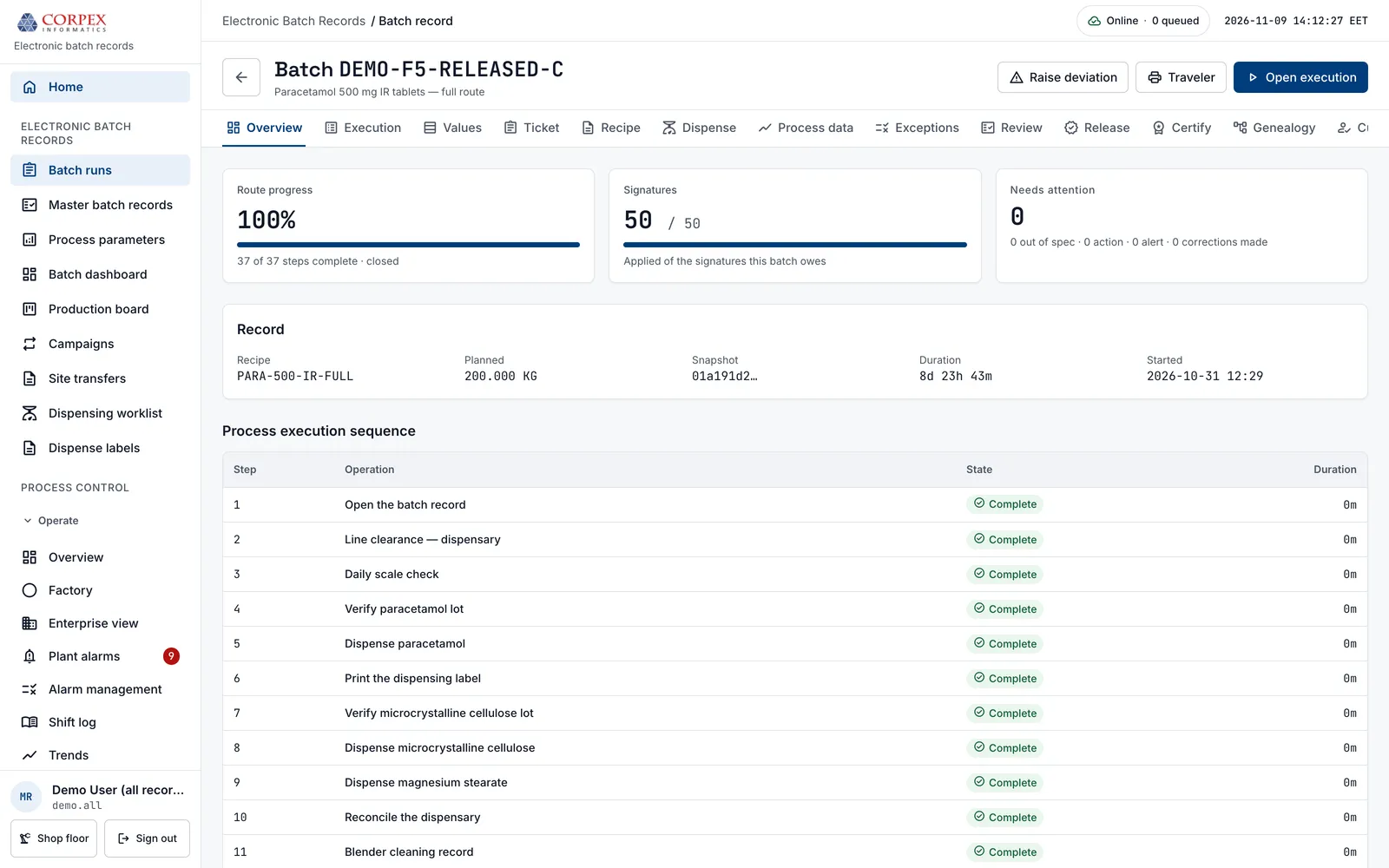
Every batch follows these seven states. A batch can also be put on hold, rejected back to production or aborted, and nothing is ever deleted.
An eBMR is only as good as the path a batch takes through it. Each step hands the same record to the next, so nothing is retyped and nothing is skipped.
Pick an area to see its screen. Every screenshot is taken from Corpex-EBR running on demo data.
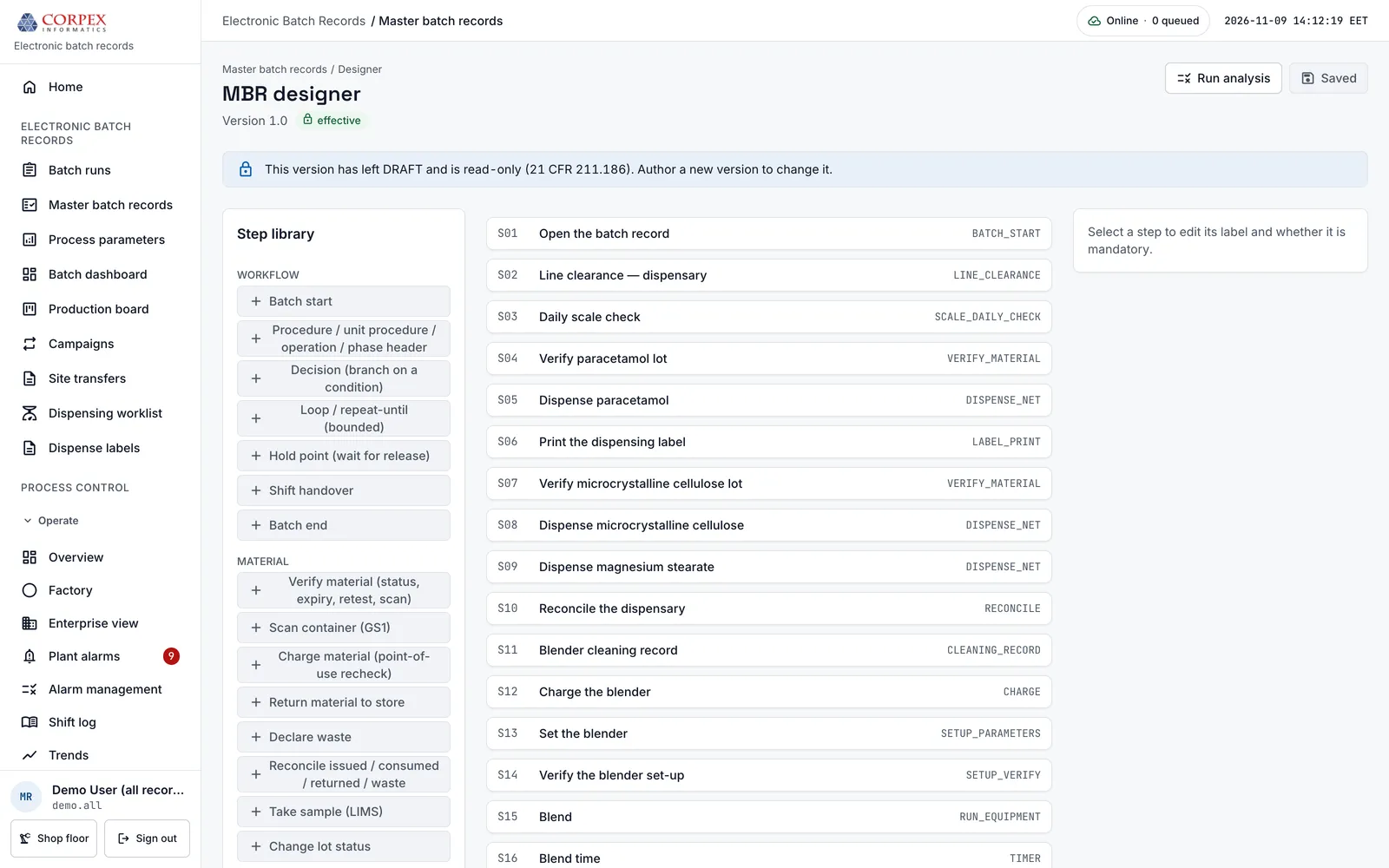
Author the recipe once, approve it, and every batch runs on a frozen copy.
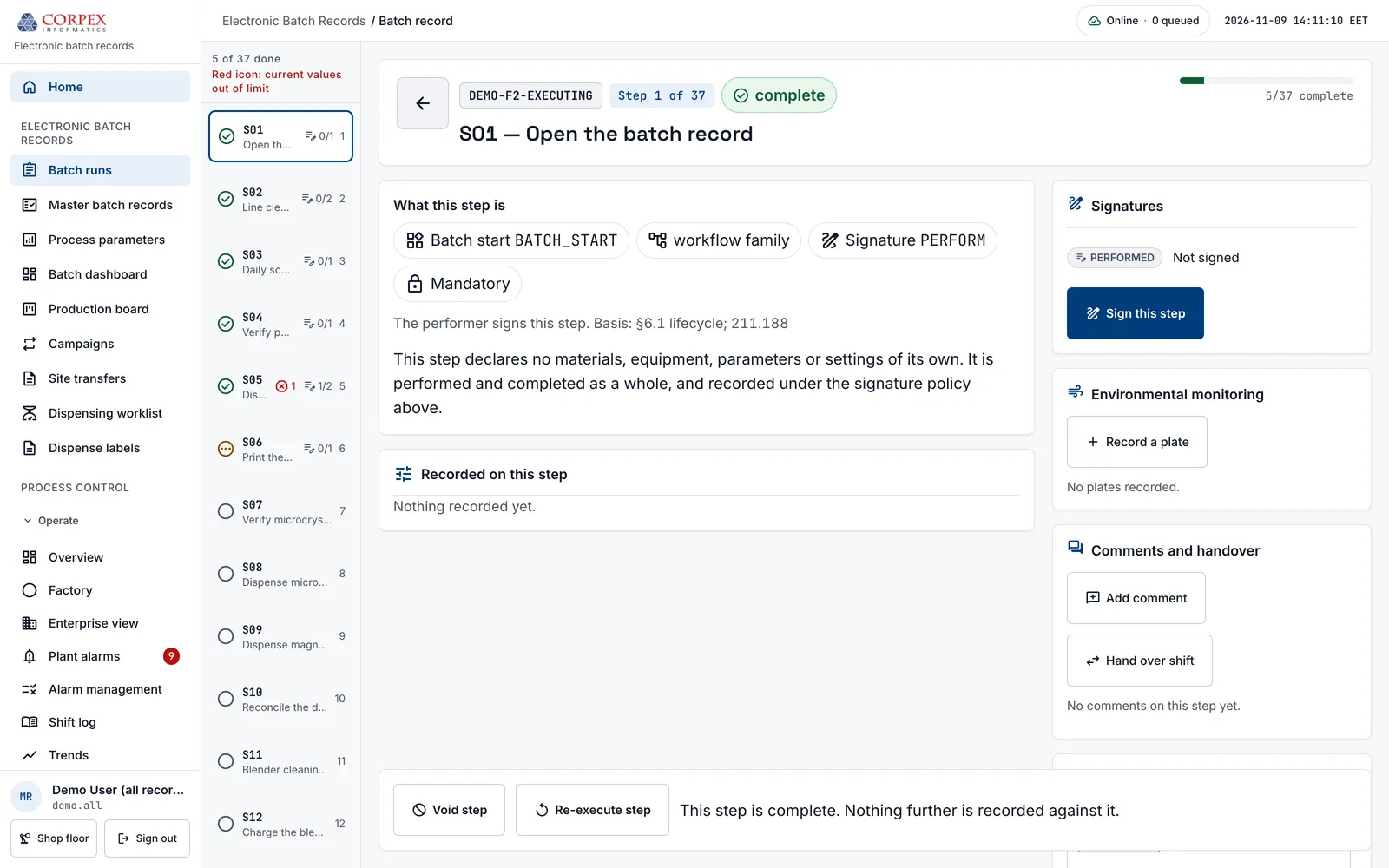
The operator sees one step at a time, with the signature the step needs.
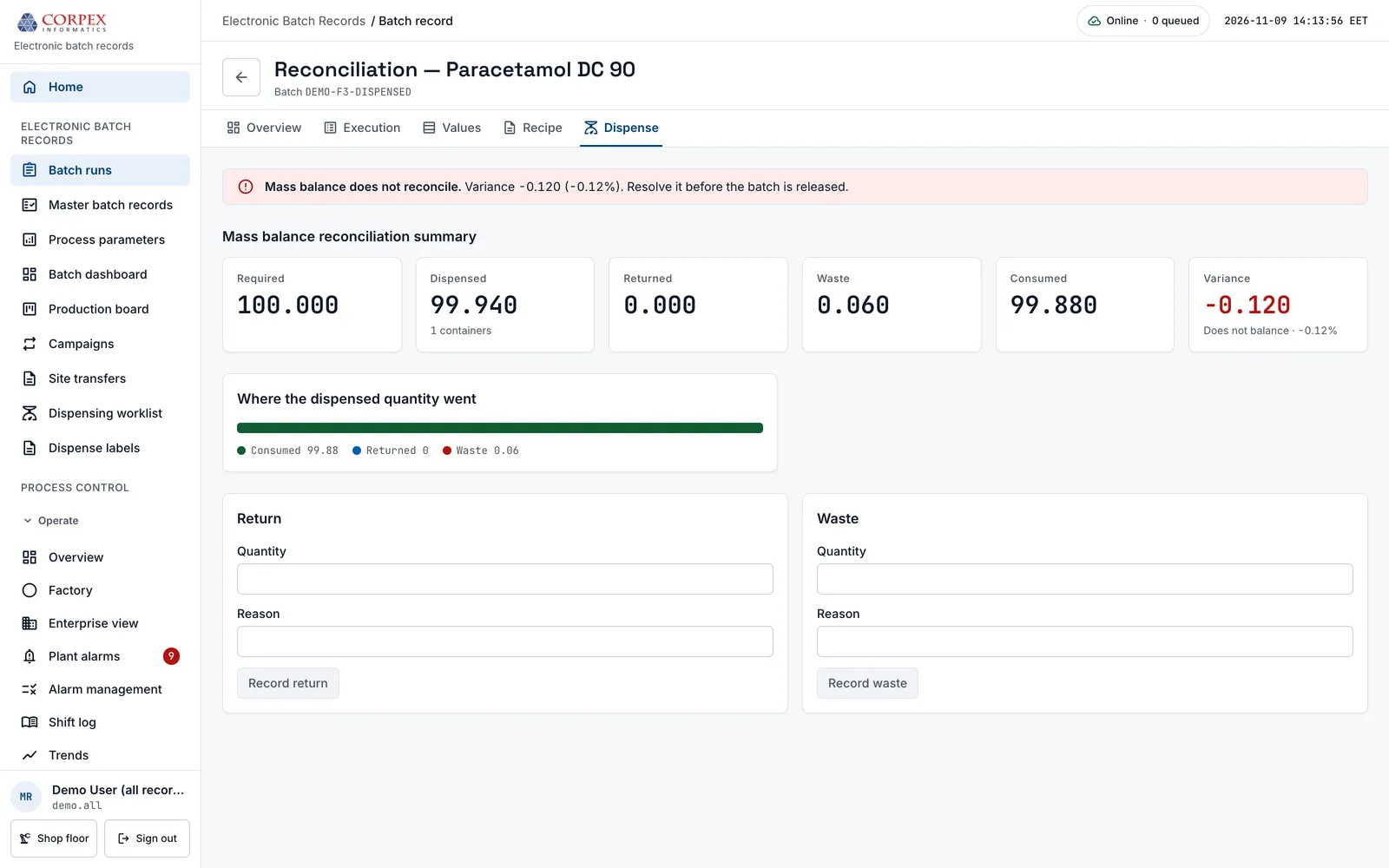
Weigh against the target, and see where every kilogram went.
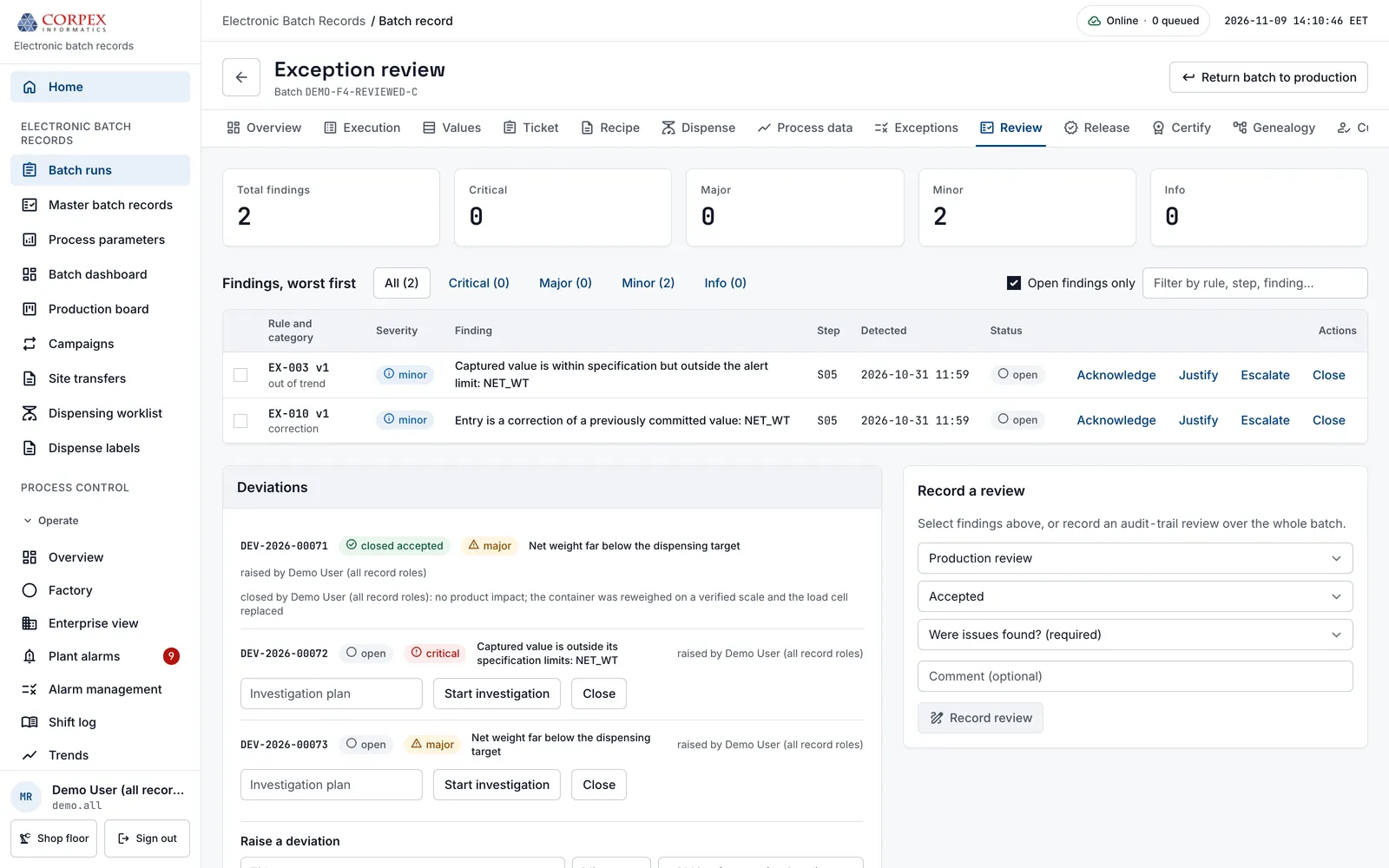
Findings are raised while the batch runs, then handled by a person.
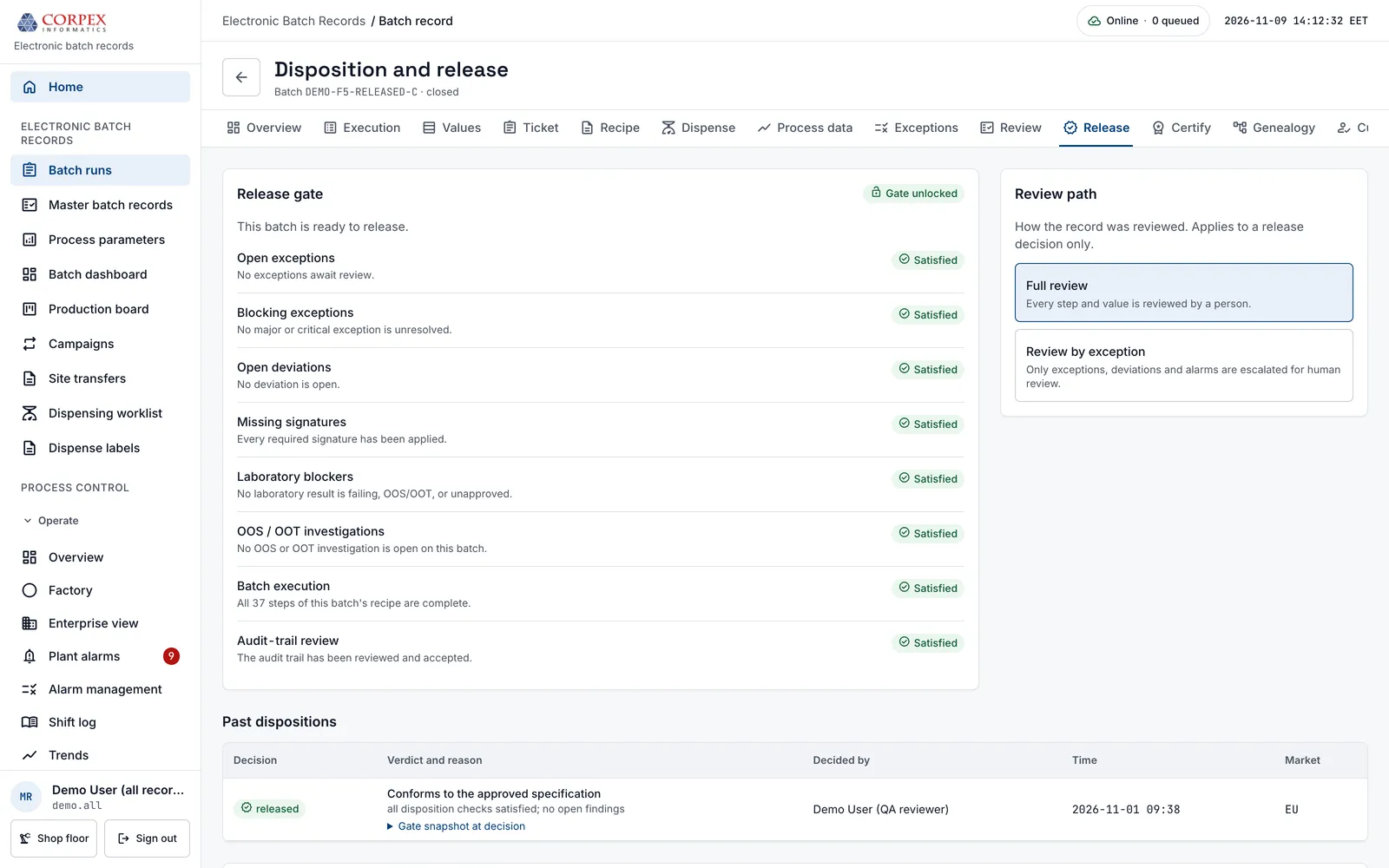
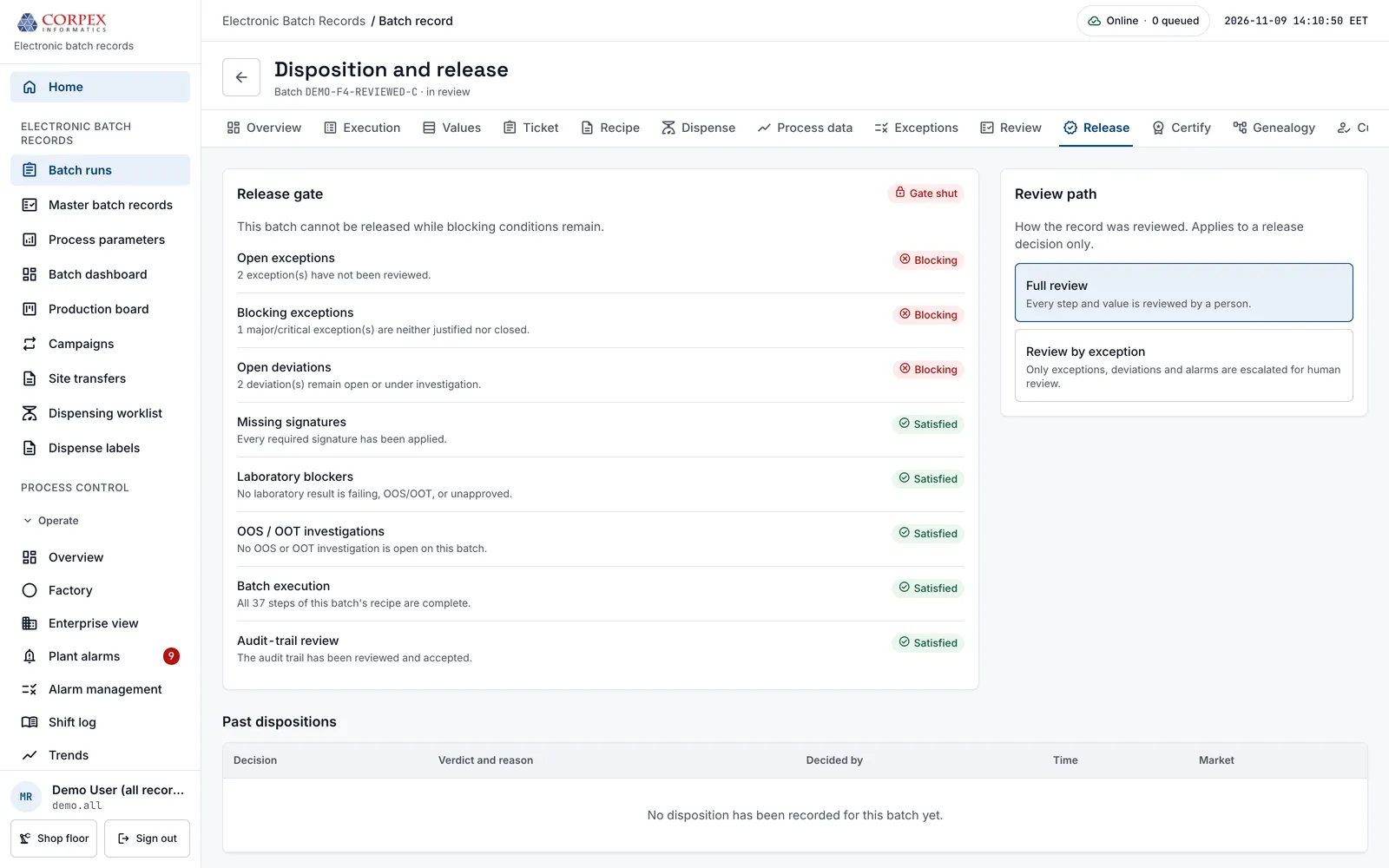
One gate lists everything that must be true before QA releases.
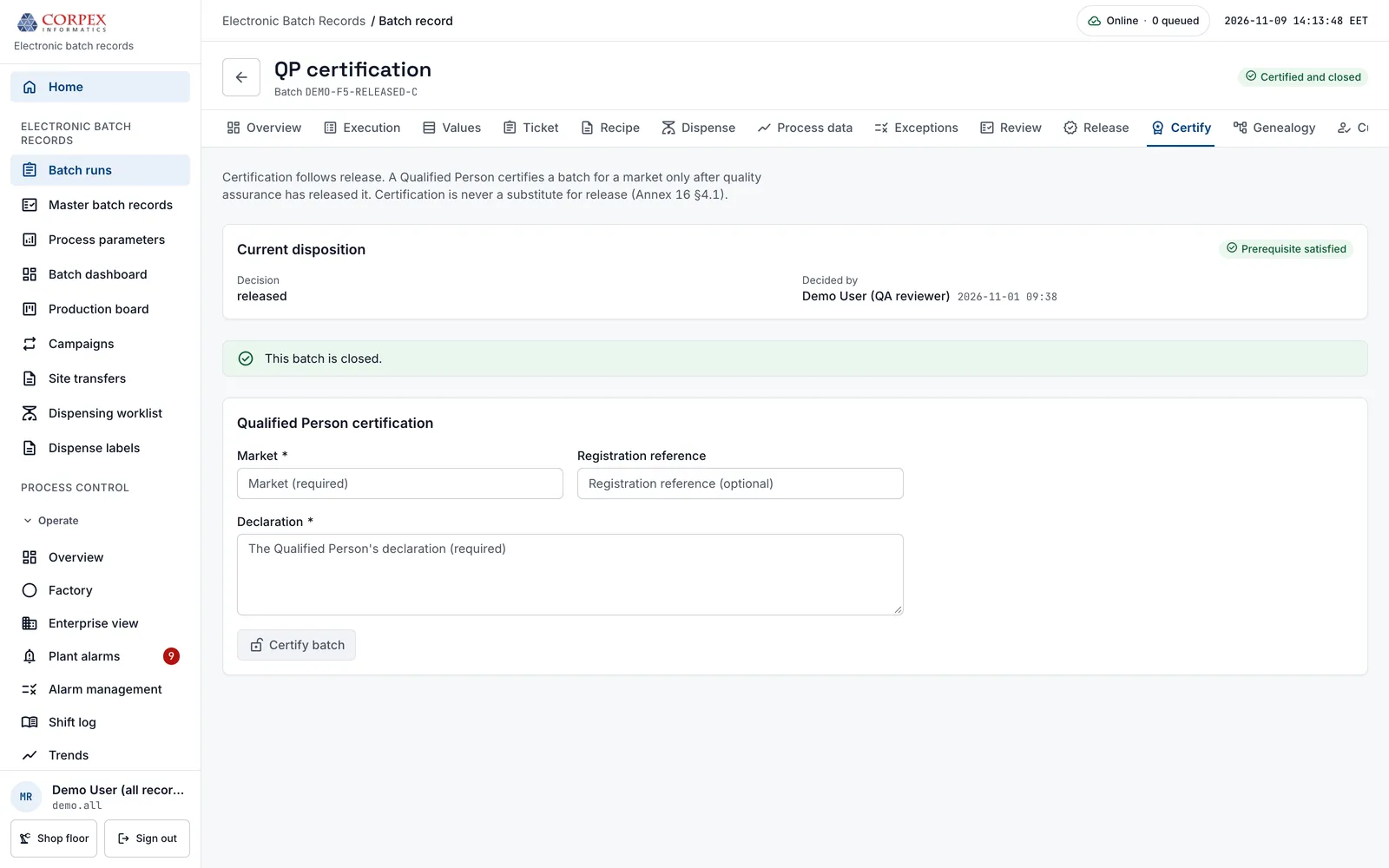
Certification follows release, and only a Qualified Person can sign it.
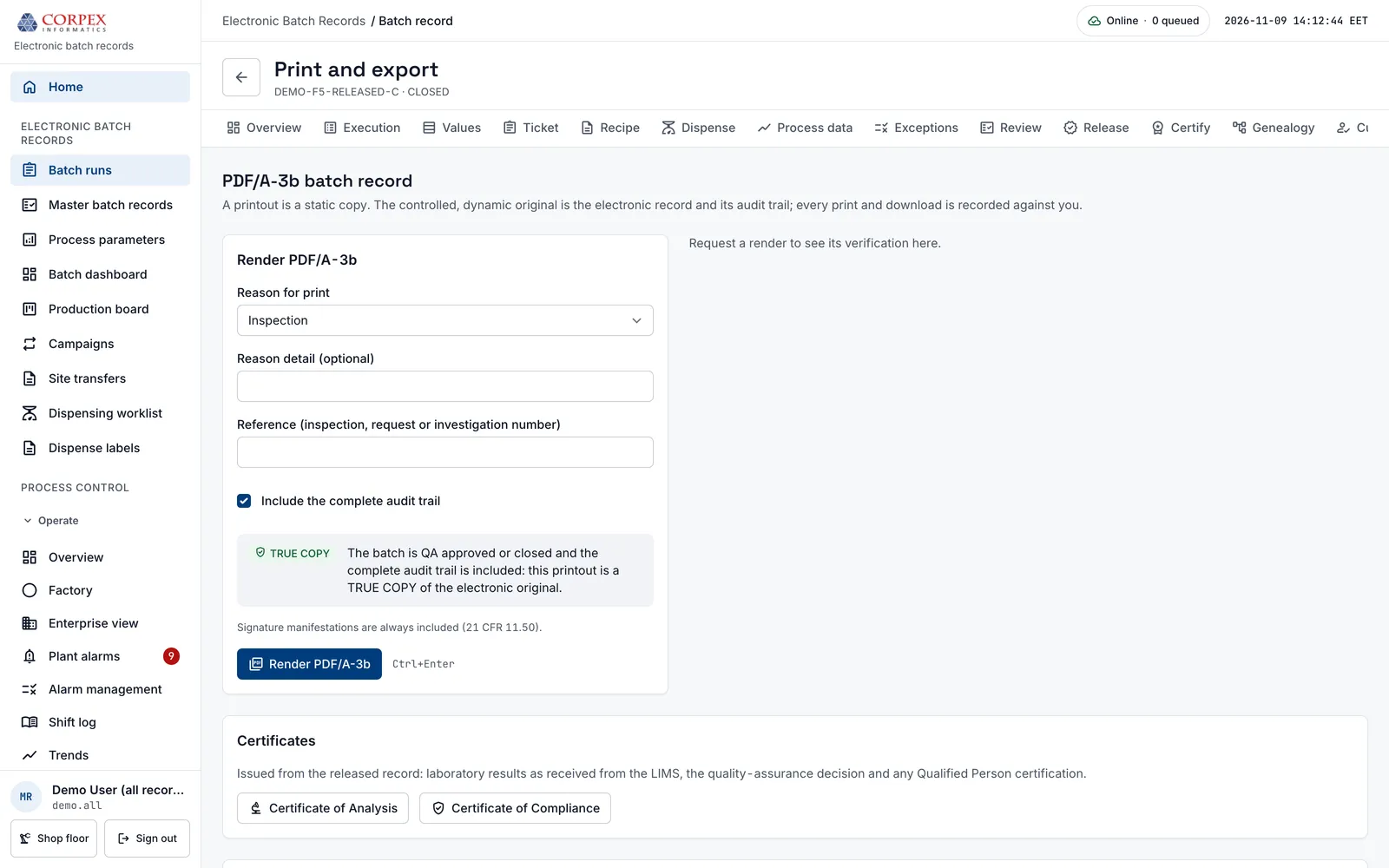
The dynamic record stays the original. The PDF is a labelled copy.
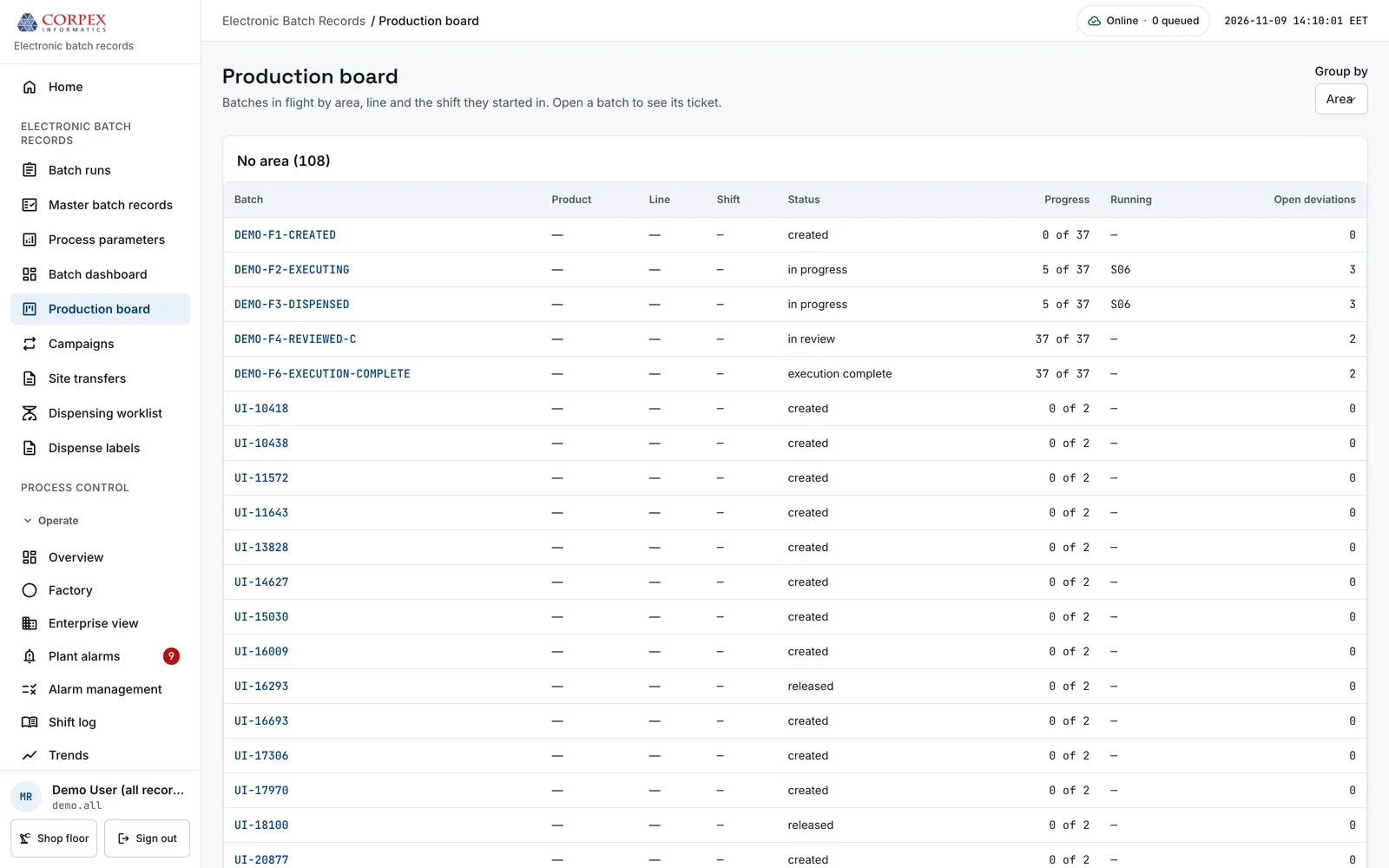
See every batch in flight, by area, line and shift.
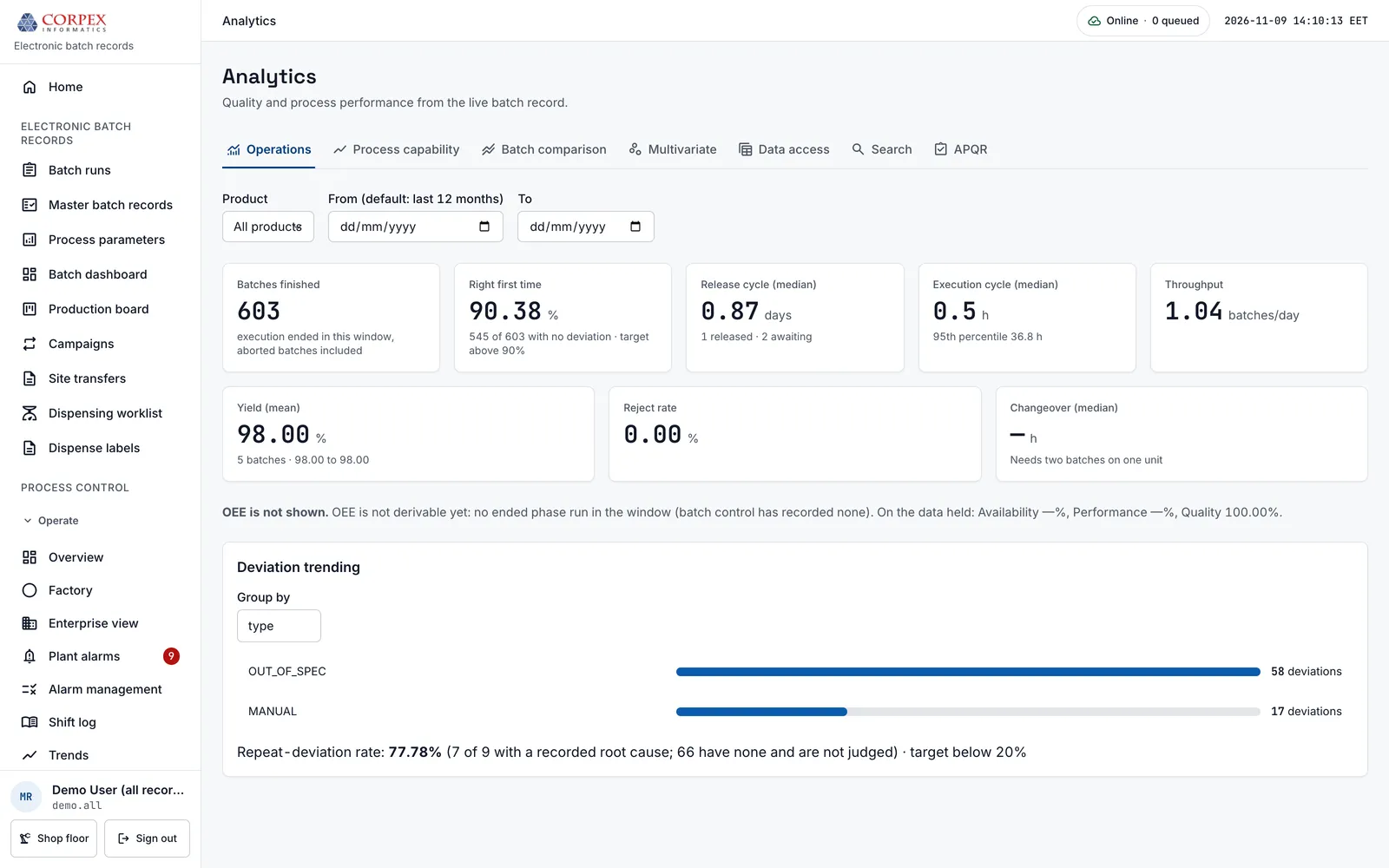
Quality and process performance from the live batch record.
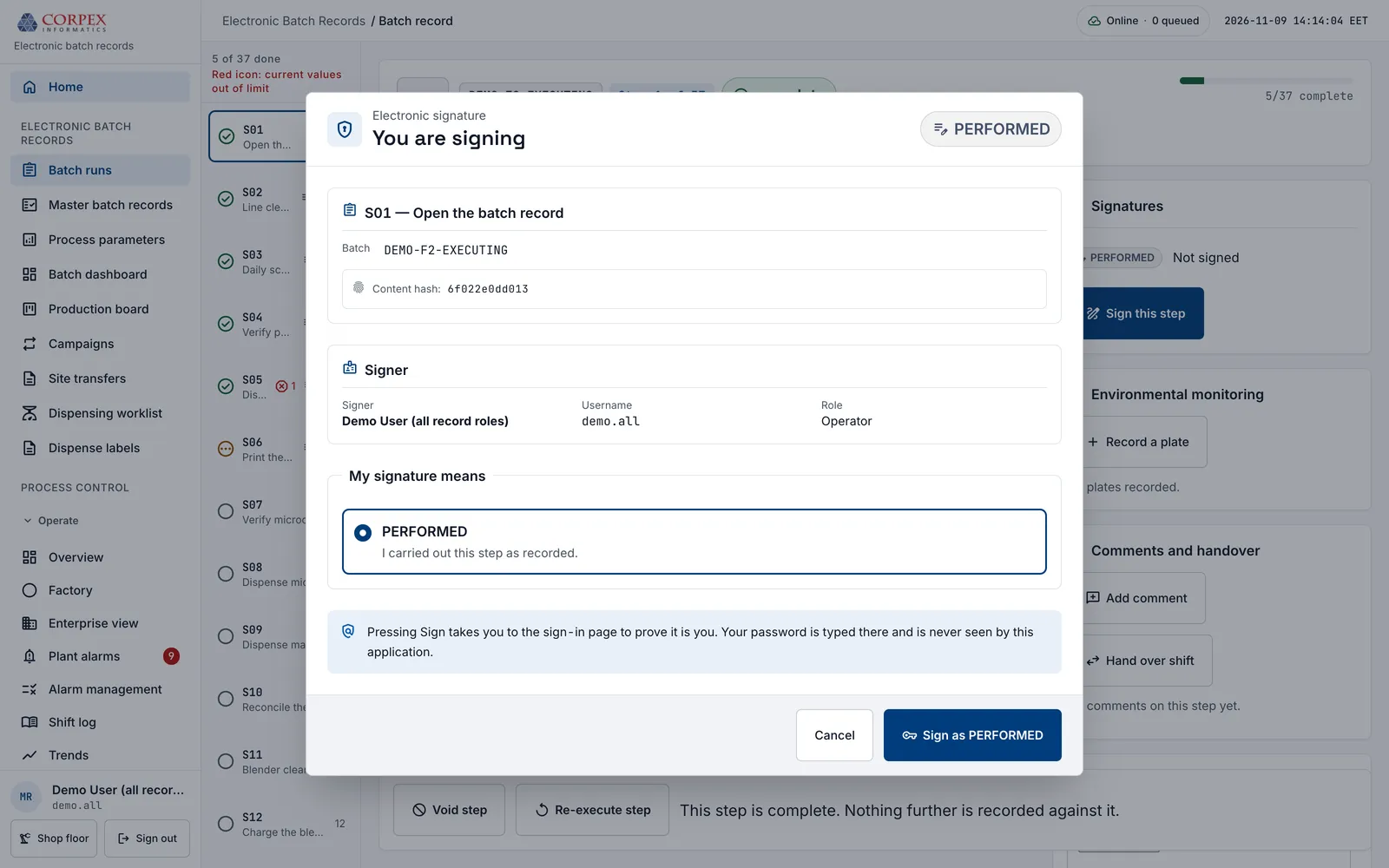
Signing does not inherit the login. The operator picks the meaning of the signature from the list the step allows, is taken to the sign-in page to prove identity, and the signature is bound to the record. If any signed content changes afterwards, the record shows as tampered.
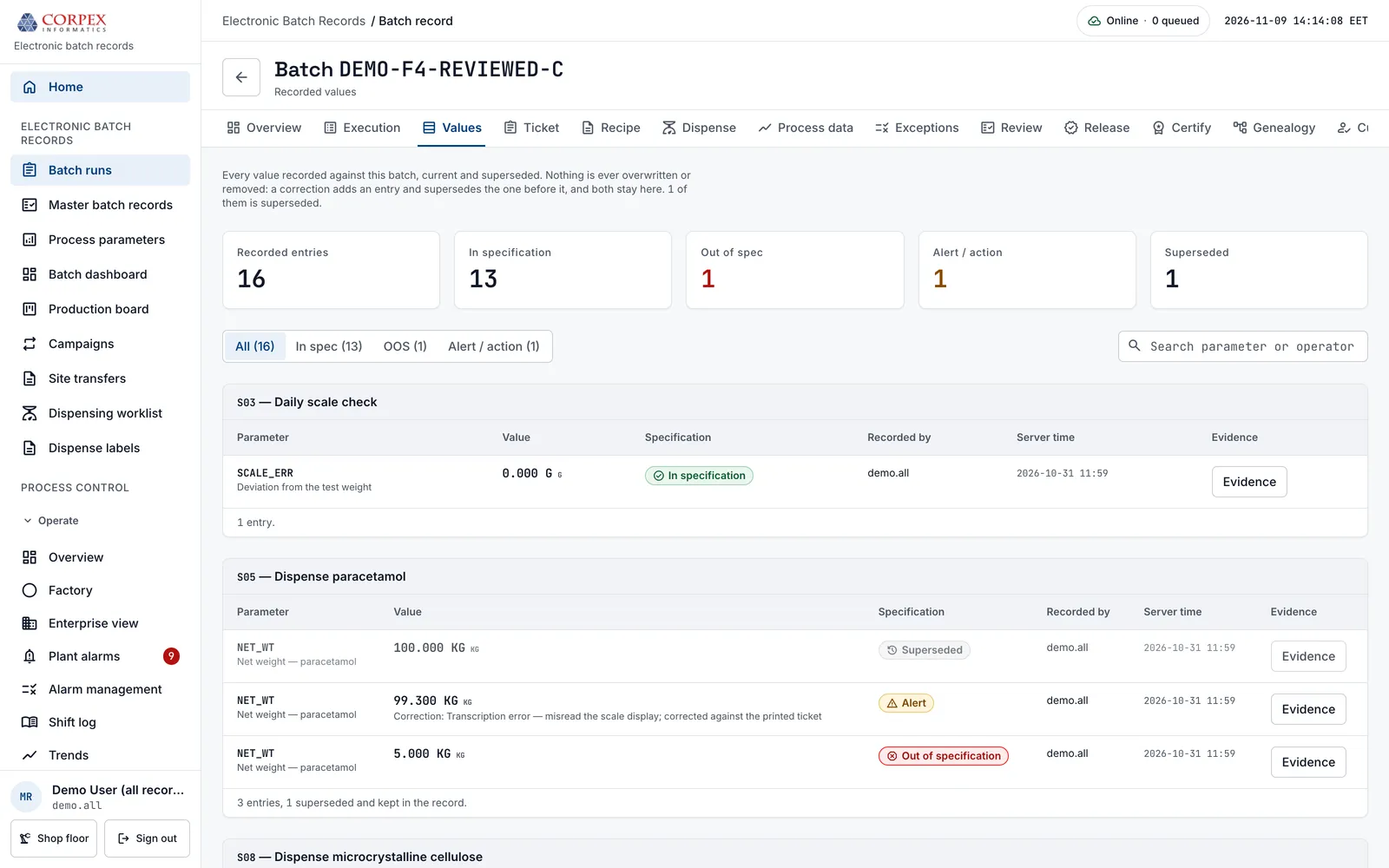
Mistakes happen on the shop floor. In Corpex-EBR the corrected value supersedes the earlier one with a reason, and both stay in the record, so the reviewer sees the original, the correction and who made it.
Release is not a button anyone can press. The gate lists each condition and whether it is satisfied. While exceptions, deviations, missing signatures or laboratory results are open, the gate stays shut and says why.
Each batch holds a frozen copy of the approved master version it was created from, with its content hash.
Performer and verifier are different people, in sequence, and every signature prints with name, date, time zone and meaning.
A correction supersedes the earlier value with a reason. The original entry stays in the record and prints as changed.
Exceptions are raised as they happen, graded, and linked to a deviation where one is needed.
The audit-trail reviewer is refused if they took part in the activities under review. The release gate shows what is still open.
A PDF/A-3b copy with the audit trail, labelled as a true copy, and carrying the identifier and hash of its source record.
Each card names the control in Corpex-EBR that answers the requirement.
Electronic records & signatures
Signing re-authenticates the user. Each signature shows printed name, date and time with time zone, and its meaning, and is bound to the record. The audit trail is always on and cannot be edited.
Computerised systems
Role-based access enforced on the server, a hash-chained audit trail, time taken from the server rather than the client, and checks on accuracy at critical entry.
Master production record
Master records are approved with author and checker as different people, and an approved version cannot be edited. A change creates a new version.
Batch production record
Each batch embeds the exact master version it started from and records every step with the person and the time.
Production record review
The release gate holds a batch until exceptions, deviations and missing signatures are dealt with and the audit trail has been reviewed.
Documentation
A controlled recipe, a complete record that cannot be overwritten, and a review-by-exception path that follows the conditions Chapter 4 sets.
Certification by a Qualified Person
QP certification is its own step after QA release, limited to the QP role, with market, reference and declaration recorded.
Data integrity
Entries are attributable, time-stamped on the server and kept in original form. Corrections add a new entry and leave the old one in place.
Compliance belongs to the validated system and the procedures around it. Corpex-EBR supplies the technical controls, and the Corpex validation team documents them for your inspection, using a risk-based approach in line with GAMP 5. See computer system validation.
A paper batch record is read page by page after the batch is finished. Corpex-EBR moves the checking into the batch itself, so the reviewer starts from a short list of findings. It works alongside CORPEX-ERP, CORPEX LIMS and CORPEX-eQMS, and is validated like any other GxP computerized system through computer system validation (CSV).
Master batch records are versioned and approved. A new version never changes a batch already running on the old one.
Defined interfaces for ERP production orders and consumption, LIMS samples and results, and label printers.
Configuration, training and validation delivered by the Corpex team, then supported after go-live.
Book a demo and we will walk one batch through dispensing, execution with signatures, exceptions and release with you.
Request a DemoAn electronic batch record is the batch manufacturing record kept as data instead of paper. The approved recipe tells the operator what to do, each step is recorded as it happens with the person and the time, and the system refuses out-of-sequence work. It is also called an eBMR (electronic batch manufacturing record).
A paper record is checked after the batch has run. In Corpex-EBR the recipe is enforced while the batch runs: a step cannot start before its prerequisites, values are checked against limits as they are entered, and out-of-limit results raise an exception on the spot instead of being found at review.
Reviewers do not re-read every entry. The system lists only the findings that need a person: out-of-limit values, bypassed controls, missing signatures, late entries, open deviations. In Corpex-EBR the review-by-exception path is available only when the market configuration permits it and the process is flagged as validated and continuously monitored. Otherwise the reviewer follows the full-review path.
It provides the technical controls those rules call for: unique user accounts, role-based access, a time-stamped audit trail that cannot be switched off or edited, and electronic signatures that re-authenticate the signer and show printed name, date and time with time zone, and the meaning of the signature. Compliance belongs to the validated system and your procedures; the Corpex team documents the controls for your inspection.
Yes. QP certification is a separate step that follows QA release and is limited to the Qualified Person role. The QP records the market, an optional registration reference and a declaration. Certification is refused until the batch has been released.
Corpex-EBR has defined interfaces for ERP production orders and material consumption, LIMS samples and results, and label printers. A deviation raised on the shop floor can carry a reference to your eQMS record. See also Corpex-ERP, Corpex LIMS and Corpex-eQMS.
Corpex-EBR comes with validation documentation written around GAMP 5: a validation plan, a risk assessment method and qualification protocols. The Corpex validation team carries out the validation with you; see our computer system validation services.
Yes. Entries made offline are held on the device and sent when the connection returns. They carry the capture time evidence and are flagged as offline in the batch record, the PDF and the audit trail. A sync conflict is never resolved silently; it goes to a person.