
Product Quality Review (PQR) Software
Your annual product reviews, without the chase. Corpex eQMS turns each PQR into one review record per product, per period: data in, statistics calculated, sections mapped to the regulations, signed electronically.
Watch: a product quality review in Corpex eQMS
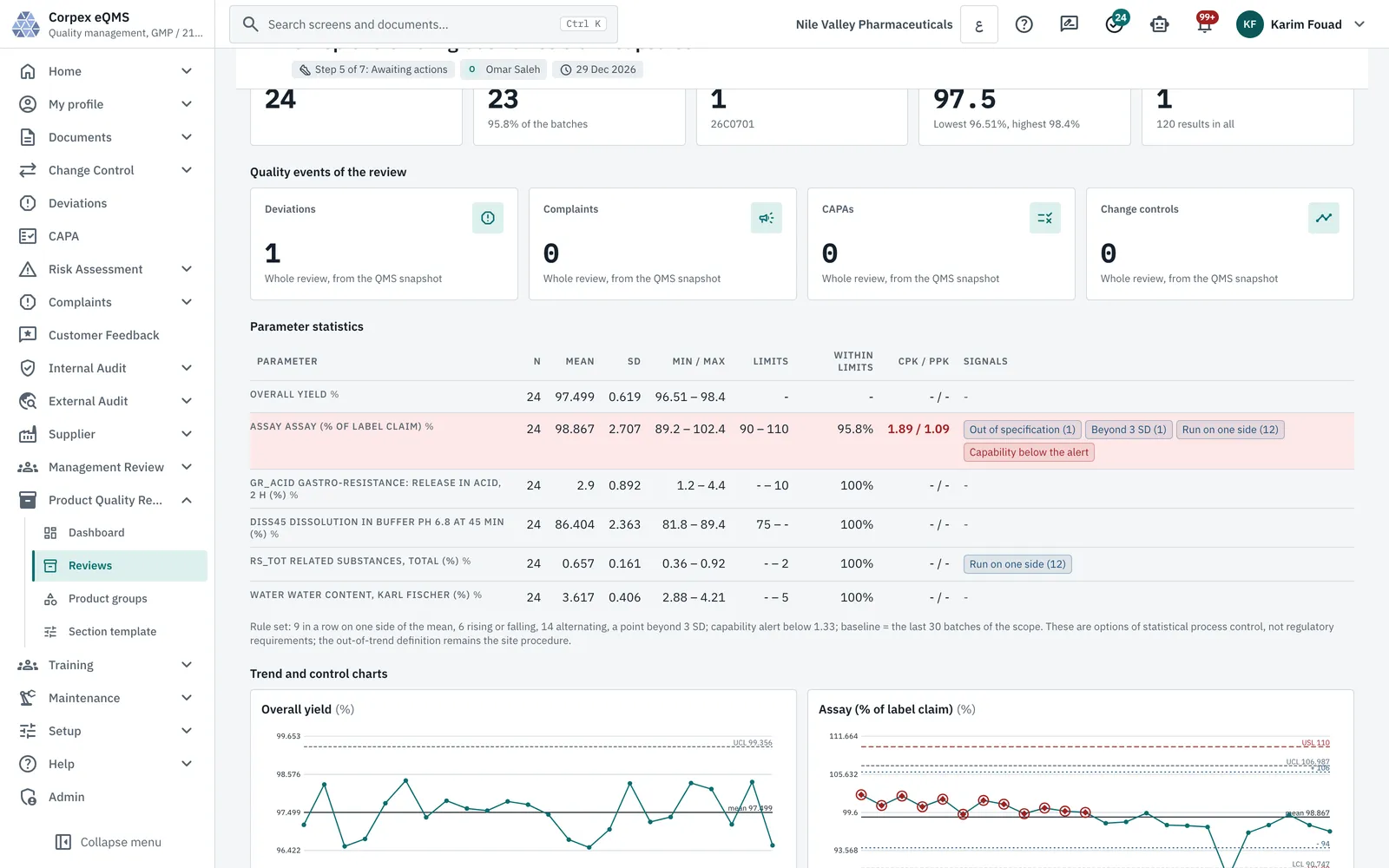
Eight manual hand-offs become one review record: plan, collect, trend, evaluate, act and sign.
Every Batch You Made This Year Has to Be Reviewed
EU GMP Chapter 1 (section 1.10) requires a regular product quality review of every licensed product; 21 CFR 211.180(e) requires the annual product review in the US.
Done by hand, a PQR means e-mailing departments, copying results into spreadsheets, working out capability by hand and chasing signatures. Corpex eQMS, part of CORPEX-eQMS, turns it into one review record per product, per period.
Manual PQR vs Corpex eQMS: the Eight Steps
The time saved is in the hand-offs removed.
| Manual | In Corpex eQMS |
|---|---|
| Track which products are due in a spreadsheet | The scheduler opens each review on time; the dashboard shows coverage |
| E-mail QC, production and the warehouse for batch data | Batch data imported from Excel / LIMS sheets, checked before it is saved |
| Copy results into spreadsheets and check the formulas | One validated grid: formulas refused, duplicates ignored |
| Work out Cpk and trends by hand | Cpk, Ppk and trend rules calculated and flagged |
| Collect deviations, changes, complaints and CAPAs from separate logs | 15 QMS sources pulled in, frozen and hash-verified |
| Write the sections in a Word template | 16 sections mapped to EU GMP, 21 CFR and PIC/S |
| Raise CAPAs and changes in another system | One click raises the CAPA or change, linked to the review |
| Chase wet-ink signatures, scan and file | Four e-signatures; the signed PDF carries every signature |
8 manual hand-offs → 1 review record.
How a PQR Runs in Corpex eQMS
Six stages carry a review from the year's raw data to a signed report.
1. Plan
Product groups carry their review periods. A scheduler plans the year's reviews and can open them automatically, and the dashboard shows annual coverage per product group.
2. Collect
Batch data, yields, results, specifications, stability and OOS are imported from Excel or LIMS sheets. A dry run comes first, formulas are refused, and re-importing the same file changes nothing.
3. Trend
Cpk (moving-range sigma) and Ppk (overall SD), capability flagged below 1.33, and administrator-set trend rules: beyond 3 SD, runs on one side, rising or falling, alternating, out of specification.
4. Evaluate
A 16-section template mapped to EU GMP Chapter 1, 21 CFR 211.180(e) and PIC/S PE 009, with 15 quality sources frozen as hash-verified snapshots at submission.
5. Act
Each recommendation raises one CAPA or one change request, linked back to the review. The review waits until they are closed.
6. Sign
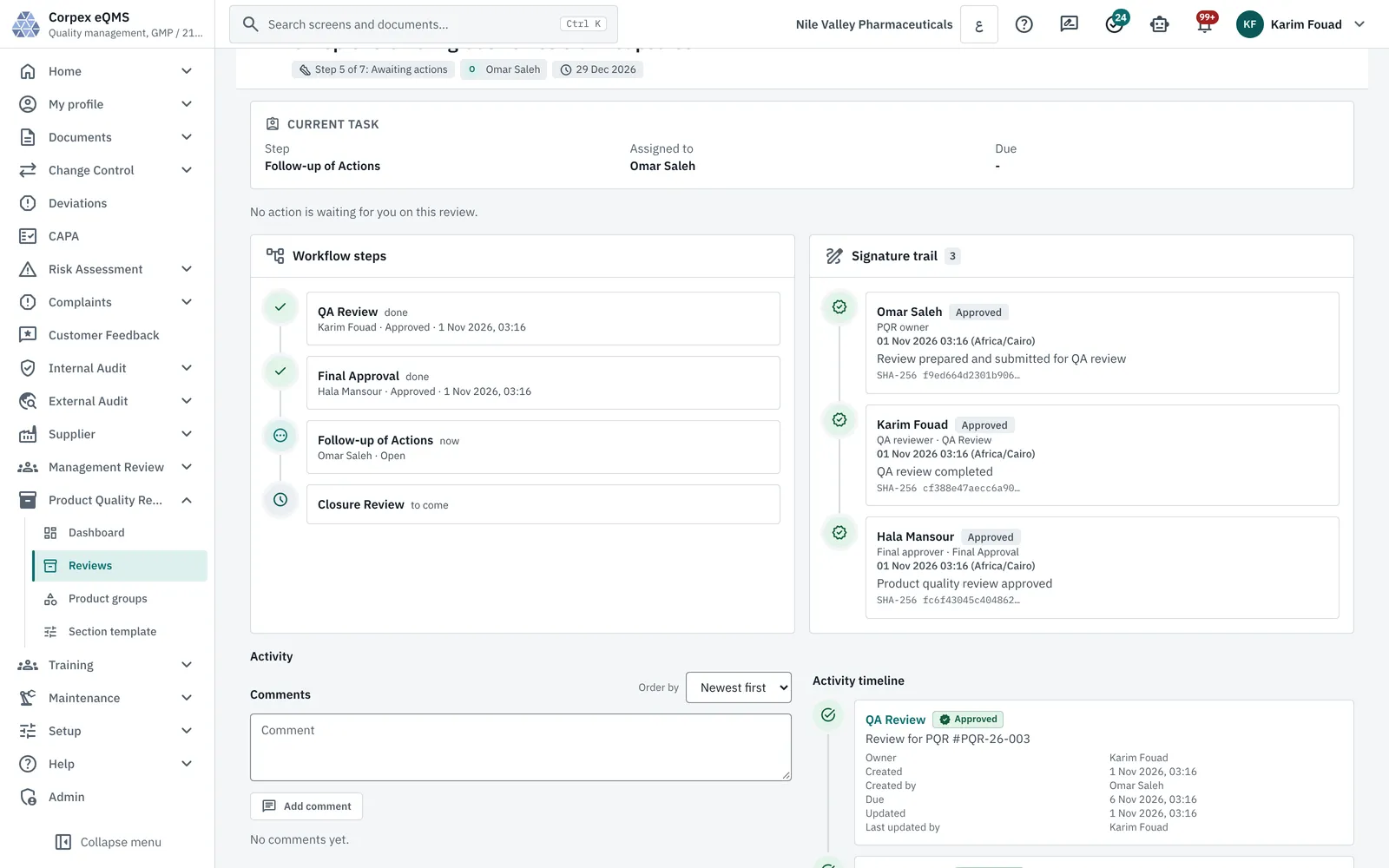
Owner, QA review, final approval, actions and closure, signed by four different people (21 CFR Part 11). Twenty checks run before submission, and the PDF report carries every signature and its hash.
Signed Before the Inspector Asks
Every step of the review is signed electronically, and each signature carries its own hash. Findings become linked CAPAs or change requests, and the review stays open until they close, so the record shows the whole loop from trend to action.
Corpex eQMS is installed on your own servers or private cloud and validated with the wider rollout; see computer system validation (CSV) services.
Product Quality Review Software — Frequently Asked Questions
What is a product quality review (PQR)?
A product quality review is the regular, usually annual, review of every licensed product required by EU GMP Chapter 1 (section 1.10). The US equivalent is the annual product review (APR) in 21 CFR 211.180(e). It looks at the period's batches, results, trends, deviations, changes, complaints, returns, stability and CAPAs to confirm the process is consistent and the specifications are still appropriate.
How does Corpex eQMS calculate Cpk and Ppk?
Cpk uses the moving-range estimate of sigma and Ppk uses the overall standard deviation. Capability below 1.33 is flagged. Trend rules (a point beyond 3 SD, runs on one side of the mean, rising or falling runs, alternating points, out of specification) are set by the administrator, and flagged points are marked on the control charts.
Where does the batch data come from?
Batch data, yields, results, specifications, stability and OOS records are imported from Excel or LIMS export sheets. Each import runs as a dry run first, formulas are refused, and re-importing the same file changes nothing. There is no live LIMS connector; LIMS data arrives by import.
Which quality records are pulled into the review?
Fifteen sources are pulled automatically, including deviations, CAPA, change controls, complaints, audits, risks, suppliers, equipment and actions from the previous PQR. They are frozen as hash-verified snapshots when the review is submitted, so the record shows exactly what the reviewers saw.
How is the PQR approved?
Through an electronically signed workflow designed for 21 CFR Part 11: the PQR owner, QA review, final approval, follow-up of actions and closure, signed by four different people. Twenty checks run before submission, and the printed PDF report carries every signature and its hash.
Is Corpex eQMS used by pharmaceutical manufacturers in Egypt?
Yes. Corpex eQMS is delivered to Egyptian pharmaceutical manufacturers, installed on the client's own servers or private cloud, with Arabic and English support. See Corpex eQMS in Egypt.
See This Year's PQRs in One Place
Book a demo and we will walk a product quality review end to end with you.
Request a Demo