
Change Control Software
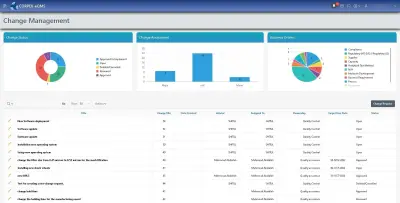
CORPEX-CC is the change control module inside CORPEX-eQMS. It routes every proposed change (to a process, a specification, a supplier or a controlled document) through impact assessment, risk-based classification and formal approval before anything is implemented, and keeps the record an EDA or FDA inspector will ask to see.
What Is CORPEX-CC?
Change control is the GMP discipline that stops changes from being made quietly.
In a regulated plant, nothing that could affect product quality (a new supplier, a revised cleaning method, a software update to a chromatography data system, a change to a specification) gets implemented until someone has assessed what else it touches and someone with the authority to approve it has signed off. CORPEX-CC is the module inside CORPEX-eQMS that runs that process: logging the change request, routing it for impact assessment and risk evaluation, tracking approval, and confirming implementation before closing the record.
It is built for QA managers, change control coordinators and department heads in pharmaceutical, food and chemical manufacturing who need one place to see every open change, who is holding it up, and what it will touch once it goes live.

The GMP Requirement Behind Change Control
Change control is not optional paperwork. It is one of the four core elements of a Pharmaceutical Quality System under ICH Q10, alongside process performance and product quality monitoring, CAPA, and management review. ICH Q10 expects a change management system that evaluates the effect of a proposed change on validated status, registered specifications, and supporting documents such as SOPs and training records before the change is made, not after.
EU GMP and WHO GMP guidance carry the same expectation: changes are documented, assessed for impact and risk, approved by quality before implementation, and reviewed for effectiveness afterward. For manufacturers exporting or registering a product abroad, a change to a manufacturing process or specification can also trigger a regulatory filing (a notification, a minor variation, or a full supplement) depending on how the change is classified. CORPEX-CC's classification step is where that judgment gets made and recorded.
Key Features
The tools that carry a change from request to closed record.
Change Request Management
Define, track, and manage change requests (CRs) throughout their entire lifecycle, from initiation to closure.
Impact Assessment
Analyze the potential impact of a change on processes, documents, validated status and compliance before it is approved.
Risk Management
Identify and mitigate the risks a proposed change carries before it is implemented, scored on the same severity and likelihood scale as the risk register.
Communication Planning
Keep approvers and affected departments informed and aligned as a change moves through review, rather than leaving them to chase status by email.
Progress Monitoring
Track the implementation of an approved change in real time so it does not silently drop off anyone's list once the approval signature is captured.
Integrated QMS
Connects to Document Control and Training so an approved change updates the SOP and reassigns training before the change record can close.
How a Change Moves Through CORPEX-CC
The module follows a change from the moment someone requests it to the moment it is live and the record is closed.
- Raise the change request. Anyone can propose a change — a lab analyst reporting a supplier issue, a maintenance engineer proposing an equipment upgrade, a QA reviewer flagging a specification gap. CORPEX-CC logs it with a unique number, the initiator, the reason, and what it affects.
- Assess the impact. Before anyone approves anything, the request goes through impact assessment against processes, specifications, validated systems, documents and compliance status — the question every inspector asks first: what else does this touch?
- Classify and evaluate the risk. Changes are scored for severity and likelihood, so a change with a real quality impact gets more scrutiny than a like-for-like part substitution.
- Route for approval and communicate. Once classified, the change routes to the right approvers — QA, the relevant department head, sometimes regulatory affairs — and stakeholders are kept informed as the request moves.
- Implement and monitor progress. Implementation tasks are tracked against the plan in real time, so an approved change does not quietly stall before it is executed.
- Close out through the rest of the QMS. A change that touches an SOP updates the document in CORPEX-DC and reassigns training in CORPEX-TM before the change record can close — the change is not finished until the people doing the work know it happened.
What Inspectors and Auditors Check
An EDA or FDA inspector reviewing change control is not looking for a folder of approved forms. They check that no change went live before it was assessed, that the impact assessment covered validated status and registered specifications, that the risk classification matches the change's real quality impact, and that dependent records (SOPs, training, validation documents) were updated to match. A gap between what changed and what the documentation says changed is one of the more common findings auditors write up.
Because CORPEX-CC keeps the request, the impact assessment, the approval signatures and the implementation record in one system with a full audit trail, answering "show every change made to this process in the last two years" is a search, not an archive dig.
How Change Control Connects to the Rest of CORPEX-eQMS
A change rarely happens in isolation. It usually starts because of something else in the quality system, and it usually finishes by updating something else.
- Quality risk management software supplies the severity and likelihood scoring that CORPEX-CC uses to classify a change.
- Deviation management is often what triggers a change request in the first place, and the CAPA it raises can point back to a control change.
- CAPA and change control share the same investigation history, so a corrective action that requires a permanent process fix routes into CORPEX-CC.
- Document control receives the updated SOP or specification once a change is approved, with version history preserved.
- Training management reassigns read-and-understand or practical training to everyone whose role touches a document a change has updated.
- All of it sits inside the CORPEX-eQMS platform, so a change record is never an island.
Implementing and Validating Change Control
Change control is itself a GxP process, which means the module that runs it needs to be validated like any other GxP system. CORPEX pairs CORPEX-CC with computer system validation services (a Validation Master Plan, user requirements, risk-based testing and IQ/OQ/PQ) so the workflow, the approval routing and the audit trail hold up under an EDA, EGAC or FDA inspection.
Change Control Software for Egyptian Manufacturers
CORPEX is an Egyptian company headquartered in the New Administrative Capital, and CORPEX-CC ships with the same Arabic-language interface and on-site implementation as the rest of CORPEX-eQMS. For Egyptian pharmaceutical and food manufacturers, that matters at inspection time: EDA GMP inspectors increasingly expect to see a controlled, audit-trailed change process rather than a change log kept in a shared spreadsheet, and QA teams get to work the module in the language they use for their SOPs. See the full electronic quality management system in Egypt for how change control fits alongside document control, deviations, CAPA, audits and training.
Change Control Software — Frequently Asked Questions
What is the difference between change control and change management?
In a GMP context the two terms are usually used for the same regulated process: assessing, approving and implementing a change to anything that could affect product quality. CORPEX-CC handles both the formal change control record and the change management activities (communication and training) needed to make the change stick.
Does every change need a full impact assessment?
Every change request should be assessed, but the depth varies with risk. CORPEX-CC's classification step lets a low-risk, like-for-like change move through a lighter review, while a change to a validated process or a registered specification gets the full assessment an inspector expects to see.
Can a change control request trigger a CAPA or a deviation?
Yes. A recurring deviation is often what starts a change request, and a change implemented outside the process can itself become a deviation and a CAPA. Because CORPEX-CC, CORPEX-DM and CORPEX-CAPA share the same records, that link is traceable rather than something someone has to remember to cross-reference.
Do we need to validate the change control module before using it?
Yes. Because change control decisions become part of the GMP record, the software running it needs computer system validation — the same IQ/OQ/PQ process used for any GxP system. CORPEX scopes that work as part of implementation.
Is CORPEX-CC available in Arabic for Egyptian sites?
Yes. CORPEX-CC is part of CORPEX-eQMS, which is built and supported in Egypt with an Arabic-language interface and on-site implementation for pharmaceutical, food and chemical manufacturers.
Bring Change Control Under Control
Contact our experts to see how CORPEX-CC can give your organization a single, audit-ready change control process.
Request a Demo