
Audit Management Software
CORPEX-AM plans, runs and closes internal and supplier audits from one place, and routes every finding straight into CAPA so a nonconformance never sits unassigned until the next inspection.
What Is CORPEX-AM?
CORPEX-AM is the audit management module inside CORPEX-eQMS.
It covers the full audit lifecycle: building the annual audit programme, scheduling individual audits, running them against a checklist, recording findings with evidence, and tracking every finding through to a closed CAPA. It handles internal audits of your own site, supplier and vendor audits, and preparation for a regulatory inspection, all from the same audit register.
It is built for QA managers and internal auditors in pharmaceutical, food and chemical manufacturing who are responsible for keeping the audit programme on schedule and every finding accountable to someone with a due date.
The Audit Requirement in ISO 9001, GMP and ISO 19011
ISO 9001 requires a planned internal audit programme that checks whether the quality management system conforms to the standard and to the organisation's own procedures, and whether it is effectively implemented and maintained. GMP guidance carries the same expectation for manufacturing and laboratory operations, and adds supplier audits as part of qualifying and monitoring vendors whose materials or services affect product quality.
ISO 19011 is the guidance most quality teams use to design that audit programme: it covers how to plan audits by risk, select and brief auditors, run an audit from opening meeting to closing meeting, and record findings in a way that supports follow-up. CORPEX-AM is structured around that same logic — a planned programme, a defined audit method, and findings that flow into corrective action rather than sitting in a report nobody reopens.
Key Features
The tools for planning, executing and closing an audit programme.
Holistic Audit Planning
Define audit schedules, allocate auditors, and set clear objectives and scope for each audit before it starts.
Risk-Based Auditing
Prioritize audits based on potential impact and likelihood, focusing effort on high-priority processes and suppliers.
Centralized Documentation
A single repository for audit plans, checklists, findings, and corrective action plans across every audit ever run.
Automated Workflow
Automate scheduling, reminder notifications, evidence collection, and report generation to cut manual admin and missed dates.
Real-time Monitoring
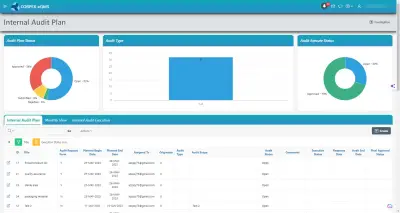
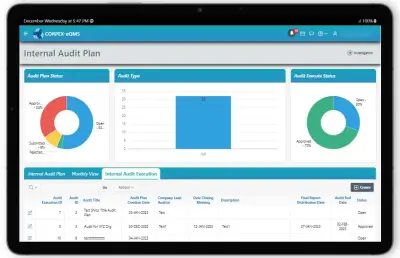
Track audit progress and open findings instantly, so a QA manager can see the whole programme's status at a glance.
Corrective Action
Push findings directly into corrective and preventive action management to address non-conformities and their root causes.
How an Audit Runs in CORPEX-AM
From the annual programme to a closed CAPA, step by step.
- Build the audit programme. Internal audits, supplier audits and self-inspections are scheduled for the year, weighted toward higher-risk processes and vendors, and assigned to qualified auditors.
- Plan the individual audit. Scope, objectives, criteria and the checklist are set before the audit date, so the auditor and the auditee both know what will be reviewed.
- Execute against the checklist. The auditor works through the checklist during the audit, capturing evidence and observations against each item in real time rather than reconstructing notes afterward.
- Record findings. Non-conformities and observations are logged with evidence, severity and the clause or procedure they relate to, at the point they are identified.
- Escalate to CAPA. Findings that need a corrective action route directly into CORPEX-CAPA, carrying the audit reference and evidence with them.
- Track to closure. The audit record stays open until every finding's CAPA is closed and its effectiveness has been checked, not just until the audit report is filed.
What Auditors and Inspectors Check
A regulatory inspector reviewing your internal audit programme is checking that the schedule was actually followed, that findings were classified consistently, that every finding has a documented corrective action, and that closed findings were verified as effective rather than just marked done. An audit programme that exists on paper but was not executed to schedule is itself an inspection finding.
Because CORPEX-AM keeps the schedule, checklist, evidence, findings and linked CAPAs in one auditable system, a QA manager can pull the full history of any audit (who ran it, what was checked, what was found, and how it was closed) before an inspector has to ask twice.
How Audit Management Connects to the Rest of CORPEX-eQMS
An audit finding is rarely the end of the story — it is usually the start of a corrective action somewhere else in the system.
- CAPA receives every finding that needs a corrective action, with the audit evidence and reference carried across automatically.
- Quality risk management software supplies the risk scoring that helps decide which processes and suppliers get audited most often.
- Supplier qualification uses supplier audit results directly when approving or requalifying a vendor.
- Document control supplies the current version of every SOP an auditor checks the site against.
- All of it runs inside the CORPEX-eQMS platform, so audit findings, CAPAs, risk and documents stay one connected record instead of five disconnected ones.
Implementing and Validating Audit Management
Because audit findings and CAPA records become part of the GMP record, the system that generates them needs to be a validated computerised system in its own right. CORPEX pairs CORPEX-AM implementation with computer system validation (requirements, risk assessment and IQ/OQ/PQ) so the audit trail behind every finding and closure holds up under inspection.
Audit Management Software for Egyptian Manufacturers
CORPEX is an Egyptian company headquartered in the New Administrative Capital, and CORPEX-AM is delivered with an Arabic-language interface and on-site implementation across Egypt. EDA GMP inspections increasingly expect to see a documented, risk-based internal audit programme with findings tracked to closure rather than a folder of past audit reports, and having auditors and auditees work the checklist in Arabic reduces the friction that leads to incomplete records. See the full electronic quality management system in Egypt for how audit management fits alongside CAPA, document control, deviations, change control and training.
Audit Management Software — Frequently Asked Questions
What is the difference between an internal audit and a supplier audit?
An internal audit checks your own site's processes against your own procedures and applicable regulations. A supplier audit checks a vendor's quality system before or during the relationship, usually against a qualification checklist. CORPEX-AM runs both from the same audit programme, so schedules, checklists and findings live in one place regardless of who is being audited.
How does CORPEX-AM turn an audit finding into a CAPA?
When an auditor records a finding during or after an audit, it can be escalated directly into the CORPEX-CAPA module without re-typing the observation. The finding, its evidence and its audit reference travel with the CAPA record, so the corrective action can always be traced back to the audit that raised it.
Does CORPEX-AM support a risk-based audit programme?
Yes. Audits can be prioritised and scheduled by risk, so higher-risk processes, suppliers or sites are audited more frequently and in more depth, following the same risk-based logic ISO 19011 recommends for an audit programme.
Can CORPEX-AM help us prepare for an EDA or FDA inspection?
Yes. Because every internal audit, its findings, and the resulting CAPAs are stored with a full audit trail, CORPEX-AM lets a QA team run a mock regulatory inspection against its own audit history and show a real inspector closed findings on demand rather than reconstructing records from email and spreadsheets.
Is audit management software required for ISO 9001 or GMP compliance?
The regulations do not mandate specific software, but ISO 9001 and GMP both require a documented, planned internal audit programme with recorded findings and follow-up. Audit management software is how most regulated companies keep that programme controlled and inspection-ready at scale rather than tracked in spreadsheets.
Run Your Next Audit Without the Spreadsheet
Contact our experts to see how CORPEX-AM can turn your audit programme into a system inspectors trust.
Request a Demo