
Quality Risk Management Software
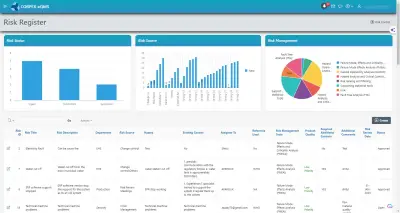
CORPEX-RM is the risk management module inside CORPEX-eQMS: a structured risk register, scored with severity and likelihood matrices, that feeds directly into how changes and deviations are classified elsewhere in the system.
What Is CORPEX-RM?
CORPEX-RM is the module inside CORPEX-eQMS that identifies, evaluates and documents risk to product quality and compliance.
Risk, in a quality system, is the potential impact of an event that could keep the organization from meeting its quality objectives — a supplier that might not hold spec, a process step with no built-in check, a piece of equipment operating near its qualified limits. CORPEX-RM gives that risk a structured record: identified, scored, assigned an owner and a mitigation plan, and reviewed on a schedule rather than rediscovered every time something goes wrong.
It is built for QA managers and process owners who need one risk register for the site, not a set of assessments buried in individual project files or validation documents that nobody revisits after sign-off.
The Requirement Behind Quality Risk Management: ICH Q9(R1)
ICH Q9(R1) is the international guideline on quality risk management. It describes a systematic process (risk identification, risk analysis, risk evaluation, risk control, and risk review) applied at a level of rigor proportionate to the risk involved. The 2023 revision sharpened two points regulators now look for directly: that risk assessments are not just documented but actually used to make decisions, and that subjectivity in scoring is minimized so two assessors reach comparable conclusions from the same facts.
In practice, that means a risk assessment cannot sit in a report that nobody reopens. It has to feed the decisions that follow from it: how a proposed change is classified, how deeply a deviation is investigated, how often a supplier is re-audited, how much testing a product needs. CORPEX-RM's severity and likelihood matrix, shared with the change control and deviation modules, is built to keep that connection live rather than leaving it to memory.
Key Features
The tools for building and maintaining a live risk register.
Comprehensive Identification
Systematically pinpoint and document risks across processes, products, compliance and external factors in a single register.
Structured Assessment
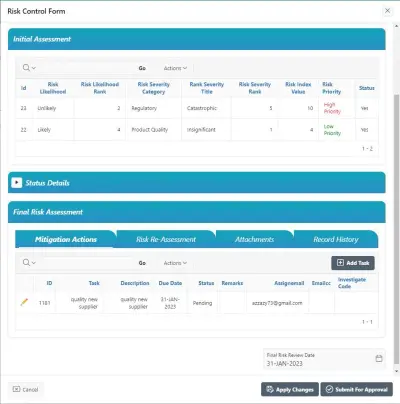
Score each risk on severity and likelihood in an FMEA-style matrix, so priority is set by the numbers, not by whoever raised it last.
Mitigation Planning
Assign an owner and a plan to reduce the impact or likelihood of each identified risk, with a due date it is tracked against.
Real-Time Monitoring
Track mitigation plan status and re-score a risk as conditions change, instead of leaving the original assessment untouched for years.
Documentation & Reporting
Capture the rationale behind every score and generate risk reports for management review and regulatory submissions.
Integration Across the QMS
Connects with document, deviation and change control modules so a risk score is not recalculated from scratch every time it is needed elsewhere.
How a Risk Moves Through CORPEX-RM
From first identification to a re-scored, reviewed entry in the register.
- Identify the risk. A risk can be raised from a deviation investigation, a change request, an audit finding, or a process owner simply flagging a concern. It is logged in the register with what it affects and why it matters.
- Assess severity and likelihood. The risk is scored on a defined matrix — how bad is the outcome if it happens, and how likely is it to happen — producing a consistent priority ranking instead of a subjective call.
- Evaluate against acceptance criteria. The score is compared against a defined threshold to decide whether the risk is acceptable as is or requires a mitigation plan before it is accepted.
- Control and mitigate. Where mitigation is required, an owner and an action plan are assigned and tracked until the risk is reduced to an acceptable level.
- Communicate. The risk and its status are visible to the modules that depend on it — change control, deviation management, audit planning — without a separate report having to be circulated.
- Review and re-score. Risks are revisited on a schedule or whenever new information appears, such as a new deviation trend, and re-scored if the picture has changed.
What Inspectors and Auditors Check
An inspector reviewing quality risk management is checking that risk assessments exist for the decisions that need them, that the scoring is applied consistently rather than adjusted to justify a conclusion already reached, and, increasingly since the ICH Q9(R1) revision, that the risk assessment actually changed a decision somewhere: a testing frequency, a change classification, an investigation depth. A risk register that never influences anything is a documentation exercise, not risk management, and inspectors have started saying so directly.
Because CORPEX-RM's risk scores are the same scores CORPEX-CC uses to classify changes and CORPEX-DM uses to prioritize investigations, a QA manager can show, record by record, exactly where a risk assessment changed what happened next.
How Risk Management Connects to the Rest of CORPEX-eQMS
A risk score is only useful if the modules that need it can see it.
- Change control software uses CORPEX-RM's severity and likelihood scoring to classify a proposed change and decide how deep the impact assessment needs to go.
- Deviation management can surface a previously undocumented risk during an investigation, which is then logged and tracked in the register going forward.
- CAPA draws on risk data to prioritize which corrective actions get resourced first.
- Audit management software uses the risk register to help decide which processes and suppliers are audited most often.
- All of it sits inside the CORPEX-eQMS platform, so a risk score raised in one module is the same score used everywhere else.
Implementing and Validating Risk Management
The risk register itself becomes part of the evidence an inspector reviews, so the software that maintains it is validated like any other GxP system in the eQMS. CORPEX pairs CORPEX-RM implementation with computer system validation (requirements, risk-based testing and IQ/OQ/PQ) so scoring logic, audit trails and linked records to change control and deviations hold up under an EDA, EGAC or FDA inspection.
Quality Risk Management Software for Egyptian Manufacturers
CORPEX is an Egyptian company headquartered in the New Administrative Capital, and CORPEX-RM ships with the same Arabic-language interface and on-site implementation as the rest of CORPEX-eQMS. EDA GMP inspections and EGAC ISO/IEC 17025 assessments increasingly expect to see a documented, ICH Q9-aligned risk process behind decisions such as testing frequency and change classification, rather than judgment calls made without a record. See the full electronic quality management system in Egypt for how risk management fits alongside change control, deviations, CAPA, audits and training.
Quality Risk Management Software — Frequently Asked Questions
What is quality risk management under ICH Q9(R1)?
ICH Q9(R1) defines quality risk management as a systematic process for the assessment, control, communication and review of risks to product quality across the product lifecycle, applied in a way proportionate to the level of risk. It expects risk assessments to be documented, revisited when new information appears, and to actually influence decisions such as testing frequency, change classification and investigation depth.
Does CORPEX-RM support FMEA-style risk assessment?
Yes. CORPEX-RM scores risks by severity and likelihood in a structured matrix, the same logic behind Failure Mode and Effects Analysis (FMEA) and other ICH Q9 tools, so risks can be ranked and prioritized consistently rather than judged case by case.
How does a risk register connect to change control?
CORPEX-CC uses the same severity and likelihood scoring as CORPEX-RM to classify a proposed change, so a change touching a process already flagged as higher risk in the register gets a deeper impact assessment automatically rather than by someone remembering to check.
Can a deviation create a new entry in the risk register?
Yes. A deviation investigation in CORPEX-DM can surface a risk that was not previously documented, and that risk can be logged in CORPEX-RM so it is tracked and reviewed going forward instead of being closed with the deviation and forgotten.
Is CORPEX-RM available in Arabic for Egyptian sites?
Yes. CORPEX-RM is part of CORPEX-eQMS, built and supported in Egypt with an Arabic-language interface and on-site implementation for pharmaceutical, food and chemical manufacturers.
Put a Number on Every Risk
Contact our experts to see how CORPEX-RM can turn scattered risk assessments into one live register.
Request a Demo