
Deviation Management Software for Planned and Unplanned Deviations
CORPEX-DM records, classifies and investigates every departure from an approved procedure or specification, and routes the ones that need it into CAPA or change control.
What Is Deviation Management Software?
CORPEX-DM is the module that captures and investigates any departure from an approved procedure, process parameter or expected result.
Deviations happen in every manufacturing and lab operation: a temperature excursion during storage, a step performed out of sequence, an instrument reading outside its normal range. What separates a well-run quality system from a weak one is not whether deviations occur, but whether every one of them is captured, investigated to an appropriate depth, and closed with a documented conclusion. CORPEX-DM is built for QA and production staff at pharmaceutical, food and chemical manufacturers who need that discipline applied consistently, not just when someone remembers to write it up.

The Regulatory Requirement Behind Deviation Management
Handling deviations is not left to internal judgment alone. It is built into the GMP regulations that govern batch release.
FDA's 21 CFR 211.192 requires that any unexplained discrepancy or the failure of a batch to meet its specifications be investigated, whether or not the batch has already been distributed, and that the investigation be extended to other batches that may have been affected by the same cause. EU GMP Chapter 1 sets the same expectation as a principle of the pharmaceutical quality system: deviations from approved processes and specifications must be recorded, evaluated for impact, and investigated with root cause identification and corrective action where needed. ICH Q10 folds deviation handling into the same CAPA and process-performance monitoring loop that governs the rest of the quality system.
Planned vs. Unplanned Deviations, and Classification
Not every deviation is a surprise, and not every deviation carries the same risk.
Planned Deviations
A planned deviation is requested and approved by quality before the activity takes place, because a known constraint means a step cannot be executed exactly as the approved procedure specifies on that occasion. It is a pre-approved exception, not a failure.
Unplanned Deviations
An unplanned deviation is discovered after the fact — something already happened outside the approved procedure or specification without prior authorization. Every unplanned deviation triggers an investigation.
Deviations are also classified by severity, commonly critical, major or minor, based on potential impact to product quality, patient safety or data integrity. CORPEX-DM captures this classification when the deviation is logged, so investigation depth and the approval level required to close it match the actual risk rather than treating a minor labeling variance the same as a sterility failure.
How the Deviation Workflow Runs in CORPEX-DM
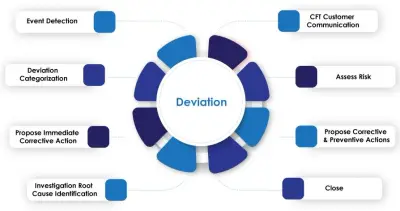
Six capabilities carry a deviation from first report to a documented resolution.
1. Systematic Identification
Staff document a deviation from established standards, procedures or expected outcomes as soon as it is found, with its planned-or-unplanned status and initial severity.
2. Root Cause Analysis
The investigation identifies the underlying cause rather than stopping at the immediate symptom, so the resolution addresses what actually went wrong.
3. Automated Resolution Workflow
Task assignments, notifications and status tracking move the investigation and its approval along without the file sitting untouched on someone's desk.
4. Real-Time Monitoring
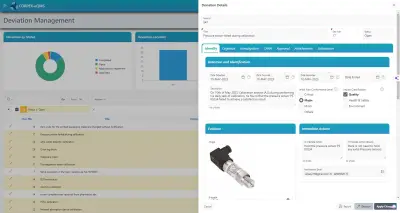
Dashboards show deviation status and age at a glance, which is what lets a QA manager catch a stalling investigation before it becomes a backlog.
5. Comprehensive Reporting
Trend reports show which areas, lines or products generate the most deviations, which is often the first sign a process needs redesigning rather than more retraining.
6. Unified Integration
Deviations connect into Document, Risk and Audit Management so a resolution can trigger a document change, a risk reassessment, or feed into the next audit.
Deviation vs. Out-of-Specification (OOS)
An out-of-specification (OOS) result is a specific type of deviation: a laboratory test result that falls outside a specification or acceptance criterion. OOS results follow their own investigation sequence — a phase 1 laboratory review to rule out testing error, followed by a phase 2 manufacturing investigation if the lab is confirmed to be correct. A deviation is the broader category and covers any departure from an approved procedure or process parameter, whether or not a lab result is involved. CORPEX-DM tracks both, and an OOS logged from the laboratory can carry forward into the same deviation record rather than living in two disconnected systems.
How Deviation Management Connects to CAPA and Change Control
A deviation record rarely stays isolated once the investigation is done.
- A deviation with a systemic root cause, rather than a one-off human error, is escalated into a CAPA so the fix is tracked to effectiveness.
- When the resolution means changing a specification, procedure or piece of equipment, that change is routed through change control before it takes effect.
- If the deviation points to a document that is unclear or wrong, the correction is issued through document control.
Deviations, CAPA, change control and document control sit inside the same CORPEX-eQMS software platform, so escalating a deviation carries its history forward instead of starting a new record from scratch.
Implementation and Validation
Deviation records are among the first things an inspector pulls, so the system that holds them has to be qualified like any other GxP computerized system. CORPEX provides computer system validation (CSV) services for CORPEX-DM, covering IQ/OQ/PQ and the traceability documentation that supports an EDA, EGAC or FDA inspection.
Deviation Management Software in Egypt
How consistently deviations are logged and investigated is one of the clearest data-integrity signals an Egyptian Drug Authority (EDA) GMP inspector looks for. CORPEX is an Egyptian company headquartered in the New Administrative Capital, and CORPEX-DM is deployed with Arabic-language support as part of the wider eQMS software in Egypt.
Deviation Management Software FAQ
What is deviation management software?
Deviation management software records, classifies, investigates and resolves any departure from an approved procedure, specification or expected result in a GMP operation, with a documented root cause, a resolution, and an audit trail an inspector can review.
What is the difference between a planned and an unplanned deviation?
A planned deviation is requested and approved by quality before an activity happens, because a known constraint means a procedure cannot be followed exactly as written on that occasion. An unplanned deviation is discovered after the fact, when something already departed from the approved procedure or specification without prior authorization. CORPEX-DM records both, but an unplanned deviation always triggers an investigation while a planned deviation is a pre-approval decision.
How is a deviation different from an out-of-specification (OOS) result?
An OOS result is specifically a laboratory test result that falls outside a specification or acceptance criterion, and is investigated through its own phase 1 (laboratory) and phase 2 (manufacturing) sequence. A deviation is the broader category: any departure from an approved procedure, process parameter or expected outcome, whether or not a lab result is involved. An OOS is a type of deviation, but not every deviation is an OOS.
How does CORPEX-DM classify deviations?
Deviations are typically classified by severity, critical, major or minor, based on the potential impact on product quality, patient safety or data integrity. CORPEX-DM captures this classification at intake so the investigation depth and approval level match the risk, rather than every deviation being handled identically.
How does deviation management connect to CAPA and change control?
A deviation with a systemic root cause, rather than a one-off error, is usually escalated into a CAPA. If the resolution requires changing a specification, procedure or piece of equipment, that change is routed through change control before it takes effect. CORPEX-DM, CORPEX-CAPA and CORPEX-CC are integrated so this escalation carries the deviation's history forward instead of starting a fresh record.
Bring Every Deviation Under One Workflow
Contact our team to see how CORPEX-DM fits into your existing quality processes.
Request a Demo