A LIMS that only records what people type is a filing cabinet. The work that actually keeps a GMP laboratory out of trouble is the work nobody remembers to start: the stability pull that falls due on a Friday, the balance whose calibration lapsed over Eid, the reagent that expired on the shelf, the interface that went quiet three days ago. In CORPEX LIMS that work belongs to the scheduler, 24 background jobs that run on their own clock, each with a cadence you can see, a last result you can read, and an audit trail that names the system, not a person, as the one who acted.
This post walks through what those 24 jobs do, grouped by the question each one answers, and the design rules that make automated work defensible in front of an inspector. If you are evaluating LIMS software, this is the part of the demo worth asking for, because it is where paper systems and spreadsheets fail silently.
Why LIMS Automation Is a GMP Question, Not a Convenience
Most of what an inspector reads in a laboratory is a promise made in advance. The stability protocol promises a pull at 3, 6, 9 and 12 months. The calibration programme promises each balance is checked on a written interval. The monitoring programme promises a water round every day. 21 CFR 211.68(a) puts it plainly for equipment: it "shall be routinely calibrated, inspected, or checked according to a written program designed to assure proper performance." 21 CFR 211.166(a) says the written stability programme "shall be followed."
The gap is never the promise. It is the follow-through. A protocol that states "every 1 day" describes an intention; unless something acts on it, the record will eventually show a hole, and the hole is found by the inspector rather than by you. A scheduler turns those intentions into work that appears in someone's queue on the right day, and leaves evidence of when it appeared and when it was done.
The 24 Scheduled Jobs, Grouped by What They Answer
"What is falling due?" The forward-looking sweeps
These jobs look ahead by a lead time held in policy, so each laboratory decides how much warning it wants. The defaults below are starting points, not fixed values.
- stability.pull_due: warns on stability pull points falling due, seven days ahead by default.
- stability.auto_ar: raises the analysis request for a stability time point on the timeline itself, not when somebody remembers to click. The pull is claimed atomically, so a retried run cannot raise the same time point twice. More on this in our stability LIMS page.
- instruments.calibration: warns on instrument calibration and maintenance falling due, 14 days ahead by default.
- instruments.autolog: starts the due work itself: a calibration event against its parameters, or a maintenance or qualification checklist from the instrument's plan. If work is already open against that schedule, it skips it rather than creating a second record that would double-count the instrument's history.
- materials.expiry: lapses expired reference standards, reagents, chemical lots and prepared solutions, and warns on those nearing expiry (30 days by default). Each is judged on its governing date, which may be an in-use life or a retest date rather than the date printed on the label.
- vs.expiry: does the same for volumetric solutions, a day ahead by default, so a lapsed solution is disposed of rather than discovered in a titration.
- qualification.expiry: lapses analyst qualifications past their validity date and warns on those due for requalification.
- masterdata.review_due: notifies QA when controlled documents and methods are due or overdue for periodic review, before the date rather than after it.
- destruction.due: lists samples and reserve samples due for destruction (seven days ahead by default), flagging the overdue ones.
- retained.inspection: flags reserve samples due for their visual inspection, weekly.
"What should exist that doesn't?" Jobs that create the planned work
- monitoring.due: turns an environmental, particle, personnel or water monitoring programme into a round that appears, with its sampling points and each point's own alert and action limits pre-filled. Only approved programmes are acted on, because a draft programme governs nothing. And only one round is outstanding at a time: a scheduler that "catches up" on a fortnight of missed rounds produces a tidy record of work nobody did, which is worse than an honest gap.
- water.generate_lots: registers water samples at their interval, moving or skipping holidays according to the water rules. It is idempotent, so a retried run cannot double-book a sampling point. See water LIMS for the sampling side.
- labels.scheduled: prepares labels for newly registered samples. It deliberately does not register a printed copy, because the server has no printer; the copy is counted when a person actually prints it, so the first real label is never mistaken for a reprint.
- workflow.start-missing: finds records that should be governed by a workflow but have none, and starts the right one. A record with no workflow has no step, no due date and no place in the pipeline.
- workflow.phase-sweep: the safety net under the phase gates. It re-checks open phases waiting on child work, closing those whose children have finished and starting child workflows for tests added since the gate opened.
"What did not happen?" The escalation jobs
The forward sweeps answer what is coming. These answer the question nobody was asking: what was due and did not get done.
- actions.escalate: hourly, chases what is due and escalates what is late up the ladder configured in Escalation Levels. It runs hourly so a rung defined in hours can actually fire, and an escalation log makes a repeat run harmless.
- tasks.overdue: every 15 minutes, flags analyst tasks that have become overdue and notifies their owners.
- workflow.sla: stamps and escalates overdue workflow steps (as distinct from the tasks they raise), firing once per escalation level.
- capa.escalation: daily, escalates CAPA actions past their due date. Laboratory investigations that end in a CAPA keep moving instead of ageing quietly; our CAPA process guide covers why that matters.
- interfaces.silence: daily, reports instrument interfaces that have stopped sending, judged against each instrument's own rhythm. This is the failure that looks like nothing: an interface that goes quiet leaves an empty inbox that looks exactly like a quiet week, and the laboratory finds out when a certificate is late.
"Is the record safe, and did it reach anyone?" Records, backup and delivery
- backup.run: a daily logical backup of the record families. The same job can be started by hand, so "automated backups without support intervention, as well as manual backups" is one piece of code, not two.
- archive.run: monthly, exports records past their retention period under each active retention policy. Policies under legal hold are skipped.
- outbox.dispatch: every five minutes, sends queued notifications and e-mail.
- integration.outbox: every five minutes, delivers queued outbound documents to a configured external endpoint such as an ERP. Until an endpoint is configured, queued documents are marked suppressed, with the reason, rather than sitting in a queue forever. The interface itself is built and validated during the integration project; see LIMS and SAP integration.
Backup and archiving are where the regulation is most direct. EU GMP Annex 11 clause 7.2 asks for "regular back-ups of all relevant data", with the integrity of backups and the ability to restore "checked during validation and monitored periodically." Clause 17 says archived data "should be checked for accessibility, readability and integrity." A scheduled job gives you the regularity. The restore test is still yours to perform and document during validation.
Five Design Rules That Make Automated Work Defensible
Automation can create findings as easily as it prevents them. A job that fabricates records, overwrites a status, or acts under a real person's name is a data-integrity problem. These are the rules the scheduler follows.
- The system acts as the system. Every change a job makes is stamped with a dedicated system identity, never borrowed from whoever last logged in. An audit entry created at 03:00 should never implicate someone who was asleep. That is the attributable part of ALCOA+.
- A retried run is a no-op. Stability pulls are claimed atomically, water lots are idempotent, escalations are logged once per level, and labels are never registered twice. A job that fires twice should leave the same record as a job that fired once.
- Never invent work that did not happen. Monitoring raises one outstanding round, not a backlog of catch-up rounds. Only approved programmes generate anything. Labels are prepared but not counted until a person prints them.
- Don't overwrite a decision made a moment ago. When qualifications lapse, the update repeats its own condition (still "Qualified", past its date) inside one transaction. A requalification that lands between the read and the write is never silently reversed, and the audit trail never carries a claim that is false.
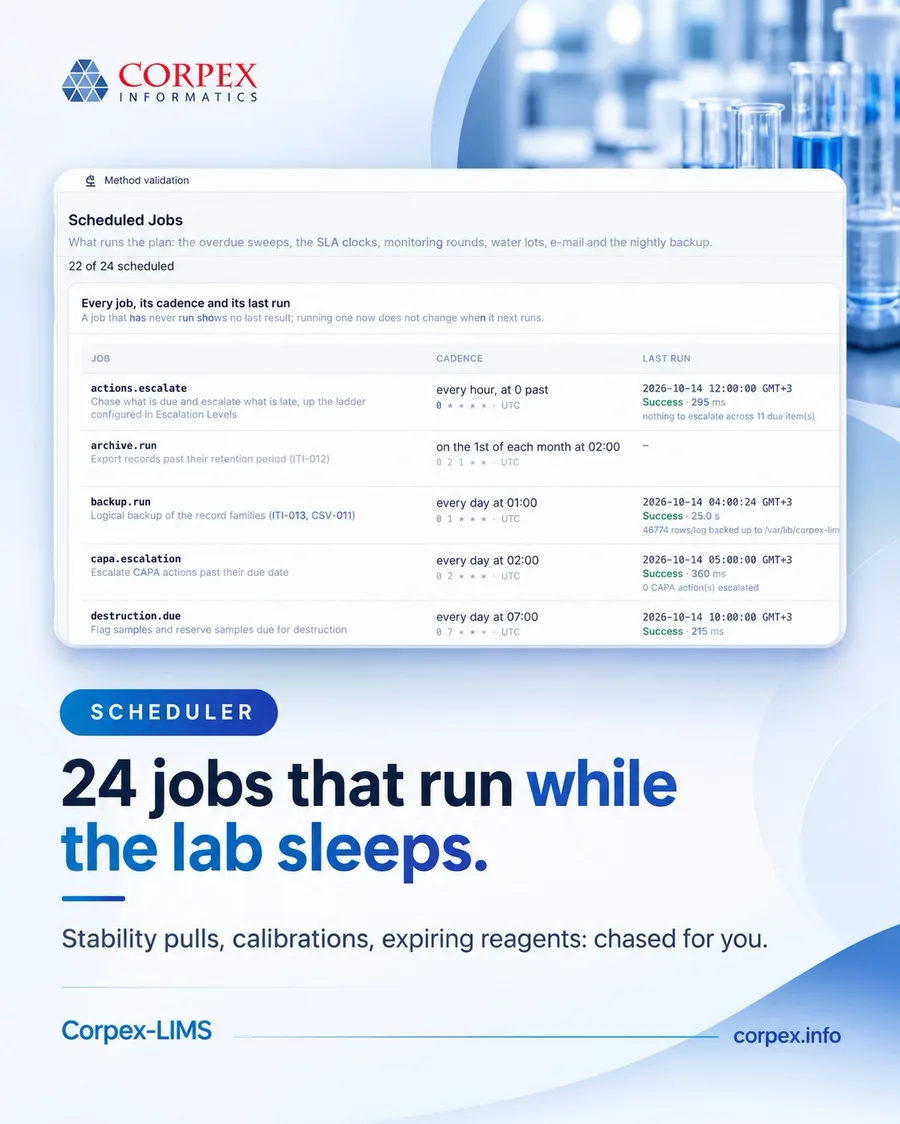
- Say what happened, in words. Each run records a plain result line, such as "nothing to escalate across 11 due item(s)", "0 CAPA action(s) escalated" or "46774 row(s) backed up", plus its duration. A job that has never run shows no result rather than a misleading one.
What the Scheduled Jobs Screen Shows
Administrators see every job in one list: its key, a one-line description of what it does, its cadence in plain language with the cron expression and time zone underneath, and its last run with time, outcome, duration and result line. Each job's cadence, time zone, recipients and on/off switch live in its configuration record, not in code. Running a job by hand does not move its next scheduled run, so an ad-hoc backup before a change does not quietly shift the nightly one.
That last-run column is what turns automation into evidence. When an inspector asks how you know the stability programme is followed, you can open the record of the job that raised every time point, not just the time points themselves.
Questions to Ask Any LIMS Vendor About Scheduling
- Which reminders are only reminders, and which jobs actually create the work (the analysis request, the calibration event, the monitoring round)?
- Whose name appears in the audit trail when a job changes a record?
- What happens if the server restarts halfway through a job and it runs again?
- If the system is down for a week, does it invent the missed rounds afterwards, or show the gap?
- How would you know an instrument interface has stopped sending?
- Can I see, for any job, when it last ran and what it did?
The answers separate a system that remembers for you from one that only stores what you remembered.
Sources
- 21 CFR 211.68, Automatic, mechanical, and electronic equipment: ecfr.gov
- 21 CFR 211.166, Stability testing: ecfr.gov
- EudraLex Volume 4, Annex 11, Computerised Systems, clauses 7.2 and 17: health.ec.europa.eu
Frequently Asked Questions
What does a LIMS scheduler do?
It runs background jobs on a fixed cadence without anyone starting them: warning on stability pulls, calibrations and expiring materials before they fall due, creating planned work such as monitoring rounds and water samples, escalating overdue tasks and CAPA actions, and running backups and archiving. Each run records when it ran and what it did.
Whose name goes in the audit trail when an automated job changes a record?
In CORPEX LIMS, a dedicated system identity, never the last person who logged in. An entry created at 03:00 by a scheduled job should not implicate a person who was asleep, and the record stays attributable to what actually acted.
What happens if a scheduled job runs twice?
Nothing extra should happen. Stability pulls are claimed atomically, water lots are generated idempotently, escalations are logged once per level and labels are never registered twice, so a retried run leaves the same record as a single run.
Does automated backup satisfy EU GMP Annex 11?
It provides the regular back-ups Annex 11 clause 7.2 asks for. The clause also requires that the integrity of backup data and the ability to restore it are checked during validation and monitored periodically, so the restore test still has to be performed and documented.
If the system was down, does the scheduler create the missed monitoring rounds afterwards?
No. Only one monitoring round is outstanding at a time. Back-filling a fortnight of missed rounds would produce a record of work nobody did, which is worse than a visible gap that can be investigated.
See the scheduler on your own workflows
Book a CORPEX LIMS demo and we will walk through the Scheduled Jobs screen with stability, calibration and monitoring set up the way your laboratory runs them.
Explore CORPEX LIMS